
Series 2: From Secession to Pea Ridge (1860–1862) — Article 1
Missouri Civil War tensions explode as elections, militias, and political collapse push the state toward open conflict. The Road to War was being paved.
Table of Contents
The Road to War – Missouri on the Brink (1860–1861)
Missouri did not stumble into war.
It was pushed — slowly, deliberately, and then all at once.
For years, the state had lived with tension just below the surface. Political compromise held, but barely. Neighbor turned against neighbor in argument long before they would face each other with weapons.
By the winter of 1860, the Missouri Civil War was already forming beneath that surface — shaped by elections, fear, and the growing belief that compromise had finally failed.
The presidential election did not create Missouri’s crisis.
It exposed it.
Lincoln’s victory confirmed what many Missourians already suspected: the nation was no longer willing to balance between North and South. To Unionists, the result offered stability. To secessionists, it signaled an existential threat.
Missouri stood uncomfortably between those worlds.
What followed was not sudden chaos, but an unraveling.
Political trust collapsed first.
Newspapers hardened language.
Public meetings turned hostile.
Private conversations grew guarded.
Militias formed quietly — some in support of the Union, others aligned with Southern interests — drilling not because war had begun, but because many believed it soon would.
Missouri still claimed peace.
But it was preparing for conflict.
By early 1861, the state was no longer deciding whether war would come — only how it would arrive, and who would control Missouri when it did.
A State Balanced on a Knife’s Edge
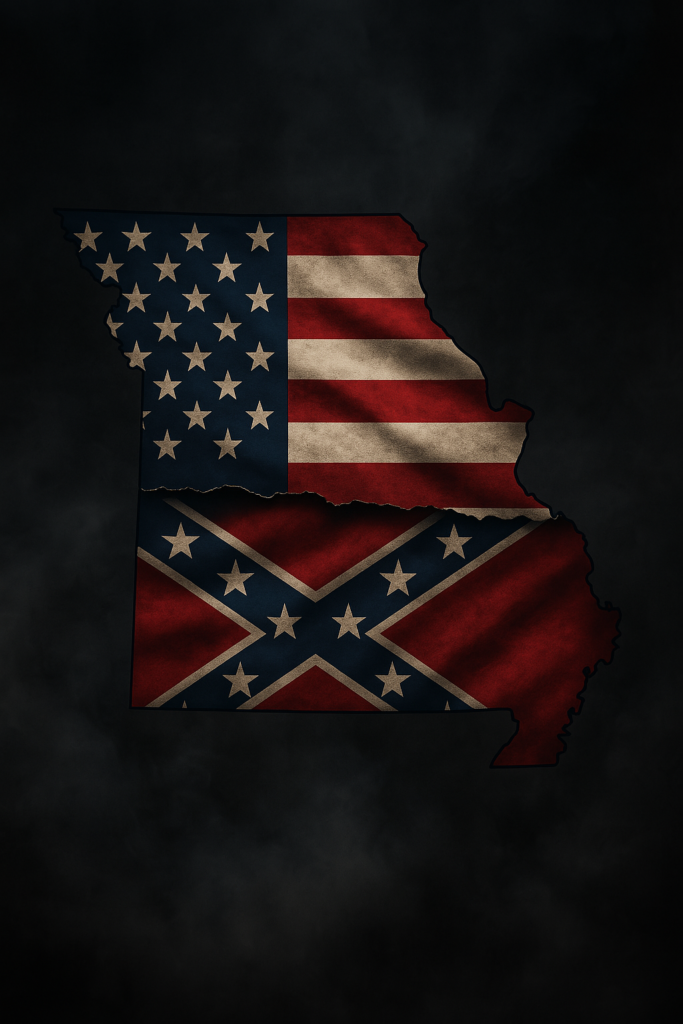
Missouri entered 1860 divided in ways no map could fully show.
Its economy, culture, and identity pulled in opposite directions at once — not neatly north or south, but fractured town by town and even household by household.
- Farmers and planters tied economically to slavery, especially along the Missouri River
- German immigrants and urban workers, particularly in St. Louis, fiercely loyal to the Union
- Border counties hardened by years of Bleeding Kansas violence, where politics had already turned deadly
These divisions were not abstract.
They shaped livelihoods, social standing, and personal safety.
The presidential election only sharpened those divides.
Abraham Lincoln’s victory convinced many Missourians that the fragile balance holding the Union together had shifted permanently. To some, it meant the survival of the nation. To others, it meant domination by a hostile North.
There was little middle ground left.
The Missouri Civil War was no longer theoretical.
It was personal.
Elections, Newspapers, and Fear
Before armies moved, words did the fighting.
Newspapers became weapons. Headlines warned of invasion, abolition, and tyranny. Editorials framed political opponents not as rivals, but as enemies.
Political meetings turned hostile.
Shouting replaced debate.
Rumors traveled faster than facts.
Unionists feared Missouri would be dragged into secession against its will, pulled south by a minority willing to use force. Secessionists feared federal troops would occupy the state, stripping Missourians of their rights before they could resist.
Fear fed fear.
In that atmosphere, restraint became weakness.
Militias began forming quietly — sometimes openly — drilling in fields, fairgrounds, and river towns. Some claimed to be defensive. Others made no such pretense.
By early 1861, Missouri was armed, angry, and waiting.
The Illusion of Neutrality
Missouri’s elected convention attempted to hold the center.
Delegates, chosen by voters across the state, voted overwhelmingly to remain in the Union. They declared Missouri neutral — and pledged that the state would stay that way unless attacked.
It was a last effort to keep Missouri out of the coming storm.
But neutrality satisfied no one.
- Secessionists viewed it as cowardice
- Unionists viewed it as dangerous hesitation
- Militias viewed it as irrelevant
Neutrality depended on trust — and trust had already collapsed.
The Missouri Civil War was undermining the authority meant to prevent it, dissolving political legitimacy before the first formal battle was fought.
Militias Take Shape
As winter turned to spring, armed groups hardened into organized forces.
What began as loosely organized companies evolved into disciplined units with command structures, supply lines, and political backing.
- Pro-Confederate Missouri State Guard units drilled openly
- Union Home Guards organized in cities and river towns
- Weapons flowed quietly across borders, often with official denials
Missouri was becoming militarized without declaring war.
The state still claimed peace.
The countryside prepared for violence.
Men who had argued months earlier now trained to kill.
The Breaking Point Approaches
By March 1861, Missouri stood at the center of a national crisis.
Federal arsenals sat within its borders, filled with weapons both sides desperately wanted. Governors, generals, and politicians watched each other closely, measuring intent as carefully as troop movements.
Every decision carried the risk of bloodshed.
Delay invited escalation.
Action invited retaliation.
When the first shots finally came, they would not be accidents.
They would be inevitable.
Why the Road to War Mattered
Understanding this moment explains everything that followed.
The Missouri Civil War did not begin with battles — it began with fear, identity, and the collapse of trust between neighbors, institutions, and governments.
By the time troops marched and cannons fired, Missouri had already chosen sides — even if it refused to admit it.
The road to war was complete.
Looking Ahead
Next Thursday (December 25, 2025), we’ll move deeper into Series 2 with:
The Camp Jackson Affair.
We’ll examine the seizure of the St. Louis arsenal, Nathaniel Lyon’s decisive actions, and the moment political crisis turned into open violence.
New articles every Thursday — follow along as we trace how Missouri became the battleground that shaped the Trans-Mississippi war.
Plan Your Next Missouri Civil War Adventure!
Ready to hit the road?
Plan your Missouri Civil War adventure with trusted travel tips, tools, and resources. Visit our Resource Page (Missouri Civil War Resources) to find everything you need for hotels, flights, car rentals, gear, and more.
Check Out These Missouri Civil War (Overview) Articles
Missouri Civil War: Why This Forgotten Story Matters
Civil War In Missouri: 6 Questions You Should Ask
Bleeding Kansas: Missouri’s Volatile Border War (1854–61)
General Lyon Takes Missouri: 1861’s Breaking Point
Guerrilla Warfare in Missouri: Chaos Explodes (1861–65)
The Cloak and Dagger Side of Missouri’s Civil War
Missouri Women at War: Discover The Unsung Heroes
General Order No. 11 – Missouri’s Burnt District
Price’s Raid (1864): Missouri’s Last Daring Gamble
Check Out These In Depth Articles About The Five Phases Of The Civil War In Missouri
Missouri’s Civil War (1854–1900): Explore The Complete Guide
Series 1: The Fires Before The War – Bleeding Kansas (1854 – 1860)
Bleeding Kansas: The Missouri and Kansas Border Ignites
The Kansas-Nebraska Act – Unleashing Pandora’s Box
Border Ruffians & Free-Staters — The Border Turns Hostile
Bleeding Kansas Massacres — Fire and Vengeance on the Border
Missouri State Militias – How They Rose From Border Chaos
Propaganda — How Words Fueled Missouri’s Civil War
Election of 1860 — Missouri at the Breaking Point
Series 2: From Secession to Pea Ridge (1860 – 1862)
Missouri Civil War Ignites – Secession Tears the State Apart
Check Out These Books Published By The Sojourner’s Compass
“Missouri in the Crossfire – The Civil War’s Forgotten Frontier” Series
From the streets of St. Louis to the prairies of southwest Missouri, this compelling short-read series uncovers the untold stories of a divided state at war. Each volume explores a new side of Missouri’s Civil War—its campaigns, commanders, civilians, and the conflicts that shaped its destiny.
Written for both history enthusiasts and casual readers, Missouri in the Crossfire brings the human side of the war to life through vivid storytelling, balanced perspectives, and accessible scholarship—all drawn from Missouri’s own battle-scarred ground.
Available on Amazon & Kindle Unlimited
“Battles & Beyond” – Companion Book Series
From river crossings to ridge fights, Missouri’s Civil War story was one of chaos, courage, and contested loyalties. This travel-ready series delivers concise battlefield guides packed with historical context, walking tips, firsthand quotes, and itinerary tie-ins—perfect for travelers, educators, and armchair historians alike.
Led by Jonathon Midgley, author of The Last Hand series, each volume brings forgotten fights into clear focus—making it easy to explore the war’s impact, one battlefield at a time.
Available On Amazon & Kindle Unlimited
Stay Connected
Follow us for travel inspiration, new articles, and short-form video features:
The Sojourner’s Compass TikTok
The Sojourner’s Compass YouTube
The Sojourner’s Compass Facebook
The Sojourner’s Compass Main Website
Leave a Reply