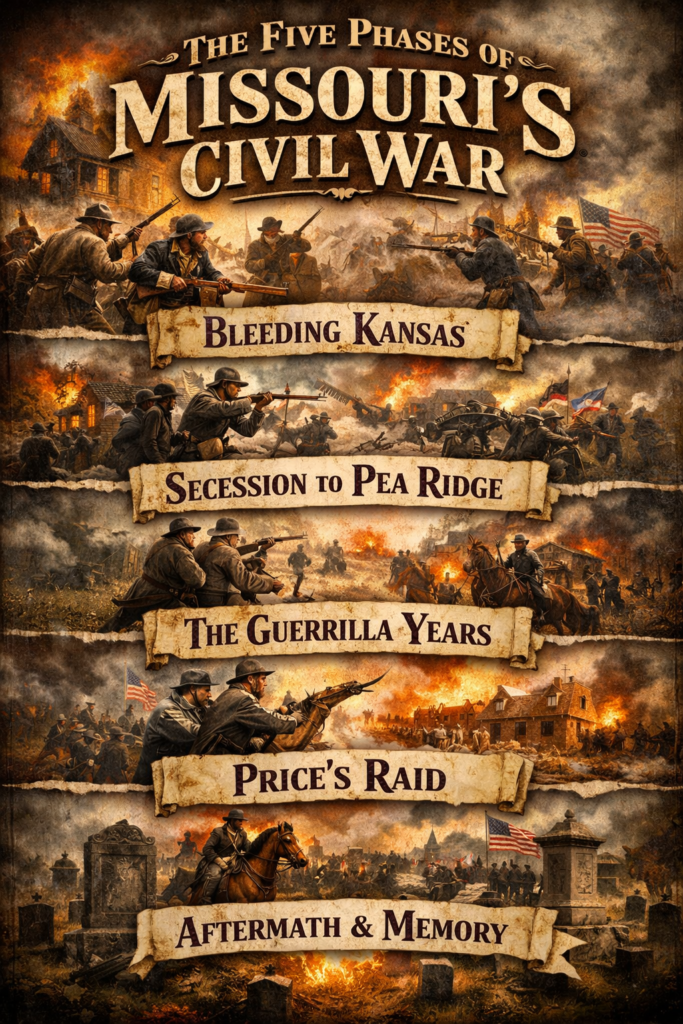
Missouri Civil War Timeline
Follow Missouri’s Civil War timeline, from early clashes to Price’s Raid, and see how key battles shaped the war in the West.
Missouri was a border state divided in loyalty, where battles, raids, and guerrilla warfare left scars that lasted long after the Civil War ended. Below is a streamlined timeline of key events and turning points.
Table of Contents
March 1820 – April 1861 — Before the Storm
(Missouri and the Nation Divide)
Mar 3, 1820: Missouri Compromise
Aug 6, 1838 – Nov 1, 1838: Mormon War of 1838
Mar 4, 1845 – Aug 12, 1846: Sterling Price Serves in the U.S. House of Representatives
May 13, 1846: United States Declares War on Mexico
1846–1848: Mexican-American War
(The conflict serves as a vital combat training ground for future Union and Confederate commanders).
Sept 20, 1850: Compromise of 1850
Jan 3, 1853 – Jan 5, 1857: Sterling Price Serves as Governor of Missouri
May 30, 1854: Kansas-Nebraska Act
1854 to 1859: “Bleeding Kansas”
1855 to 1857: “Border Ruffians” Elections
May 21, 1856: Sack of Lawrence, KS
May 22, 1856: Brooks-Sumner Incident
May 24–25, 1856: Pottawatomie Massacre
Aug 30, 1856: Battle of Osawatomie
Mar 6, 1857: Dred Scott Decision
(St. Louis Case)
1857 to 1858: Lecompton Constitution Crisis
Aug–Oct 1858: Lincoln-Douglas Debates
May 19, 1858: Marais des Cygnes Massacre
(Pivotal border event just across the Mo./Kan. line)
Dec 20, 1858: John Brown’s Vernon County Raid
(Brown raids Missouri, frees 11 enslaved people, kills a planter)
Oct 16–18, 1859: John Brown’s Raid on Harpers Ferry
Aug 6, 1860: Election of Governor Claiborne Jackson
Nov–Dec 1860: The Southwest Expedition
(Governor Stewart sends MO militia to the border to repel James Montgomery’s Jayhawkers)
Nov 6, 1860: Election of Abraham Lincoln
Dec 20, 1860: South Carolina Secedes
Secession Timeline:
- South Carolina: December 20, 1860
- Mississippi: January 9, 1861
- Florida: January 10, 1861
- Alabama: January 11, 1861
- Georgia: January 19, 1861
- Louisiana: January 26, 1861
- Texas: February 1, 1861
- Virginia: April 17, 1861
- Arkansas: May 6, 1861
- North Carolina: May 20, 1861
- Tennessee: June 8, 1861
- Missouri’s pro-Confederate “Rebel Legislature” passed its ordinance of secession on October 28, 1861, in Neosho, Missouri.
(Missouri as the 12th Confederate state on November 28, 1861)
- Kentucky’s shadow Confederate government adopted its ordinance of secession on November 20, 1861, during the Russellville Convention.
(Kentucky as the 13th Confederate state on December 10, 1861.)
Jan 2, 1861: Governor Claiborne Jackson Inaugurated
(Jackson won the Aug 6, 1860 election but took office on this date, immediately pushing for secession)
Jan 29, 1861: Kansas Admitted as a Free State
Feb 4, 1861: Confederate States of America Formed
(Montgomery, AL)
Feb 18, 1861: Missouri State Convention Delegates Elected
Feb 28 – March 22, 1861: Missouri State Convention Convenes
Mar 4, 1861: Abraham Lincoln Inaugurated
Mar 19, 1861: Missouri Convention Votes 98-1 Against Secession
Apr 12, 1861: Fort Sumter Fired Upon
Apr 17, 1861: Governor Jackson Refuses Lincoln’s Request for Troops
(Jackson calls Lincoln’s request “illegal, unconstitutional, revolutionary, inhuman and diabolical”)
Apr 20, 1861: Liberty Arsenal Seizure
(Pro-Confederate Missourians seize federal weapons at Liberty, MO)
Apr 25, 1861: Missouri Arsenal Secured
“Missouri entered the Civil War already divided by four decades of sectional conflict.”
May 1861 – March 1862 — Missouri erupts
(The fight for control of Missouri)
May 10, 1861: Camp Jackson Affair
May 11, 1861: Missouri State Guard Created
June 11, 1861: Planter’s House Meeting
(St. Louis)
June 12, 1861: Price & Jackson’s Proclamation of Resistance
June 14, 1861: Union Occupation of Jefferson City / Governor Jackson Flees
June 17, 1861: First Battle of Boonville
June 19, 1861: Battle of Cole Camp
July 5, 1861: Battle of Carthage
July 30, 1861: Missouri State Convention Vacates State Offices
(The provisional government is established, appointing Hamilton Gamble as provisional governor)
Aug 2, 1861: Battle of Dug Springs
Aug 5, 1861: Battle of Athens
Aug 10, 1861: Battle of Wilson’s Creek
(Battle of Oak Hills)
Aug 30, 1861: Fremont’s Emancipation Proclamation
(General John C. Fremont declares martial law in Missouri and emancipates slaves of secessionist owners)
Sept 3, 1861: Platte Bridge Railroad Tragedy
(Pro-Southern bushwhackers sabotage a bridge near St. Joseph, killing 17–20 people)
Sept 13, 1861: Second Battle of Boonville
Sept 17, 1861: Battle of Blue Mills Landing
Sept 13–20, 1861: First Battle of Lexington
Sept 22, 1861: Sacking of Osceola
(Union forces under James H. Lane loot and burn the town—a prominent early Union atrocity)
Oct 15, 1861: Battle of Big River Bridge / Blackwell Station
Oct 21, 1861: Battle of Fredericktown
Oct 25, 1861: First Battle of Springfield
Oct 28, 1861: Neosho Secession Convention
Nov 7, 1861: Battle of Belmont
Nov 18, 1861: First Battle of Platte City / Battle of Bee Creek
(Silas Gordon’s bushwhackers skirmish with Union forces)
Dec 16, 1861: First Burning of Platte City
(Union Colonel W. James Morgan burns the town in retaliation)
Dec 28, 1861: Battle of Mount Zion Church
Jan 8, 1862: Battle of Roan’s Tan Yard
Feb 28 – Apr 8, 1862: Siege and Battle of Island No. 10 / New Madrid Campaign
Mar 7–8, 1862: Battle of Pea Ridge
(Battle of Elkhorn Tavern)
“The struggle for Missouri shifted from political crisis to open warfare.”
April 1862 – October 1864 — raids, reprisals, and chaos
(Raids, reprisals, and the fight for the heartland)
Apr 6–7, 1862: Battle of Shiloh
(Tennessee – Future Missouri Confederate General John S. Marmaduke commands an Arkansas brigade; numerous Missouri regiments fight on both sides).
July 28, 1862: Battle of Moore’s Mill
Aug 1, 1862: Battle of Newark
Aug 2, 1862: Battle of Clear Creek @ Gordon’s Farm
(Taberville, MO)
Aug 6, 1862: Battle of Kirksville
Aug 11, 1862: First Battle of Independence
Aug 11, 1862: Compton’s Ferry
Aug 13, 1862: Battle of Yellow Creek
Aug 16, 1862: Battle of Lone Jack
Aug 1862: Martial Law Declared in Missouri
Sept 18, 1862: Skirmish at Pink Hill
(Eastern Jackson Co.)
Sept 30, 1862: First Battle of Newtonia
Oct 3–4, 1862: Second Battle of Corinth
(Mississippi – Major General Sterling Price commands the Confederate Army of the West).
Oct 18, 1862: Palmyra Massacre
Oct 22–23, 1862: Skirmish at Bloomfield
(Stoddard Co.)
Oct 27–29, 1862: Battle of Island Mound
Dec 7, 1862: Battle of Prairie Grove
(Arkansas battle that shattered Confederate strength in the region and secured northwest Arkansas/southwest Missouri for the Union)
Jan 8, 1863: Second Battle of Springfield
Jan 11, 1863: Battle of Hartville
Apr 26, 1863: Battle of Cape Girardeau
May 1–2, 1863: Battle of Chalk Bluff
(Arkansas)
July 1–3, 1863: Battle of Gettysburg
(Pennsylvania – The Union victory permanently breaks Confederate strategic offensive momentum nationwide).
July 4, 1863: Surrender of Vicksburg
(Mississippi – The Union gains total control of the Mississippi River, cutting Missouri and the Trans-Mississippi off from Richmond).
Aug 13, 1863: Kansas City Women’s Prison Collapse
(Killed several women including Josephine Anderson; intensified guerrilla retaliation and contributed to the climate that preceded Lawrence.)
Aug 21, 1863: Lawrence Massacre
(Kansas)
Aug 25, 1863: Order No. 11 & The Burnt District
Sept–Oct 1863: Shelby’s Raid
(“Missouri Lightning”)
Oct 6, 1863: Battle of Baxter Springs
Oct 11, 1863: Third Battle (Raid) of Boonville
Oct 13, 1863: Battle of Marshall
June 7, 1864: Skirmish at Rocheport
(Boone Co.)
July 13, 1864: Battle/Skirmish at Camden Point
(Platte Co.)
July 23, 1864: Platte City Raid
Sept 24, 1864: Defense of Fayette
Sept 27, 1864: Centralia Massacre & Battle
Oct 26, 1864: Skirmish at Albany
(Ray Co. — just northeast of modern-day Orrick, Missouri. The action occurred on the Old Albany Road, just north of Highway 210 and near Brashears Road.)
Note: Old Albany in Ray County (an unincorporated community) is frequently confused with Albany, the county seat of Gentry County, which is located about 150 miles to the northwest.
“As conventional armies faded, guerrilla warfare and retaliation consumed the state.”
September – November 1864 — Price’s Missouri Expedition “Price’s Raid”
(The last Confederate invasion of Missouri)
Sept 19, 1864: Price’s Raid Begins
Sept 26–27, 1864: Battle of Pilot Knob
(Fort Davidson)
Sept 29–30, 1864: Skirmishes Around Potosi & Caledonia
Oct 5–6, 1864: Defense/Skirmishes at Hermann & Washington
(Before reaching Jefferson City, Price’s army hit these Union-held Missouri River towns, destroying railroad tracks, capturing supplies, and forcing a Union retreat.)
Oct 7, 1864: Feint on Jefferson City
Oct 9, 1864: Russellville Raid
Oct 11, 1864: Fourth Battle of Boonville
Oct 12–13, 1864: Action at Lamine Bridge
(Cooper Co.)
Oct 15, 1864: Skirmish/Occupation of Sedalia
Oct 15, 1864: Battle of Glasgow
Oct 17, 1864: Battle of Otterville
Oct 19, 1864: Second Battle of Lexington
Oct 21, 1864: Battle of Little Blue River
Oct 22, 1864: Action at Mockbee Farm
(This action occurred simultaneously with the heavy fighting around Independence and Byram’s Ford as Union and Confederate cavalry collided.)
Oct 22, 1864: Second Battle of Independence
Oct 22–23, 1864: Battle of Byram’s Ford / Big Blue River
Oct 23, 1864: Battle of Westport
(“Gettysburg of the West”)
Oct 25, 1864: Battle of Marais des Cygnes
Oct 25, 1864: Battle of Mine Creek (Kansas)
Oct 25, 1864: Battle of Marmaton River
(Charlot’s Farm)
Oct 28, 1864: Second Battle of Newtonia
Nov 1–4, 1864: Siege of Fayetteville / Operations at Fayetteville
(Arkansas – Confederate forces attempt a desperate supply raid in Arkansas during the final stages of the retreat. The attack is repulsed)
“The Confederacy’s final attempt to reclaim Missouri ended in defeat.”
January 1865 – April 1885 — Aftermath & Reconstruction
(Rebuilding after the Chaos)
Jan 11, 1865: Abolition of Slavery in Missouri
Jan 11, 1865: Missouri’s “Drake Constitution” Drafted
Apr 9, 1865: General Lee’s Confederate Surrender at Appomattox
Apr 14, 1865: Assassination of Abraham Lincoln
Apr 26, 1865: General Johnston’s Surrender to General Sherman
May 26, 1865: General Kirby Smith’s Surrender
(Trans-Mississippi Department surrender, directly affecting Missouri forces)
June 6, 1865: Missouri’s “Drake Constitution” Ratified by Voters
June 23, 1865: Brigadier General Stand Watie’s Surrender
(Final Confederate general to surrender)
Summer 1865: End of the Guerrilla War
1865: Return of Union Veterans & Militia Disbanded
Feb 13, 1866: Liberty Bank Robbery
(First daylight peace-time bank robbery, attributed to the James–Younger Gang)
1866: Freedmen’s Schools Appear in Missouri
Late 1860s: Violence & Political Turmoil
July 9, 1868: Ratification of the 14th Amendment
1866–1868: Ex-Confederate Amnesty & Pardons
1866–1876: Rise of the James–Younger Gang
1870: 15th Amendment Ratified
1870: Liberal Republican Schism
(B. Gratz Brown defeats Radical Republicans, leading to the end of the “Ironclad Oath” for ex-Confederates)
October 30, 1875: New Missouri Constitution Adopted
(Replaced the restrictive 1865 constitution and fully restored ex-Confederate political power)
April 3, 1882: Assassination of Jesse James
(The former bushwhacker and outlaw is shot and killed by Robert Ford in St. Joseph, Missouri).
“Missouri reunited politically long before it healed socially.”