
Series 3: The Guerrilla Years (1862–1864) — Introduction
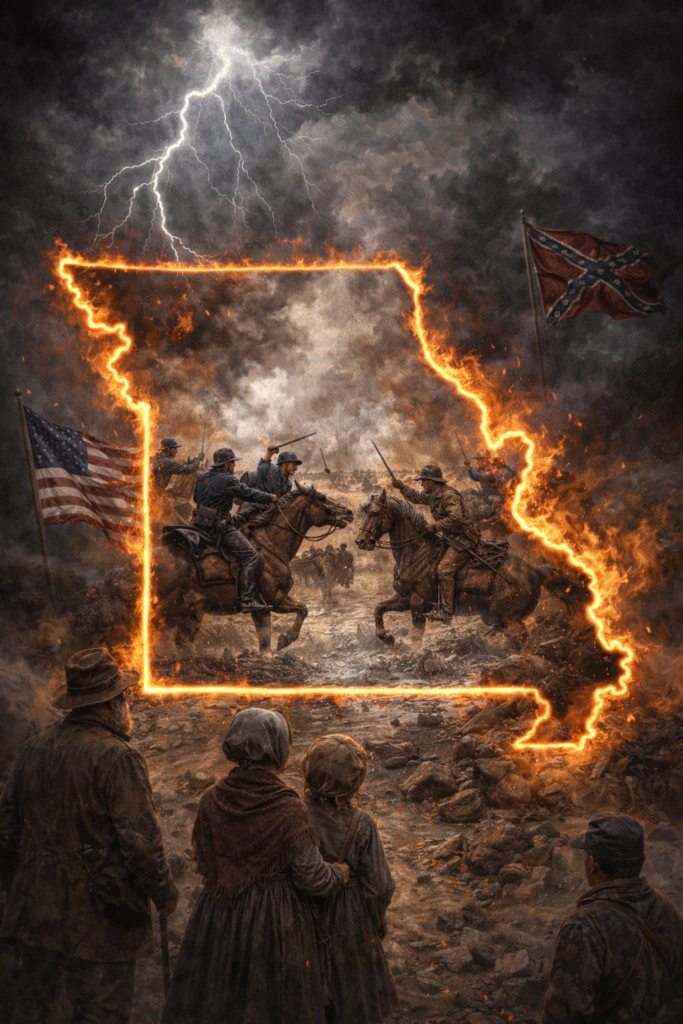
Missouri’s Guerrilla War defines 1862–1864, as raids, retaliation, and civilian terror replace clear battle lines across the divided state.
Table of Contents
Missouri’s Guerrilla War and Missouri’s Descent into Chaos
Missouri did not “transition” into guerrilla warfare.
It fell into it.
By 1862, the fight for who would control Missouri wasn’t happening only through armies and campaigns. It was happening through ambushes, burnings, revenge killings, forced oaths, and the slow collapse of any shared definition of safety.
This is the world of Missouri’s Guerrilla War—a conflict that lived inside communities and spread through personal networks as much as military strategy.
The war didn’t just move through Missouri.
It moved into Missouri.
And once it did, there were no clean front lines to retreat behind.
Why Missouri’s Guerrilla War Was Different
Missouri had already seen major battles. It had already seen political collapse and divided government. But the guerrilla phase became something else entirely—because it changed the rules of survival.
In Missouri’s Guerrilla War, the battlefield was:
- the road between towns
- the farmyard at dusk
- the river crossing at night
- the courthouse square when rumors turned into violence
- the home where someone was accused of helping “the other side”
This wasn’t war as a single story.
It was war as a thousand local stories—each one escalating the next.
The Pattern: Raids, Reprisals, and No Safe Middle
The guerrilla years were fueled by a simple cycle:
- an attack
- retaliation
- escalation
- punishment of entire communities
- renewed violence
That cycle made moderation impossible.
In Missouri’s Guerrilla War, neutrality wasn’t a political stance—it was a liability. People were pressured to prove loyalty, and proof was often demanded by whichever armed group arrived first.
Over time, the question wasn’t “Who is right?”
It became “Who will punish me if I’m wrong?”
Missouri’s Guerrilla War Was a Civilian War
This is the phase where Missouri’s Civil War becomes personal—because civilians were no longer just witnesses to the conflict.
They were targets.
They were informants.
They were providers.
They were the terrain.
Families hid men on the run. Neighbors whispered names. Towns were accused of harboring raiders. Homes were burned because someone’s cousin was rumored to be sympathetic.
Missouri’s Guerrilla War collapsed the distance between war and life.
If the earlier phase was about armies fighting for control, this phase was about communities fighting for survival.
Why It Spiraled: Border Hatreds and Broken Authority
The guerrilla years didn’t appear out of nowhere.
Missouri sat on a border where politics had already turned violent before the Civil War began. By the time conventional battles faded from the center of the story, Missouri’s internal divisions—especially along the Kansas border—were already primed for revenge.
And in Missouri’s Guerrilla War, revenge was not an emotion.
It was a method.
Civil authority was weak. Military power was uneven. Local loyalties shifted by county, by town, sometimes by street. That instability created the perfect environment for irregular warfare to thrive.
What This Series Covers
This series follows Missouri’s Guerrilla War through its defining threads—not as isolated episodes, but as connected steps in a widening collapse.
We’ll move through:
- early clashes that show how fast the war turned local
- border violence that made retaliation a system
- the rise of guerrilla leadership and terror tactics
- Union countermeasures that punished entire regions
- the hidden networks—women, spies, and survival systems—holding communities together
- the final shock moments that revealed how far the conflict had fallen
This is not the story of tidy campaigns.
It’s the story of what happens when a society fractures and violence becomes normal.
What to Watch For as You Read
As we move through this series, keep an eye on three themes that define Missouri’s Guerrilla War:
1) Identity becomes dangerous
People are not judged by actions alone—but by family, neighbors, and rumors.
2) Retaliation becomes policy
Violence doesn’t end violence here. It multiplies it.
3) The war stops being “somewhere else”
The conflict becomes embedded in daily life, and ordinary decisions become life-threatening.
Missouri’s Descent Was Not Just Military
It’s tempting to treat guerrilla warfare as an ugly side story—something separate from the “real war.”
But in Missouri, this wasn’t a sideshow.
Missouri’s Guerrilla War became the defining experience for thousands of people who never stood in a formal battle line, but lived through raids, threats, forced loyalties, and community punishment.
This phase explains why Missouri’s war memory is so complicated—why it produced bitterness that lasted generations, and why it blurred the line between political cause and personal vendetta.
The Cost: Fear Becomes the Map
By the time the guerrilla years reach full intensity, Missouri is no longer organized primarily by county lines or party loyalties.
It is organized by fear.
Which road is safe?
Which town is accused?
Which family is marked?
Who is watching?
In Missouri’s Guerrilla War, people learn to measure distance differently.
Not miles—risk.
Not direction—danger.
Not community—suspicions.
This is why the guerrilla years feel like a descent.
They are.
Looking Ahead
Next Thursday (February 5, 2026), we begin the first stage of Missouri’s guerrilla descent—when the fighting turns local, personal, and fast-moving, and communities realize the war will not be fought only by armies.
New articles every Thursday as we dive deeper into the chaos of Missouri’s Civil War and its lasting divisions.
Plan Your Next Missouri Civil War Adventure!
Ready to hit the road?
Plan your Missouri Civil War adventure with trusted travel tips, tools, and resources. Visit our Resource Page (Missouri Civil War Resources) to find everything you need for hotels, flights, car rentals, gear, and more.
Check Out These Missouri Civil War (Overview) Articles
Missouri Civil War: Why This Forgotten Story Matters
Civil War In Missouri: 6 Questions You Should Ask
Bleeding Kansas: Missouri’s Volatile Border War (1854–61)
General Lyon Takes Missouri: 1861’s Breaking Point
Guerrilla Warfare in Missouri: Chaos Explodes (1861–65)
The Cloak and Dagger Side of Missouri’s Civil War
Missouri Women at War: Discover The Unsung Heroes
General Order No. 11 – Missouri’s Burnt District
Price’s Raid (1864): Missouri’s Last Daring Gamble
Check Out These In Depth Articles About The Five Phases Of The Civil War In Missouri
Missouri’s Civil War (1854–1900): Explore The Complete Guide
Series 1: The Fires Before The War – Bleeding Kansas (1854 – 1860)
Bleeding Kansas: The Missouri and Kansas Border Ignites
The Kansas-Nebraska Act – Unleashing Pandora’s Box
Border Ruffians & Free-Staters — The Border Turns Hostile
Bleeding Kansas Massacres — Fire and Vengeance on the Border
Missouri State Militias – How They Rose From Border Chaos
Propaganda — How Words Fueled Missouri’s Civil War
Election of 1860 — Missouri at the Breaking Point
Series 2: From Secession to Pea Ridge (1860 – 1862)
Missouri Civil War Ignites – Secession Tears the State Apart
Missouri Civil War Erupts – The Road to War (1860–1861)
Camp Jackson Affair: The Spark That Ignited Missouri
Battle of Boonville – Jefferson City Falls & Missouri Breaks
Missouri Early Battles: The Clash Before Wilson’s Creek
Missouri’s Split Government – A State Torn in Two
Union Control in Missouri – Pea Ridge Seals the State
Check Out These Books Published By The Sojourner’s Compass
“Missouri in the Crossfire – The Civil War’s Forgotten Frontier” Series
From the streets of St. Louis to the prairies of southwest Missouri, this compelling short-read series uncovers the untold stories of a divided state at war. Each volume explores a new side of Missouri’s Civil War—its campaigns, commanders, civilians, and the conflicts that shaped its destiny.
Written for both history enthusiasts and casual readers, Missouri in the Crossfire brings the human side of the war to life through vivid storytelling, balanced perspectives, and accessible scholarship—all drawn from Missouri’s own battle-scarred ground.
Available on Amazon & Kindle Unlimited
“Battles & Beyond” – Companion Book Series
From river crossings to ridge fights, Missouri’s Civil War story was one of chaos, courage, and contested loyalties. This travel-ready series delivers concise battlefield guides packed with historical context, walking tips, firsthand quotes, and itinerary tie-ins—perfect for travelers, educators, and armchair historians alike.
Led by Jonathon Midgley, author of The Last Hand series, each volume brings forgotten fights into clear focus—making it easy to explore the war’s impact, one battlefield at a time.
Available On Amazon & Kindle Unlimited
Stay Connected
Follow us for travel inspiration, new articles, and short-form video features:
The Sojourner’s Compass TikTok
The Sojourner’s Compass YouTube
The Sojourner’s Compass Facebook
The Sojourner’s Compass Main Website
Leave a Reply