
Series 3: The Guerrilla Years (1862–1864) — Article 4
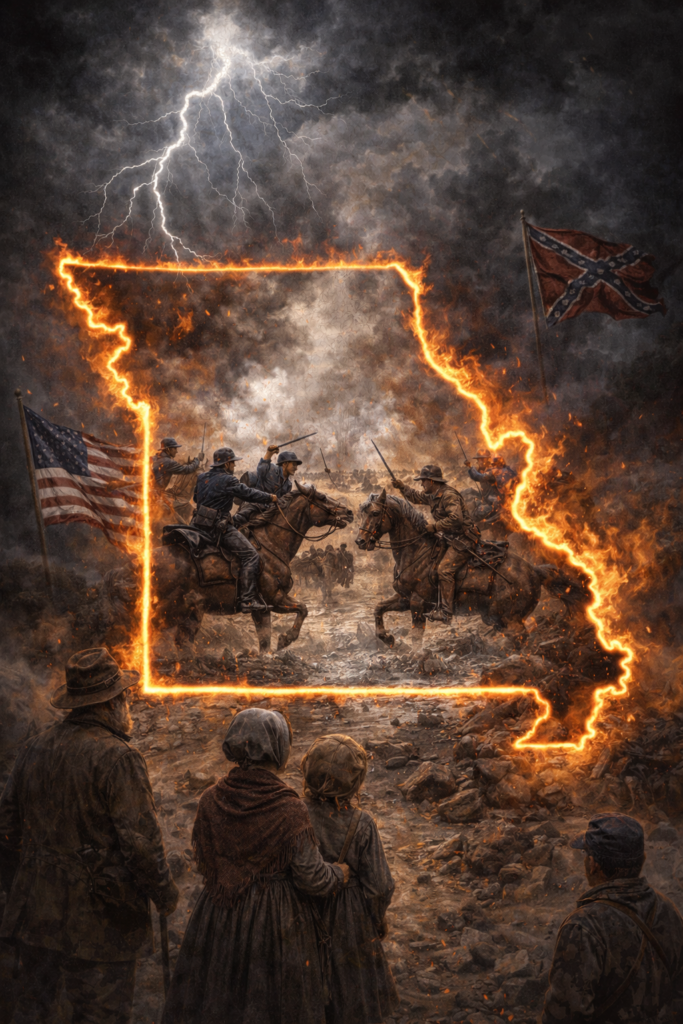
Order No. 11 emptied four Missouri counties, creating the Burnt District and reshaping Missouri’s guerrilla war into a civilian crisis.
Table of Contents
Order No. 11 was not a battle.
It was a policy response.
A forced removal.
And it left behind a name Missouri still carries:
The Burnt District.
Order No. 11 and the War Moves Into the Countryside
Missouri didn’t just fight guerrillas.
It fought what kept guerrillas alive.
Because by 1863, the conflict was no longer decided only by who held a town.
It was decided by:
- who had food
- who had horses
- who had shelter
- who had information
- who had silence
That’s the guerrilla advantage.
It doesn’t require supply lines.
It requires a landscape that can hide a man, feed him, and warn him.
Order No. 11 targeted that landscape.
Why Order No. 11 Was Issued
By late 1863, the border conflict had reached a level where retaliation was no longer random.
It was becoming routine.
Union authorities concluded that raids were being supported—directly or indirectly—by local conditions the military could not reliably police.
So the objective shifted.
Not “catch every raider.”
But “break the support system.”
Order No. 11 was written as a countermeasure to a problem the Union described as persistent and organized.
And once a government frames a region as a system of support, the people inside that region become part of the problem.
Whether they are guilty or not.
What Order No. 11 Required
Order No. 11 directed the evacuation of civilians from designated areas of western Missouri.
It applied to four counties:
- Jackson
- Cass
- Bates
- and parts of Vernon
The order required residents to leave their homes under strict timelines.
It also created categories of allowed relocation based on loyalty determinations and proximity to Union military posts.
In plain terms:
Order No. 11 turned residency into a legal risk.
And turned the countryside into a compliance zone.
The Legal Logic Behind Order No. 11
Order No. 11 was built on one central assumption:
Guerrilla war survives on local support.
So the law aimed at the environment, not just the fighters.
This is the reasoning structure:
If the countryside sustains raiders,
then reduce what the countryside can provide.
That means removing:
- shelter
- supplies
- concealment
- and sympathetic access
Order No. 11 was intended to deny “material aid,” “harbor,” and “intelligence” by making normal rural life impossible to maintain.
It is a control measure.
But it is also a collective measure.
And collective measures create collective consequences.
The Burnt District Was the Result
Order No. 11 did not create calm.
It created absence.
Homes emptied.
Farms were abandoned.
Families moved with what they could carry.
And enforcement took a harsh shape on the ground.
That is how the Burnt District forms:
Not as a single event.
But as a chain reaction.
Once a region is treated as a guerrilla zone, it becomes subject to:
- suspicion as default
- punishment as prevention
- and destruction as a tool of denial
The Burnt District is what happens when policy treats geography like guilt.
Three Rules That Defined Order No. 11
1) Control becomes removal
When authority cannot separate fighters from civilians with confidence, it may choose displacement over investigation.
Order No. 11 is that choice, formalized.
2) Safety becomes conditional
In a normal society, you live where you live.
Under Order No. 11, residence required approval.
And approval required proof.
That changes the meaning of daily life.
3) Policy becomes memory
The most lasting effect of Order No. 11 was not only what it did in the moment.
It was what it taught people to believe:
That the state could be punished as a unit.
That families could be moved as a solution.
That the war could reach into your home and make your address a liability.
That memory does not end when the order expires.
It continues as a justification for the next act.
What Order No. 11 Did to Ordinary Life
Order No. 11 did not only change who fought.
It changed how people lived.
Because once removal becomes possible, everything becomes unstable.
People start measuring life like this:
- Which road is safe today?
- Which neighbor is watching?
- Who will report me if I speak wrong?
- What can I keep without being accused?
- Where can I sleep without becoming a problem?
This is the civilian math of guerrilla war.
And Order No. 11 intensified it.
It made survival legalistic.
It made movement compulsory.
It made trust dangerous.
What This Means for the Rest of Series 3
If Article 3 showed how the shadow war becomes a system, Article 4 shows what happens when the state attempts to destroy that system by force.
Order No. 11 proves something critical:
The Union did not treat the guerrilla war as a simple criminal problem.
It treated it as an environmental threat.
And when a government treats an environment as hostile, civilians inside that environment absorb the consequences first.
That is why Order No. 11 matters in this series.
Not because it ended guerrilla war.
But because it changed what “countermeasures” meant in Missouri.
Looking Ahead
Next Thursday (March 5, 2026), we move into the hidden structure that kept the guerrilla conflict alive—women, families, couriers, safe houses, coded favors, quiet threats, and the underground networks that made the war function when armies weren’t present.
New articles every Thursday as we dive deeper into the chaos of Missouri’s Civil War and its lasting divisions.
Plan Your Next Missouri Civil War Adventure!
Ready to hit the road?
Plan your Missouri Civil War adventure with trusted travel tips, tools, and resources. Visit our Resource Page (Missouri Civil War Resources) to find everything you need for hotels, flights, car rentals, gear, and more.
Check Out These Missouri Civil War (Overview) Articles
Missouri Civil War: Why This Forgotten Story Matters
Civil War In Missouri: 6 Questions You Should Ask
Bleeding Kansas: Missouri’s Volatile Border War (1854–61)
General Lyon Takes Missouri: 1861’s Breaking Point
Guerrilla Warfare in Missouri: Chaos Explodes (1861–65)
The Cloak and Dagger Side of Missouri’s Civil War
Missouri Women at War: Discover The Unsung Heroes
General Order No. 11 – Missouri’s Burnt District
Price’s Raid (1864): Missouri’s Last Daring Gamble
Check Out These In Depth Articles About The Five Phases Of The Civil War In Missouri
Missouri’s Civil War (1854–1900): Explore The Complete Guide
Series 1: The Fires Before The War – Bleeding Kansas (1854 – 1860)
Bleeding Kansas: The Missouri and Kansas Border Ignites
The Kansas-Nebraska Act – Unleashing Pandora’s Box
Border Ruffians & Free-Staters — The Border Turns Hostile
Bleeding Kansas Massacres — Fire and Vengeance on the Border
Missouri State Militias – How They Rose From Border Chaos
Propaganda — How Words Fueled Missouri’s Civil War
Election of 1860 — Missouri at the Breaking Point
Series 2: From Secession to Pea Ridge (1860 – 1862)
Missouri Civil War Ignites – Secession Tears the State Apart
Missouri Civil War Erupts – The Road to War (1860–1861)
Camp Jackson Affair: The Spark That Ignited Missouri
Battle of Boonville – Jefferson City Falls & Missouri Breaks
Missouri Early Battles: The Clash Before Wilson’s Creek
Missouri’s Split Government – A State Torn in Two
Union Control in Missouri – Pea Ridge Seals the State
Series 3: The Guerrilla Years (1862 – 1864)
Missouri’s Guerrilla War – When Order Collapsed
Missouri Guerrilla War – The Brutal Personal Turn
Savage Border War Retaliation – Osceola to Lawrence
Unmasking the Missouri Shadow War – Guerrilla War Evolves
Check Out These Books Published By The Sojourner’s Compass
“Missouri in the Crossfire – The Civil War’s Forgotten Frontier” Series
From the streets of St. Louis to the prairies of southwest Missouri, this compelling short-read series uncovers the untold stories of a divided state at war. Each volume explores a new side of Missouri’s Civil War—its campaigns, commanders, civilians, and the conflicts that shaped its destiny.
Written for both history enthusiasts and casual readers, Missouri in the Crossfire brings the human side of the war to life through vivid storytelling, balanced perspectives, and accessible scholarship—all drawn from Missouri’s own battle-scarred ground.
Available on Amazon & Kindle Unlimited
“Battles & Beyond” – Companion Book Series
From river crossings to ridge fights, Missouri’s Civil War story was one of chaos, courage, and contested loyalties. This travel-ready series delivers concise battlefield guides packed with historical context, walking tips, firsthand quotes, and itinerary tie-ins—perfect for travelers, educators, and armchair historians alike.
Led by Jonathon Midgley, author of The Last Hand series, each volume brings forgotten fights into clear focus—making it easy to explore the war’s impact, one battlefield at a time.
Available On Amazon & Kindle Unlimited
Stay Connected
Follow us for travel inspiration, new articles, and short-form video features:
The Sojourner’s Compass TikTok
The Sojourner’s Compass YouTube
The Sojourner’s Compass Facebook
The Sojourner’s Compass Main Website
Leave a Reply