
Series 2: From Secession to Pea Ridge (1860–1862) — Introduction
Missouri Civil War chaos erupts in 1861 as secession, militias, and a divided government pull the state into the conflict’s opening battles.
Table of Contents
Missouri Civil War – The War Comes to Missouri: Secession & Chaos Begin
Missouri did not slip quietly into the Civil War — it plunged in headfirst.
By 1860, the state sat on a political fault line, its people split between Union loyalty and Southern sympathy, its future hanging on a knife’s edge.
When the national crisis exploded in 1861, Missouri became one of the war’s most important battlegrounds — not only for armies, but for ideas, identity, and control of the West.
This is the story of how the conflict arrived on Missouri soil and reshaped the nation’s fate.
A State Pulling Apart
As Abraham Lincoln took office in March 1861, Missouri’s leadership was openly divided.
Governor Claiborne Fox Jackson, a Southern-leaning Democrat, quietly hoped to lead the state into the Confederacy.
But the Missouri Convention, elected by voters across the state, overwhelmingly declared that Missouri should remain neutral — and firmly in the Union unless attacked.
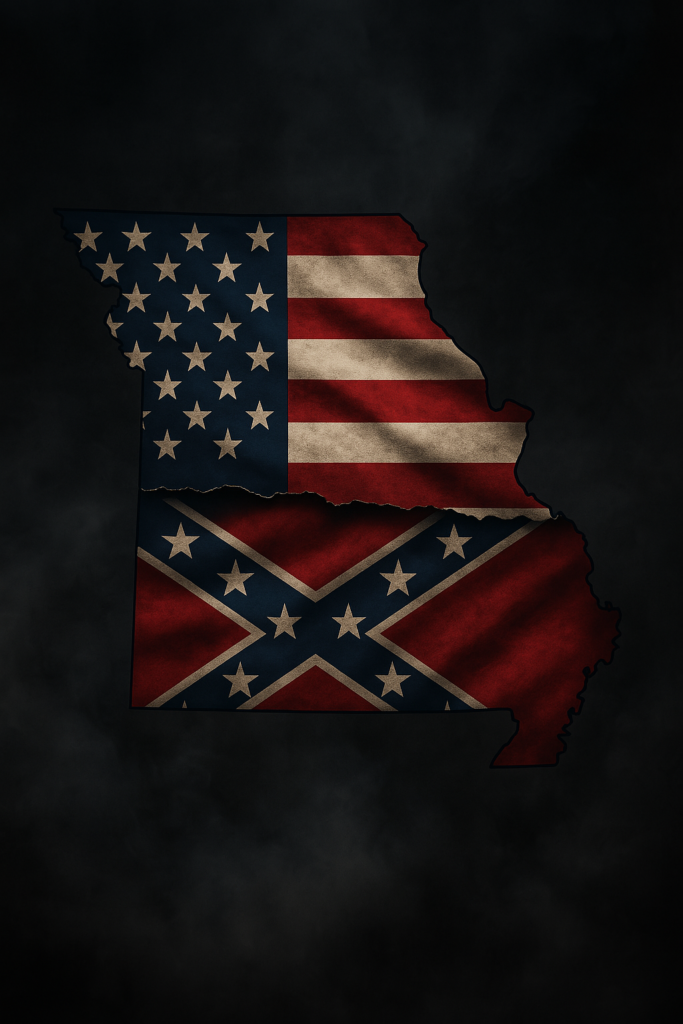
Two governments now claimed to speak for Missouri.
Two visions of the state’s future were locked in a political standoff.
And behind that tension, militias drilled, newspapers attacked each other, and whispers of secession crept across dinner tables, churches, and courthouse squares.
The Missouri Civil War had begun long before the firing of the first local shot.
The Arsenal: The Spark Everyone Feared
The turning point arrived in St. Louis.
The city held one of the largest stockpiles of Federal weapons west of the Mississippi — and both sides wanted them.
Union Captain Nathaniel Lyon, suspicious of the governor’s intentions, secretly moved thousands of muskets across the river into Illinois.
That single decision ensured the U.S. Army would not lose Missouri without a fight.
It also convinced Governor Jackson that Lyon was preparing for an armed takeover.
The crisis was no longer political.
It was military.
The Camp Jackson Affair — Missouri’s First Flash of War
On May 10, 1861, Lyon surrounded a militia encampment west of St. Louis — Camp Jackson — and forced its surrender.
As the captured militiamen were marched toward the city, a hostile crowd gathered.
Shouting turned to shoving.
Rocks flew.
Gunfire erupted.
By the time the smoke cleared, dozens of civilians lay dead or wounded.
St. Louis was shaken to its core.
Missouri had tasted war for the first time, and the bitterness would linger.
The event tore the state apart:
- Unionists blamed the militia and secessionists
- Secessionists condemned Lyon as a tyrant
- Moderates realized neutrality was crumbling
The Camp Jackson Affair made one thing certain: Missouri’s Civil War was no longer avoidable.
Two Governments, One State
Governor Jackson fled the capital.
Lyon pursued him across the state in a race for control of Missouri’s political and military future.
Jackson convened a pro-Confederate government-in-exile, claiming Missouri had seceded.
The elected Convention — still in Union control — declared the governor’s office vacant and formed a Unionist provisional government.
Missouri now had:
- A Union government recognized by Washington
- A Confederate-aligned government recognized by Richmond
No other state experienced this dual identity as sharply or violently.
Across Missouri, neighbors no longer simply disagreed — they enlisted.
Missouri Civil War – Missouri Becomes a Battlefield
By midsummer 1861, the war’s opening battles arrived in rapid succession.
- Boonville: A swift Union victory that secured the Missouri River
- Carthage: A massive fight that showed the Confederate-aligned Missouri State Guard would not retreat quietly
- Dug Springs & Wilson’s Creek: Where Union and Confederate forces collided in the campaign that would determine Missouri’s fate
Armies marched through fields that had once held harvests.
Families watched from porches as blue and gray columns passed.
The border counties — inflamed by years of Bleeding Kansas violence — became recruiting grounds overnight.
The Missouri Civil War was not just beginning.
It was accelerating.
Why Missouri Mattered
Both sides knew Missouri was more than another state.
- Its rivers connected east to west
- Its railroads linked North and South
- Its farms fed armies across the Trans-Mississippi
- Its loyalty shaped the fate of the entire region
If Missouri fell to the Confederacy, Union control of the West would collapse.
If Missouri remained in the Union, the Confederacy’s western ambitions would suffocate.
That is why 1861 became a whirlwind of battles, proclamations, political reversals, and desperate campaigns.
Missouri was the key to the West — and both sides fought to hold it.
Looking Ahead
Next Thursday (December 18, 2025), we’ll continue Series 2 with the first deep-dive article:
We’ll explore the months leading up to the Camp Jackson Affair — elections, newspaper wars, militias forming in secret, and the political unraveling that set Missouri on a collision course with civil war.
New articles every Thursday — follow along as we uncover how Missouri became the battleground that shaped the Trans-Mississippi.
Plan Your Next Missouri Civil War Adventure!
Ready to hit the road?
Plan your Missouri Civil War adventure with trusted travel tips, tools, and resources. Visit our Resource Page (Missouri Civil War Resources) to find everything you need for hotels, flights, car rentals, gear, and more.
Check Out These Missouri Civil War (Overview) Articles
Missouri Civil War: Why This Forgotten Story Matters
Civil War In Missouri: 6 Questions You Should Ask
Bleeding Kansas: Missouri’s Volatile Border War (1854–61)
Missouri – 3 Reasons It Was the Civil War’s Western Key
General Lyon Takes Missouri: 1861’s Breaking Point
Guerrilla Warfare in Missouri: Chaos Explodes (1861–65)
The Cloak and Dagger Side of Missouri’s Civil War
Missouri Women at War: Discover The Unsung Heroes
General Order No. 11 – Missouri’s Burnt District
Price’s Raid (1864): Missouri’s Last Daring Gamble
Check Out These In Depth Articles About The Five Phases Of The Civil War In Missouri
Missouri’s Civil War (1854–1900): Explore The Complete Guide
Series 1: The Fires Before The War – Bleeding Kansas (1854 – 1860)
Bleeding Kansas: The Missouri and Kansas Border Ignites
The Kansas-Nebraska Act – Unleashing Pandora’s Box
Border Ruffians & Free-Staters — The Border Turns Hostile
Bleeding Kansas Massacres — Fire and Vengeance on the Border
Missouri State Militias – How They Rose From Border Chaos
Propaganda — How Words Fueled Missouri’s Civil War
Election of 1860 — Missouri at the Breaking Point
Check Out These Books Published By The Sojourner’s Compass
“Missouri in the Crossfire – The Civil War’s Forgotten Frontier” Series
From the streets of St. Louis to the prairies of southwest Missouri, this compelling short-read series uncovers the untold stories of a divided state at war. Each volume explores a new side of Missouri’s Civil War—its campaigns, commanders, civilians, and the conflicts that shaped its destiny.
Written for both history enthusiasts and casual readers, Missouri in the Crossfire brings the human side of the war to life through vivid storytelling, balanced perspectives, and accessible scholarship—all drawn from Missouri’s own battle-scarred ground.
Available on Amazon & Kindle Unlimited
“Battles & Beyond” – Companion Book Series
From river crossings to ridge fights, Missouri’s Civil War story was one of chaos, courage, and contested loyalties. This travel-ready series delivers concise battlefield guides packed with historical context, walking tips, firsthand quotes, and itinerary tie-ins—perfect for travelers, educators, and armchair historians alike.
Led by Jonathon Midgley, author of The Last Hand series, each volume brings forgotten fights into clear focus—making it easy to explore the war’s impact, one battlefield at a time.
Available On Amazon & Kindle Unlimited
Stay Connected
Follow us for travel inspiration, new articles, and short-form video features:
The Sojourner’s Compass TikTok
The Sojourner’s Compass YouTube
The Sojourner’s Compass Facebook
The Sojourner’s Compass Main Website
Leave a Reply