
Series 3: The Guerrilla Years (1862–1864) — Article 1
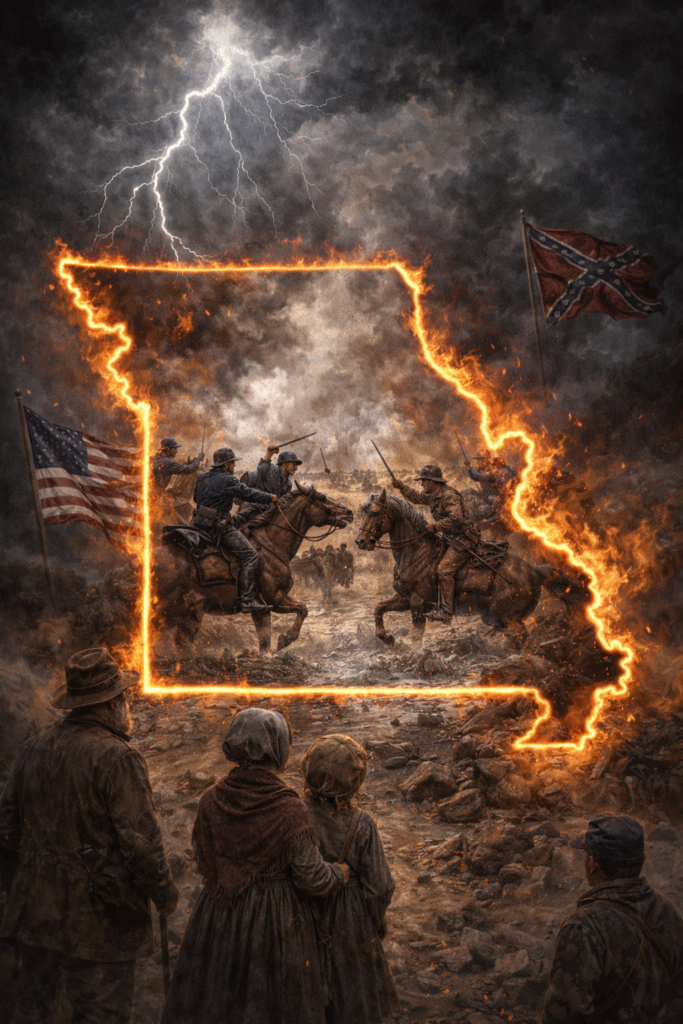
Missouri guerrilla war turns personal in 1862—Island Mound and Lone Jack show how raids, neighbors, and fear replaced clean battle lines.
Table of Contents
Missouri Guerrilla War and the War Turns Personal
Missouri didn’t ease into the guerrilla phase.
It snapped into it.
By 1862, the struggle inside the state was no longer defined by marching columns and clean, named battlefields. The war was still “Civil War” on paper—but on the ground it felt like something else: ambushes on back roads, homes searched at night, whispers that could get a family punished, and violence that didn’t always wear a uniform.
That’s the core shift of the Missouri guerrilla war.
The conflict starts acting like a neighborhood war—where identity becomes dangerous, and survival becomes a daily calculation.
And two 1862 fights show that turn clearly:
- Lone Jack — a brutal, confused clash that proved Missouri could still produce “real” battles, but without the stability that makes battles end wars.
- Island Mound — a smaller fight with an outsized meaning, exposing how quickly the war in Missouri targeted communities, and how the guerrilla phase pulled new people into direct danger.
These weren’t the beginning of violence in Missouri.
They were the moment the violence started changing shape.
Why the Missouri Guerrilla War Turned Personal
If Series 2 was about who could control Missouri strategically, Series 3 is about what happens when “control” stops protecting people.
By 1862, Missouri had already endured political collapse, divided authority, and major battles. But the Missouri guerrilla war added a new ingredient that made everything worse:
the battlefield moved into ordinary life.
In the Missouri guerrilla war, the conflict lived in:
- the road between towns
- the farm lane at dusk
- the river crossing at night
- the courthouse square when rumors turned into arrests
- the home where someone was accused of helping “the other side”
That’s why people stopped asking, “Who is right?”
And started asking:
“Who will punish me if I’m wrong?”
This is what “personal” means in Missouri’s guerrilla phase: the consequences weren’t distant. They were immediate, local, and often aimed at families.
Lone Jack and the Missouri Guerrilla War Becomes a Local Battlefield
Lone Jack (August 1862) is one of the best examples of how Missouri could produce a major clash and still feel like a fractured internal war.
It wasn’t a grand turning point like Pea Ridge.
It didn’t settle the strategic question.
But it did something just as important for this series:
It showed how the Missouri guerrilla war grew out of local stakes—where communities, loyalty networks, and regional control collided in a way that refused to stay tidy.
Lone Jack mattered because it revealed the pattern Missouri would keep repeating:
- Forces clash hard in one place
- The “win” doesn’t stabilize anything
- The conflict disperses back into raids, reprisals, and constant threat
A battle could be fierce. It could be costly. It could even look decisive for a few days.
And then Missouri would swallow it and keep burning anyway.
That’s the guerrilla reality taking hold: conflict doesn’t end—it reappears somewhere else, wearing a different form.
In other words, Lone Jack wasn’t just a fight.
It was a warning that Missouri’s war was becoming a chain of local emergencies, not a single campaign with clean outcomes.
Island Mound and the Missouri Guerrilla War Expands Who Gets Targeted
Island Mound (October 1862) is often remembered because it highlights who was being pulled into the conflict—and how quickly violence followed them.
In this period, Black soldiers were serving in Union formations in the region, and Island Mound became one of the early moments where Black troops fought in the field against irregular pro-Confederate forces.
That matters for the story of the Missouri guerrilla war because guerrilla conflict doesn’t just widen violence.
It widens vulnerability.
Island Mound points to a truth that will define the entire series:
When war becomes local and irregular, it doesn’t stay focused on armies.
It starts pressuring communities—by race, by politics, by rumor, by geography, by who your neighbors think you are.
And once that happens, the war becomes harder to contain and harder to stop.
Because you’re no longer trying to defeat an enemy line.
You’re trying to survive an environment.
That’s what Island Mound symbolizes in this series: the guerrilla phase creates a kind of battlefield where social identity and daily movement can become life-or-death factors.
What These Two Fights Reveal About Missouri’s Guerrilla War
Put Lone Jack and Island Mound side by side, and you can see the shape of what’s coming.
1) Violence becomes portable.
Not anchored to one front. Not confined to one campaign. It moves with people and rumors.
2) Battles don’t end the danger.
Even when a clash is “over,” the instability remains—because local power is still contested.
3) Community becomes the terrain.
The war stops being something armies do near you and becomes something that happens through you—through networks, families, and fear.
This is why the Missouri guerrilla war feels different than a conventional military story. It’s not a straight line. It’s a spiral.
And once that spiral starts, it feeds itself:
attack → retaliation → escalation → punishment → renewed violence
Missouri doesn’t just fight.
It fractures—and then fights inside the fracture.
The War Turns Personal When Authority Can’t Protect Anyone
Here’s the core idea to carry forward:
The guerrilla phase didn’t arrive because Missourians suddenly became violent.
It arrived because authority broke unevenly.
Some places were heavily protected.
Other places were exposed.
And many communities lived under overlapping pressures—Union forces, Confederate-leaning bands, local militias, irregular raiders—each claiming legitimacy, each demanding proof of loyalty.
In that environment, personal choices become public risks:
- where you trade
- who you shelter
- who you speak to
- which road you take
- what you’re rumored to believe
That’s why the Missouri guerrilla war becomes a civilian war so quickly: civilians aren’t just witnesses.
They become leverage.
They become targets.
They become the map.
Looking Ahead
Next Thursday (February 12, 2026), we move into the next stage of Missouri’s guerrilla descent—when retaliation stops being a reaction and becomes a strategy, and entire towns begin paying the price for the choices (and accusations) swirling around them.
New articles every Thursday as we dive deeper into the chaos of Missouri’s Civil War and its lasting divisions.
Plan Your Next Missouri Civil War Adventure!
Ready to hit the road?
Plan your Missouri Civil War adventure with trusted travel tips, tools, and resources. Visit our Resource Page (Missouri Civil War Resources) to find everything you need for hotels, flights, car rentals, gear, and more.
Check Out These Missouri Civil War (Overview) Articles
Missouri Civil War: Why This Forgotten Story Matters
Civil War In Missouri: 6 Questions You Should Ask
Bleeding Kansas: Missouri’s Volatile Border War (1854–61)
Missouri – 3 Reasons It Was the Civil War’s Western Key
General Lyon Takes Missouri: 1861’s Breaking Point
Guerrilla Warfare in Missouri: Chaos Explodes (1861–65)
The Cloak and Dagger Side of Missouri’s Civil War
Missouri Women at War: Discover The Unsung Heroes
General Order No. 11 – Missouri’s Burnt District
Price’s Raid (1864): Missouri’s Last Daring Gamble
Check Out These In Depth Articles About The Five Phases Of The Civil War In Missouri
Missouri’s Civil War (1854–1900): Explore The Complete Guide
Series 1: The Fires Before The War – Bleeding Kansas (1854 – 1860)
Bleeding Kansas: The Missouri and Kansas Border Ignites
The Kansas-Nebraska Act – Unleashing Pandora’s Box
Border Ruffians & Free-Staters — The Border Turns Hostile
Bleeding Kansas Massacres — Fire and Vengeance on the Border
Missouri State Militias – How They Rose From Border Chaos
Propaganda — How Words Fueled Missouri’s Civil War
Election of 1860 — Missouri at the Breaking Point
Series 2: From Secession to Pea Ridge (1860 – 1862)
Missouri Civil War Ignites – Secession Tears the State Apart
Missouri Civil War Erupts – The Road to War (1860–1861)
Camp Jackson Affair: The Spark That Ignited Missouri
Battle of Boonville – Jefferson City Falls & Missouri Breaks
Missouri Early Battles: The Clash Before Wilson’s Creek
Missouri’s Split Government – A State Torn in Two
Union Control in Missouri – Pea Ridge Seals the State
Series 3: The Guerrilla Years (1862 – 1864)
Missouri’s Guerrilla War – When Order Collapsed
Check Out These Books Published By The Sojourner’s Compass
“Missouri in the Crossfire – The Civil War’s Forgotten Frontier” Series
From the streets of St. Louis to the prairies of southwest Missouri, this compelling short-read series uncovers the untold stories of a divided state at war. Each volume explores a new side of Missouri’s Civil War—its campaigns, commanders, civilians, and the conflicts that shaped its destiny.
Written for both history enthusiasts and casual readers, Missouri in the Crossfire brings the human side of the war to life through vivid storytelling, balanced perspectives, and accessible scholarship—all drawn from Missouri’s own battle-scarred ground.
Available on Amazon & Kindle Unlimited
“Battles & Beyond” – Companion Book Series
From river crossings to ridge fights, Missouri’s Civil War story was one of chaos, courage, and contested loyalties. This travel-ready series delivers concise battlefield guides packed with historical context, walking tips, firsthand quotes, and itinerary tie-ins—perfect for travelers, educators, and armchair historians alike.
Led by Jonathon Midgley, author of The Last Hand series, each volume brings forgotten fights into clear focus—making it easy to explore the war’s impact, one battlefield at a time.
Available On Amazon & Kindle Unlimited
Stay Connected
Follow us for travel inspiration, new articles, and short-form video features:
The Sojourner’s Compass TikTok
The Sojourner’s Compass YouTube
The Sojourner’s Compass Facebook
The Sojourner’s Compass Main Website
Leave a Reply