
Series 4: Price’s Raid & Missouri’s Last Confederate Gamble (1864–1865) — Article 1
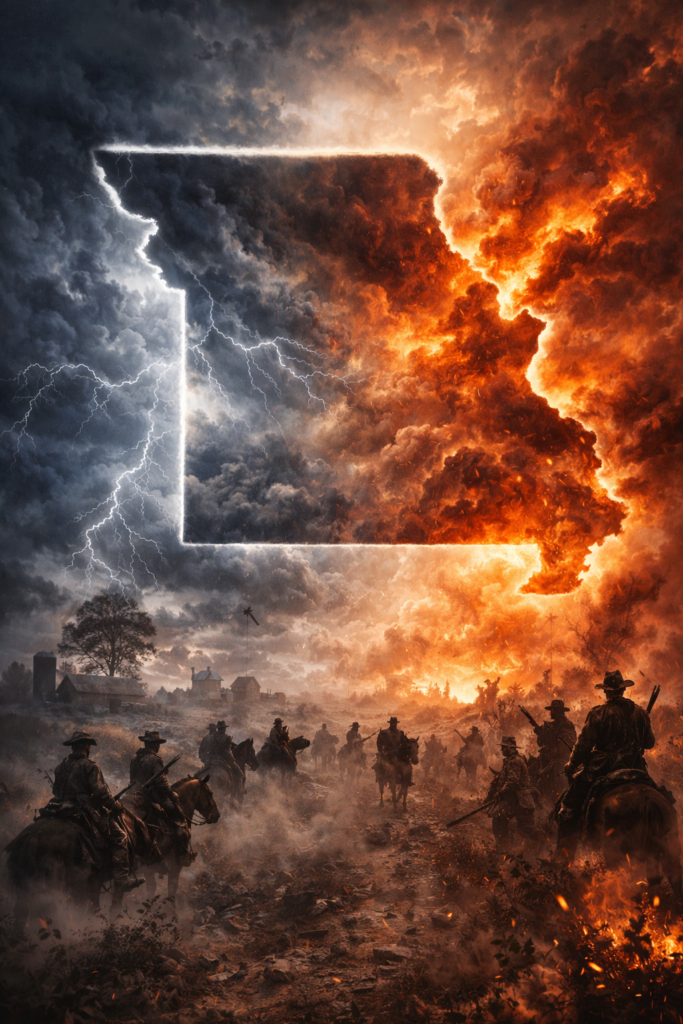
Price’s Raid begins as Confederate forces move out of Arkansas toward Pilot Knob, testing Union control and reigniting Missouri’s war in 1864.
Table of Contents
Price’s Raid did not begin with one dramatic battle.
It began with movement.
With a column crossing a border and turning Missouri into a target again—because the Confederacy still believed the state could be shaken, flipped, or at least disrupted long enough to matter.
This first stage of the campaign is about entry.
Where the invasion comes from.
Why it comes at all.
And what it means when a late-war Confederate force aims itself at Missouri’s roads, towns, and supply lines.
This is the opening move of Price’s Raid.
Price’s Raid Begins in the Border Country
By 1864, Missouri was not an untouched prize.
It was scarred territory.
Union control had tightened in the strategic sense, but Missouri’s internal instability remained—especially in areas where authority was thin, distances were wide, and the war had already trained people to panic.
That made the border country valuable.
Not because it was easy to hold.
Because it was easier to enter.
To spread uncertainty.
To trigger reaction.
And reaction was part of the plan.
When Price’s Raid begins, it begins with a question the campaign is designed to force:
Can the Confederacy still move through this region in strength—and make Missouri feel contestable again?
Why Pilot Knob Matters to the Opening Stage
The opening stage points toward Pilot Knob for a reason.
In a campaign built on movement, you don’t aim first at symbolism alone.
You aim at access.
At routes.
At positions that either open roads or close them.
Pilot Knob sits in a region that matters for how forces move between key points in Missouri, and for how a campaign can signal intent:
- we can enter
- we can concentrate
- we can threaten more than one direction at once
That does not mean everything depends on one place.
But it does mean early targets are chosen because they shape momentum.
And momentum is the weapon in this campaign.
That is the difference between a raid that “hits and runs” and Price’s Raid, which tries to build pressure inside Missouri.
What the Confederacy Needed from Price’s Raid
A late-war invasion cannot be measured only by what it captures.
It has to be measured by what it changes.
The Confederacy needed Price’s Raid to do at least some of the following:
- force Union authorities to redirect troops and attention
- capture supplies, horses, and matériel to sustain movement
- encourage enlistment or collaboration in places where Confederate sympathy still existed
- create fear and uncertainty that could disrupt normal governance
- produce victories that could be framed as proof of Confederate reach
This is important for understanding the opening:
The campaign is not only moving through terrain.
It is moving through perception.
And in Missouri, perception can move faster than troops.
The Real Battlefield Was the Road Network
This stage is not defined by one field.
It is defined by routes.
Because Price’s Raid is a campaign where control is measured by:
- which roads can be used safely
- which towns can be entered, held briefly, or denied to the enemy
- which crossings stay open
- which supply lines can keep a force moving
- how quickly pursuit can be delayed or redirected
That is why the invasion begins the way it does—through the border region, along paths that allow movement and concentration.
In this kind of campaign, the raid is not “somewhere.”
It is everywhere the column can reach.
And everywhere the Union has to respond.
What This Opening Stage Did to Missouri
The moment Price’s Raid begins, Missouri changes temperature.
Because an invasion does not need to win the entire state to destabilize it.
It only needs to prove it can appear.
And when it appears, it forces choices:
- towns decide whether to resist, comply, or hide
- civilians decide what to say, what not to say, and who to trust
- Union forces decide where to concentrate and what to protect first
- Confederate forces decide where to strike for maximum effect
This is why the opening stage matters.
Not because it settles the raid.
Because it starts the chain reaction.
Looking Ahead
Next Thursday (April 2, 2026), we follow the campaign as it pushes deeper into Missouri and collides with a hard problem every invading force faces: a raid can move fast, but it cannot be everywhere—and the moment it slows, Union pressure begins to close the trap.
New articles every Thursday as we dive deeper into the chaos of Missouri’s Civil War and its lasting divisions.
Plan Your Next Missouri Civil War Adventure!
Ready to hit the road?
Plan your Missouri Civil War adventure with trusted travel tips, tools, and resources. Visit our Resource Page (Missouri Civil War Resources) to find everything you need for hotels, flights, car rentals, gear, and more.
Check Out These Missouri Civil War (Overview) Articles
Missouri Civil War: Why This Forgotten Story Matters
Civil War In Missouri: 6 Questions You Should Ask
Bleeding Kansas: Missouri’s Volatile Border War (1854–61)
Missouri – 3 Reasons It Was the Civil War’s Western Key
General Lyon Takes Missouri: 1861’s Breaking Point
Guerrilla Warfare in Missouri: Chaos Explodes (1861–65)
The Cloak and Dagger Side of Missouri’s Civil War
Missouri Women at War: Discover The Unsung Heroes
General Order No. 11 – Missouri’s Burnt District
Price’s Raid (1864): Missouri’s Last Daring Gamble
Check Out These In Depth Articles About The Five Phases Of The Civil War In Missouri
Missouri’s Civil War (1854–1900): Explore The Complete Guide
Series 1: The Fires Before The War – Bleeding Kansas (1854 – 1860)
Bleeding Kansas: The Missouri and Kansas Border Ignites
The Kansas-Nebraska Act – Unleashing Pandora’s Box
Border Ruffians & Free-Staters — The Border Turns Hostile
Bleeding Kansas Massacres — Fire and Vengeance on the Border
Missouri State Militias – How They Rose From Border Chaos
Propaganda — How Words Fueled Missouri’s Civil War
Election of 1860 — Missouri at the Breaking Point
Series 2: From Secession to Pea Ridge (1860 – 1862)
Missouri Civil War Ignites – Secession Tears the State Apart
Missouri Civil War Erupts – The Road to War (1860–1861)
Camp Jackson Affair: The Spark That Ignited Missouri
Battle of Boonville – Jefferson City Falls & Missouri Breaks
Missouri Early Battles: The Clash Before Wilson’s Creek
Missouri’s Split Government – A State Torn in Two
Union Control in Missouri – Pea Ridge Seals the State
Series 3: The Guerrilla Years (1862 – 1864)
Missouri’s Guerrilla War – When Order Collapsed
Missouri Guerrilla War – The Brutal Personal Turn
Savage Border War Retaliation – Osceola to Lawrence
Unmasking the Missouri Shadow War – Guerrilla War Evolves
Brutal Order No. 11 – Missouri’s Burnt District
Hidden Underground Networks – Women in Missouri’s War
Centralia Massacre – Missouri’s Darkest Day
Series 4: Price’s Raid & Missouri’s Last Confederate Gamble (1864–1865) — Introduction
Price’s Raid Begins – Missouri’s Last Confederate Gamble
Check Out These Books Published By The Sojourner’s Compass
“Missouri in the Crossfire – The Civil War’s Forgotten Frontier” Series
From the streets of St. Louis to the prairies of southwest Missouri, this compelling short-read series uncovers the untold stories of a divided state at war. Each volume explores a new side of Missouri’s Civil War—its campaigns, commanders, civilians, and the conflicts that shaped its destiny.
Written for both history enthusiasts and casual readers, Missouri in the Crossfire brings the human side of the war to life through vivid storytelling, balanced perspectives, and accessible scholarship—all drawn from Missouri’s own battle-scarred ground.
Available on Amazon & Kindle Unlimited
“Battles & Beyond” – Companion Book Series
From river crossings to ridge fights, Missouri’s Civil War story was one of chaos, courage, and contested loyalties. This travel-ready series delivers concise battlefield guides packed with historical context, walking tips, firsthand quotes, and itinerary tie-ins—perfect for travelers, educators, and armchair historians alike.
Led by Jonathon Midgley, author of The Last Hand series, each volume brings forgotten fights into clear focus—making it easy to explore the war’s impact, one battlefield at a time.
Available On Amazon & Kindle Unlimited
Stay Connected
Follow us for travel inspiration, new articles, and short-form video features:
The Sojourner’s Compass TikTok
The Sojourner’s Compass YouTube
The Sojourner’s Compass Facebook
The Sojourner’s Compass Main Website
Leave a Reply