
Series 3: The Guerrilla Years (1862–1864) — Article 2
Border war retaliation turned towns into targets—Osceola burned, Lawrence massacred—proof the Missouri-Kansas line made revenge a strategy.
Table of Contents
Border War Retaliation and the Towns That Burned
Missouri didn’t invent revenge.
But on the Missouri–Kansas line, revenge became a system.
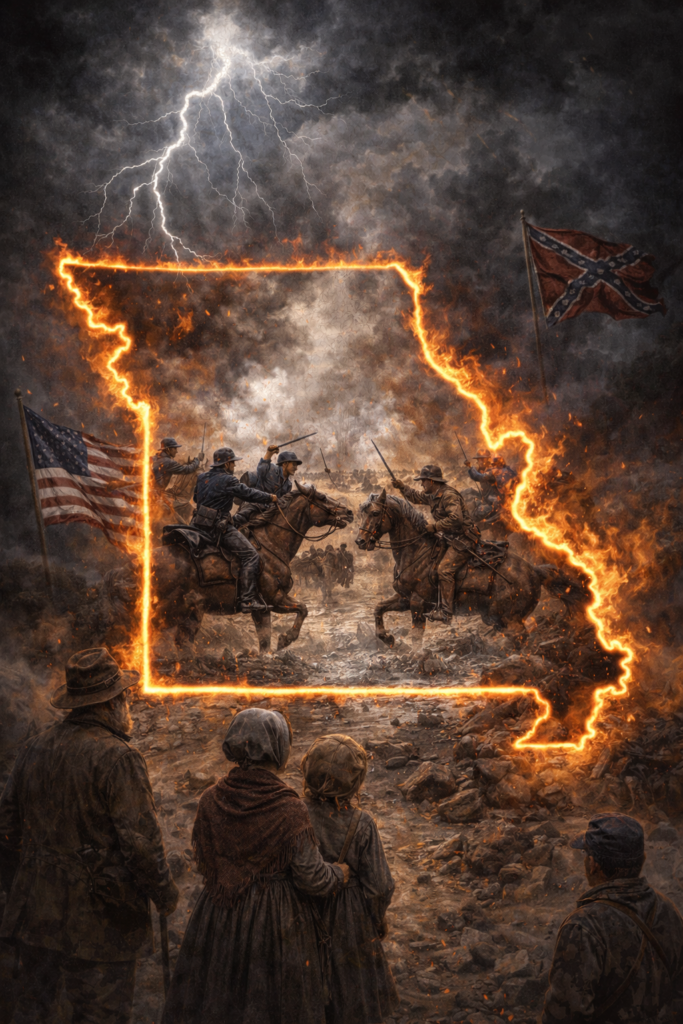
By the time the guerrilla years took full shape, border war retaliation wasn’t just something people felt—it was something people planned. A town could become a symbol. A symbol could become a target. And once that happened, violence didn’t need a battlefield.
It just needed a name on a map.
This is why the guerrilla phase feels different than everything that came before it. In Series 2, we tracked armies, invasions, and the fight for control.
In Series 3, we track something worse:
When retaliation becomes policy, and ruin becomes the message.
And two towns—Osceola and Lawrence—show the pattern in its rawest form.
Not because they were the only places to suffer.
But because they became reference points—the kind people pointed to later and said:
“This is why we did what we did.”
That’s border war retaliation in its purest form.
Why This Was Different: Border War Retaliation Had Momentum
This wasn’t a clean “cause → effect.”
It was a spiral:
- an attack
- a reprisal
- an escalation
- a punishment
- renewed violence
- and a new justification for the next strike
And the most dangerous part?
Each side could tell the story as defense.
That’s what border war retaliation does. It makes cruelty feel reasonable—because it’s framed as payback. It turns communities into stand-ins for guilt. It replaces “who did it?” with “who belongs to them?”
By the early 1860s, the border region was already primed for this kind of war. Missourians and Kansans didn’t just disagree politically. They carried years of bitterness, raids, and hard memories—long before guerrillas became a household word.
So when the war broke open, the violence didn’t arrive on neutral ground.
It landed on dry timber.
Osceola: A Town Burned, a Grudge Planted
Osceola sits in western Missouri—right in the zone where the border conflict could reach into daily life.
In September 1861, Union-aligned forces associated with Kansas “Jayhawkers” entered Osceola and the town was sacked and burned. Whatever the motives and arguments around it, what mattered for the later guerrilla years was the result:
People didn’t remember it as “a military action.”
They remembered it as humiliation.
They remembered loss.
They remembered fire.
And Osceola didn’t fade into the background. It became a story that traveled—passed through families, militia circles, and eventually the guerrilla networks that lived on anger and memory.
That’s one of the most important truths of border war retaliation:
Even when the violence happens in one year, it can shape what people feel justified doing two years later.
Osceola became a symbol of what happens when war stops respecting lines—when your town becomes the battlefield, even if you never fired a shot.
And once a town becomes a symbol, it doesn’t stay local.
It becomes currency.
Lawrence: Retaliation Turns Into Ruin
By 1863, the guerrilla war had evolved.
It wasn’t just scattered raids and local feuds anymore.
It was organized terror—designed to punish, intimidate, and send a message far beyond the immediate target.
In August 1863, Lawrence, Kansas was attacked by guerrilla fighters under William Quantrill. The raid became one of the most infamous moments of the war west of the Mississippi—because it wasn’t aimed at an army formation.
It was aimed at a community.
And in the logic of border war retaliation, Lawrence could be framed as “deserved.”
Not because every person there had committed a crime—most hadn’t.
But because the town carried meaning.
Lawrence symbolized Kansas power, Kansas militancy, and Kansas resistance. It also sat inside the long memory of the border conflict—where earlier violence (including Osceola) could be pulled forward as justification.
This is the terrifying math of border war retaliation:
- A town gets labeled.
- The label becomes guilt.
- The guilt becomes permission.
And once permission exists, the war can do anything it wants.
Lawrence wasn’t just a strike.
It was a statement:
“No place is off-limits.”
What Osceola and Lawrence Reveal About Missouri’s Guerrilla Years
Put Osceola and Lawrence side by side, and you can see the shape of the guerrilla war more clearly.
1) Revenge becomes portable
It isn’t confined to one front. It moves with people, rumors, and memory.
That’s why border war retaliation spreads so quickly. It can ride a horse down any road and call itself justice.
2) Violence becomes symbolic
Towns aren’t attacked only for strategy. They’re attacked for meaning.
In a conventional campaign, a town matters because of roads, rivers, supply, or rail.
In the guerrilla war, a town can matter because it represents “them.”
That’s border war retaliation replacing military logic with identity logic.
3) Ruin becomes communication
Burning and destruction aren’t just outcomes.
They’re messages.
They tell nearby towns:
“This is what happens if you’re on the wrong side.”
And the “wrong side” isn’t always about uniforms.
It’s about perception.
Why Missouri Couldn’t Escape This
Missouri was the perfect environment for this kind of war, because it had all the ingredients at once:
- divided communities
- unstable authority
- proximity to Kansas
- armed bands that could move fast
- and civilians who couldn’t relocate their lives out of danger
When authority is uneven, people don’t trust institutions.
They trust whoever can protect them—today.
And that’s the pivot where border war retaliation becomes a way of life:
People stop asking, “Who is right?”
They start asking, “Who will punish me if I’m wrong?”
In that world, survival shapes loyalty.
Fear shapes silence.
And rumor becomes lethal.
The Border War Retaliation Trap
Here’s the trap Missouri fell into during the guerrilla years:
Retaliation feels like control.
But it actually destroys control.
Because retaliation doesn’t stabilize anything—it expands the conflict. It pulls in new enemies, creates new grievances, and makes neutrality impossible.
That’s why Missouri’s guerrilla war doesn’t move in a straight line.
It spirals.
Attack → reprisal → escalation → punishment → renewed violence.
And every new act becomes a reason the next one was “necessary.”
That’s border war retaliation working exactly as intended—fueling itself.
Looking Ahead
Next Thursday (February 19, 2026), we move deeper into the guerrilla escalation—when the war stops looking like scattered violence and starts looking like leadership, networks, and men who learn to weaponize fear as a strategy across Missouri.
New articles every Thursday as we dive deeper into the chaos of Missouri’s Civil War and its lasting divisions.
Plan Your Next Missouri Civil War Adventure!
Ready to hit the road?
Plan your Missouri Civil War adventure with trusted travel tips, tools, and resources. Visit our Resource Page (Missouri Civil War Resources) to find everything you need for hotels, flights, car rentals, gear, and more.
Check Out These Missouri Civil War (Overview) Articles
Missouri Civil War: Why This Forgotten Story Matters
Civil War In Missouri: 6 Questions You Should Ask
Bleeding Kansas: Missouri’s Volatile Border War (1854–61)
Missouri – 3 Reasons It Was the Civil War’s Western Key
General Lyon Takes Missouri: 1861’s Breaking Point
Guerrilla Warfare in Missouri: Chaos Explodes (1861–65)
The Cloak and Dagger Side of Missouri’s Civil War
Missouri Women at War: Discover The Unsung Heroes
General Order No. 11 – Missouri’s Burnt District
Price’s Raid (1864): Missouri’s Last Daring Gamble
Check Out These In Depth Articles About The Five Phases Of The Civil War In Missouri
Missouri’s Civil War (1854–1900): Explore The Complete Guide
Series 1: The Fires Before The War – Bleeding Kansas (1854 – 1860)
Bleeding Kansas: The Missouri and Kansas Border Ignites
The Kansas-Nebraska Act – Unleashing Pandora’s Box
Border Ruffians & Free-Staters — The Border Turns Hostile
Bleeding Kansas Massacres — Fire and Vengeance on the Border
Missouri State Militias – How They Rose From Border Chaos
Propaganda — How Words Fueled Missouri’s Civil War
Election of 1860 — Missouri at the Breaking Point
Series 2: From Secession to Pea Ridge (1860 – 1862)
Missouri Civil War Ignites – Secession Tears the State Apart
Missouri Civil War Erupts – The Road to War (1860–1861)
Camp Jackson Affair: The Spark That Ignited Missouri
Battle of Boonville – Jefferson City Falls & Missouri Breaks
Missouri Early Battles: The Clash Before Wilson’s Creek
Missouri’s Split Government – A State Torn in Two
Union Control in Missouri – Pea Ridge Seals the State
Series 3: The Guerrilla Years (1862 – 1864)
Missouri’s Guerrilla War – When Order Collapsed
Missouri Guerrilla War – The Brutal Personal Turn
Check Out These Books Published By The Sojourner’s Compass
“Missouri in the Crossfire – The Civil War’s Forgotten Frontier” Series
From the streets of St. Louis to the prairies of southwest Missouri, this compelling short-read series uncovers the untold stories of a divided state at war. Each volume explores a new side of Missouri’s Civil War—its campaigns, commanders, civilians, and the conflicts that shaped its destiny.
Written for both history enthusiasts and casual readers, Missouri in the Crossfire brings the human side of the war to life through vivid storytelling, balanced perspectives, and accessible scholarship—all drawn from Missouri’s own battle-scarred ground.
Available on Amazon & Kindle Unlimited
“Battles & Beyond” – Companion Book Series
From river crossings to ridge fights, Missouri’s Civil War story was one of chaos, courage, and contested loyalties. This travel-ready series delivers concise battlefield guides packed with historical context, walking tips, firsthand quotes, and itinerary tie-ins—perfect for travelers, educators, and armchair historians alike.
Led by Jonathon Midgley, author of The Last Hand series, each volume brings forgotten fights into clear focus—making it easy to explore the war’s impact, one battlefield at a time.
Available On Amazon & Kindle Unlimited
Stay Connected
Follow us for travel inspiration, new articles, and short-form video features:
The Sojourner’s Compass TikTok
The Sojourner’s Compass YouTube
The Sojourner’s Compass Facebook
The Sojourner’s Compass Main Website
Leave a Reply