Missouri Civil War Timeline
Follow Missouri’s Civil War timeline, from early clashes to Price’s Raid, and see how key battles shaped the war in the West.
Missouri was a border state divided in loyalty, where battles, raids, and guerrilla warfare left scars that lasted long after the Civil War ended. Below is a streamlined timeline of key events and turning points.
Table of Contents
March 1820 – April 1861 — Before the Storm
(Missouri and the Nation Divide)
March 3, 1820: Missouri Compromise – Admits Missouri as a slave state and Maine as a free state; draws the 36°30′ line limiting slavery in future territories.
Sept 20, 1850: Compromise of 1850 – Admits California free, strengthens the Fugitive Slave Law, and opens new territories to “popular sovereignty,” reviving sectional tension.
May 30, 1854: Kansas-Nebraska Act – Sen. Stephen Douglas’s law repeals the Missouri Compromise line and lets settlers vote on slavery; ignites violence along Missouri’s western border.
1854 to 1859: “Bleeding Kansas” Begins – Pro-slavery Missourians cross the border to influence Kansas elections; Free-Staters fight back at Lawrence (1856) and Osawatomie (1856).
1855 to 1857: “Border Ruffians” Elections – Kansas territorial elections repeatedly swung by thousands of pro-slavery Missourians crossing the border. This is the core of Bleeding Kansas and deserves its own line.
May 21, 1856: Sacking of Lawrence – Pro-slavery forces destroy the Free-State press in Lawrence, Kansas; Missouri border men heavily involved.
May 22, 1856: Brooks-Sumner Incident – South Carolina Rep. Preston Brooks canes Sen. Charles Sumner after Sumner’s speech denouncing “Bleeding Kansas.”
May 24–25, 1856: Pottawatomie Massacre – John Brown and abolitionists kill five pro-slavery men in revenge for Lawrence; national outrage follows.
1857 to 1858: Lecompton Constitution Crisis – Pro-slavery constitution pushed by Missouri-influenced legislators in Kansas; national controversy tied directly to Missouri politics.
March 6, 1857: Dred Scott Decision (St. Louis Case) – Supreme Court rules that Black Americans are not citizens and Congress cannot ban slavery in the territories; originated from a Missouri lawsuit.
Aug–Oct 1858: Lincoln-Douglas Debates – Illinois Senate campaign centers on slavery expansion and popular sovereignty; Missouri press follows closely.
Oct 16–18, 1859: John Brown’s Raid on Harpers Ferry – Failed attempt to spark a slave uprising heightens Southern fear of abolitionist plots.
Aug 6, 1860: Governor Claiborne Jackson Elected – Missouri elects a pro-Southern governor weeks before the war begins.
Nov 6, 1860: Election of Abraham Lincoln – Lincoln wins with no Southern electoral votes; Missouri splits between four candidates, revealing deep division.
Dec 20, 1860: South Carolina Secedes – First state to leave the Union; by February 1861 six more follow (MS Jan 9, FL Jan 10, AL Jan 11, GA Jan 19, LA Jan 26, TX Feb 1).
Jan 29, 1861: Kansas Admitted as a Free State – Directly affects Missouri’s western border and ends the Bleeding Kansas period officially.
Feb 4, 1861: Confederate States of America Formed (Montgomery, AL) – Seven Deep South states create a new government with Jefferson Davis as president.
Feb 28, 1861: Missouri Convention Convenes – Delegates vote to stay in the Union but declare state “neutral.”
March 4, 1861: Abraham Lincoln Inaugurated – Pledges to preserve the Union but not invade the South unless provoked; Missouri remains on edge.
April 12, 1861: Fort Sumter Fired Upon – War begins; Lincoln calls for 75,000 volunteers four days later, forcing border states to choose sides.
Apr 25, 1861: Missouri Arsenal Secured – Lyon moves arms to Illinois to keep them from secessionists; Missouri’s fate is sealed.
May 1861 – March 1862 — Missouri erupts
(The fight for control of Missouri)
May 10, 1861: Camp Jackson Affair – Union captures pro-Confederate militia in St. Louis; riot follows.
May 11, 1861: Missouri State Guard Created – Gov. Claiborne F. Jackson establishes a state defense force commanded by Maj. Gen. Sterling Price.
June 11, 1861: Planters House Meeting (St. Louis) – Lyon, Price, and Jackson meet in a final bid to avoid bloodshed; Lyon ends talks declaring, “This means war!”
June 12, 1861: Price & Jackson’s Proclamation of Resistance – Issued one day after Planters House, it calls Missourians to resist Federal “invasion.”
June 14, 1861: Union Occupation of Jefferson City / Governor Jackson Flees – Federal forces seize the capital; the pro-Confederate state government goes into exile.
June 17, 1861: First Battle of Boonville – Swift Federal victory secures Missouri River.
June 19, 1861: Battle of Cole Camp – Night attack by pro-Southern forces; Union Home Guards crushed.
July 1861: Missouri State Guard recruitment surge – Thousands of new volunteers swell Price’s ranks, transforming the MSG into a major field force ahead of Wilson’s Creek and Lexington.
July 5, 1861: Battle of Carthage – State Guard forces chase Federals through town and fields.
Aug 2, 1861: Battle of Dug Springs – First real clash between Lyon’s army and Price’s Missourians.
Aug 5, 1861: Battle of Athens – Union Home Guards repel secessionists on the Iowa border.
Aug 10, 1861: Battle of Wilson’s Creek – Lyon killed; Confederate/MSG tactical win near Springfield.
Sept 13, 1861: Second Battle of Boonville – Guerrilla skirmish; small-scale action.
Sept 17, 1861: Battle of Blue Mills Landing – MSG ambushes Federals near Liberty.
Sept 13–20, 1861: First Battle of Lexington – Price’s hay-bale assault; major Confederate victory.
Sept 22, 1861: Sacking of Osceola – Lane’s Kansas Jayhawkers burn the town in revenge.
Oct 15, 1861: Battle of Big River Bridge / Blackwell Station – Jeff Thompson burns Iron Mountain Railroad bridge; only Civil War action in Jefferson County.
Oct 25, 1861: First Battle of Springfield – Small MSG vs. Union skirmish post-Wilson’s Creek.
Oct 28, 1861: Neosho Secession Convention – Missouri’s pro-Confederate government claims secession.
Nov 7, 1861: Battle of Belmont – Grant’s first battle; fought partly on Missouri soil.
Dec 28, 1861: Battle of Mount Zion Church – Union militia crush guerrillas in snowy Callaway County.
Jan 8, 1862: Battle of Roan’s Tan Yard – Union forces attacked Col. Poindexter’s camp.
Mar 7–8, 1862: Battle of Pea Ridge (Elkhorn Tavern) – Decisive Union victory secures Missouri.
Mar 1862 – Sept 1864 — raids, reprisals, and chaos
(Raids, reprisals, and the fight for the heartland)
July 28, 1862: Battle of Moore’s Mill – Cavalry battle near Fulton; Union victory.
Aug 1862: Martial Law Declared in Missouri – The entire state placed under Federal military authority amid guerrilla warfare and divided loyalties.
Aug 1862: Formation of the 1st Kansas Colored Infantry – Black soldiers, many formerly enslaved Missourians, begin combat service months before the Emancipation Proclamation.
August 2, 1862: Battle of Clear Creek @ Gordon’s Farm (Taberville, MO) – Union troops clash with guerrillas near the Osage.
Aug 6, 1862: Battle of Kirksville – Union cavalry routs guerrilla bands in town streets.
Aug 11, 1862: Battle of Newark (Knox County) – Confederate cavalry under Joseph C. Porter briefly captured Newark before being driven off by Union militia.
Aug 11, 1862: First Battle of Independence – Confederate cavalry and guerrillas capture the Union garrison after fierce street fighting, paving the way to Lone Jack.
Aug 11, 1862: Compton’s Ferry – Federals pursue Poindexter’s MSG forces.
August 13, 1862: Yellow Creek – Federal’s continue to pursue Poindexter
Aug 16, 1862: Battle of Lone Jack – Brutal close-quarters fight; Confederate tactical win.
Sept 18, 1862: Skirmish at Pink Hill (Eastern Jackson Co.) – Union troops from Lexington fought guerrillas near Pink Hill; Confederate tactical success.
Sept 30, 1862: First Battle of Newtonia – Confederate victory in southwest Missouri.
Oct 18, 1862: Palmyra Massacre – Union executes ten prisoners in retaliation; border terror escalates.
Oct 22–23, 1862: Skirmish at Bloomfield (Stoddard Co.) – Union troops under Col. Carleton expelled Confederate forces from Bloomfield; control shifted several times that fall.
Oct 27–29, 1862: Battle of Island Mound – 1st Kansas Colored Infantry; first combat by Black troops.
Jan 8, 1863: Second Battle of Springfield – Marmaduke’s raid repelled in fierce town fighting.
Jan 11, 1863: Battle of Hartville – Hard battle; both sides claim victory.
Apr 26, 1863: Battle of Cape Girardeau – Marmaduke defeated at the river city.
May 1–2, 1863: Battle of Chalk Bluff (Arkansas) – Union forces under Gen. Vandever clash with Marmaduke’s retreating Confederates at the St. Francis River on the Missouri–Arkansas line; a rear-guard fight that ends the raid.
Aug 21, 1863: Lawrence, Kansas Massacre – Quantrill’s raid kills ~150 civilians.
Aug 25, 1863: Order No. 11 & The Burnt District – Ewing expels civilians from four Missouri counties.
Sept–Oct 1863: Shelby’s Raid (“Missouri Lightning”) – Daring Confederate raid through central Missouri.
Oct 6, 1863: Battle of Baxter Springs – Quantrill ambushes Union column; “Baxter Springs Massacre.”
Oct 11, 1863: Third Battle (Raid) of Boonville – Skirmish during Shelby’s advance.
Oct 13, 1863: Battle of Marshall – Running cavalry fight.
June 7, 1864: Skirmish at Rocheport (Boone Co.) – Union militia attacked Bill Anderson’s band near the Missouri River landing.
July 13, 1864: Battle/Skirmish at Camden Point (Platte Co.) – Union troops ambushed Captain Thrailkill’s guerrillas, capturing supplies.
July 23, 1864: Platte City Raid (Platte Co.) – Anderson and Todd’s men burned the courthouse and much of town in retaliation for Union actions.
Sept 19, 1864: Price’s Raid Begins – Sterling Price crosses from Arkansas into Missouri with 12,000 men, launching the last major Confederate invasion of the state.
Sept 24, 1864: Defense of Fayette (Howard Co.) – Militia under Col. W. Switzler repelled Todd and Anderson’s guerrillas during Price’s Raid.
Sept 27, 1864: Centralia Massacre & Battle – Anderson stops train, kills soldiers, then ambushes pursuing cavalry.
Price’s Missouri Raid (Sept – Oct 1864)
(The last Confederate invasion of Missouri)
Sept 26–27, 1864: Battle of Pilot Knob (Fort Davidson) – Union fort stands; Price forced to retreat.
Sept 29–30, 1864: Skirmishes Around Potosi & Caledonia – Price’s cavalry screens the retreat from Pilot Knob.
Oct 7, 1864: Attack on Jefferson City – Skirmish at the capital; Price withdraws.
Oct. 9, 1864: Russellville Raid – Union forces engaged Confederate cavalry near Russellville, Missouri.
Oct 11, 1864: Fourth Battle of Boonville – Price’s forces occupy the town early in the raid.
Oct 12–13, 1864: Action at La Mine Bridge (Cooper Co.) – During Price’s Raid, Fagan’s division captured and destroyed the MKT Railroad bridge near Otterville.
Oct 15, 1864: Skirmish/Occupation of Sedalia (Pettis Co.) – Price’s troops seized Sedalia for a few hours, looted stores, then marched toward Glasgow.
Oct 15, 1864: Battle of Glasgow – Confederates seize badly needed supplies.
Oct 19, 1864: Second Battle of Lexington – Federals fall back toward Kansas City.
Oct 21, 1864: Battle of Little Blue River – Bridge defense and running fight east of Independence.
Oct 22, 1864: Second Battle of Independence – Urban street battle; Price advances west.
Oct 22–23, 1864: Battle of Byram’s Ford / Big Blue River – Union stand at river crossings; sets stage for Westport.
Oct 23, 1864: Battle of Westport (“Gettysburg of the West”) – Major Union victory; Price’s army broken.
Oct 25, 1864: Battle of Mine Creek (Kansas) – One of the largest cavalry fights of the war; Confederate defeat.
Oct 25, 1864: Battle of Marmiton River (Charlot’s Farm) – Running gunfight after Mine Creek.
Oct 27, 1864: Battle of Albany (Ray Co.) – Union forces under Lt. Col. Samuel P. Cox defeated Anderson’s guerrillas; Anderson killed.
Oct 28, 1864: Second Battle of Newtonia – Final major battle in Missouri.
1865 – 1875 — Aftermath & Reconstruction
(Rebuilding after the Chaos)
Jan 11, 1865: Abolition of Slavery in Missouri – State convention abolishes slavery months before the 13th Amendment; Missouri becomes the first former slave state to do so by its own action.
Jan 11, 1865 / Ratified June 1865: Missouri’s “Drake Constitution” – Imposes ironclad loyalty oaths on ex-Confederates, clergy, and teachers, disenfranchising many Southern sympathizers.
Apr 9, 1865: Confederate Surrender at Appomattox – Gen. Robert E. Lee’s surrender effectively ends major fighting; Missouri guerrilla warfare continues sporadically for months.
Apr 14, 1865: Assassination of Abraham Lincoln – News shocks Missouri; radical Unionists tighten control in state politics under Gov. Thomas Fletcher.
Summer 1865: End of the Guerrilla War – Bands led by men like Jesse and Frank James, Archie Clement, and Anderson’s survivors either surrender, are killed, or go underground.
1865: Return of Union Veterans & Militia Disbanded – Federal forces withdraw; local militias demobilize, leaving communities to rebuild amid resentment and lawlessness.
Late 1860s: Violence & Political Turmoil – Veterans on both sides clash in elections; vigilante justice and secret societies (like the Knights of the Golden Circle) persist.
1866: Freedmen’s Schools Appear in Missouri – Short-lived due to political violence; shows the racial tension of immediate Reconstruction.
1866–1868: Ex-Confederate Amnesty & Pardons – Gradual political reintegration begins; many former Missouri soldiers regain voting rights and return to civic life.
July 9, 1868: Ratification of the 14th Amendment – Missouri supports national Reconstruction amendments granting citizenship to freedmen.
1866–1876: Rise of the James–Younger Gang – Former guerrillas, disillusioned by Radical rule, turn to outlawry; their actions become postwar legends tied to Missouri’s fractured legacy.
1870: 15th Amendment Ratified – Ensures voting rights for Black men; often paired with the 14th.
1875: New Missouri Constitution – Replaces the restrictive “Drake Constitution,” ending test oaths and formally restoring rights to all former Confederates, closing the Civil War chapter.
Sources: Missouri State Archives; American Battlefield Trust; Library of Congress; Civil War on the Western Border (Kansas City Public Library).
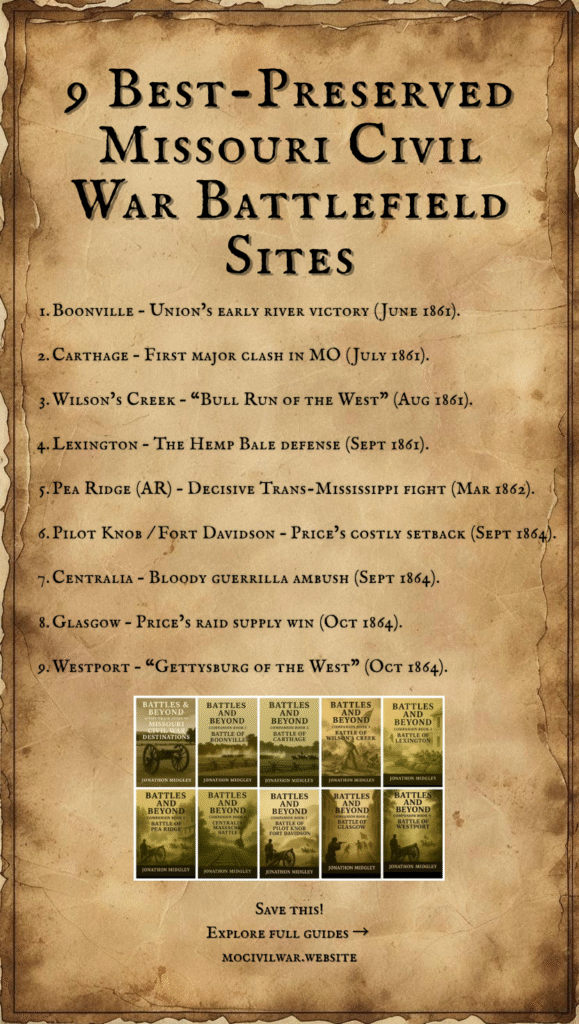
Timeline Of The 9 Best-Preserved Missouri Civil War Battlefield Sites
These are the most well-preserved Civil War battle sites in Missouri — places where you can still walk the fields, visit museums, and experience more than just a roadside marker.