
Series 5: Aftermath & Memory (1865–1900) — Introduction
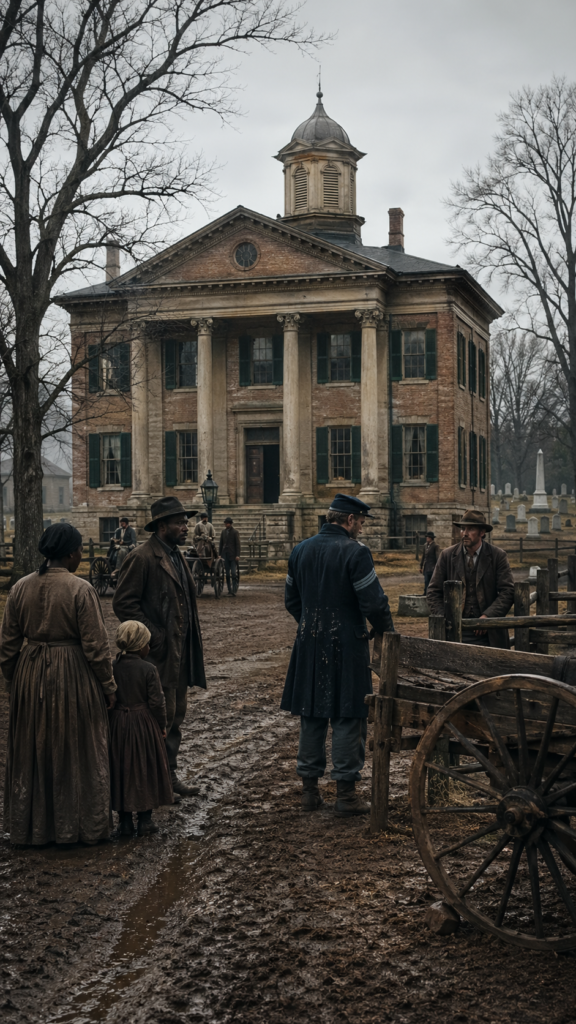
When guns fell silent, Missouri War Aftermath began—broken authority, unsettled loyalties, and a long fight over memory that shaped the next generation.
Table of Contents
Missouri War Aftermath and a State in Pieces
When people say “the war ended,” they often mean the firing stopped.
But Missouri did not experience a clean ending.
Missouri experienced a collapse that slowed down, spread out, and kept reshaping daily life long after armies moved on. That is what this series is about: how a war can end on paper while its effects stay active in courts, elections, neighborhoods, and family stories.
This is the beginning of the Missouri War Aftermath—not as a final scene, but as a new phase with new rules.
Because once the guns fell silent, Missourians still had to answer questions the war had trained them to fear:
Who has authority now?
Who gets protected?
Who gets punished?
And who gets remembered as “right”?
This introduction sets the frame for Series 5: the long transition from violence to governance, from emergency to routine, and from survival to memory.
Missouri War Aftermath Was Not Peace Yet
The end of major fighting did not automatically restore trust.
In many places, the war had changed how people recognized power. During the conflict, power often arrived with uniforms, raids, patrols, and sudden orders. After the conflict, power was supposed to arrive through courts, sheriffs, elections, and written law again.
But the handoff was not instant.
Some communities regained predictable routines quickly. Others stayed tense, divided, and armed—less because the war was still being “fought,” and more because the habits the war created were still in circulation.
This is one of the first truths of Missouri War Aftermath:
Peace is not just the absence of battle.
Peace is the return of predictable rules.
And predictable rules require something the war weakened badly—legitimacy.
Missouri War Aftermath Turned Conflict Into Politics
During the war, Missouri’s conflict was often decided locally—by who controlled a road, a town, a river crossing, or a courthouse.
After the war, the fight shifted into institutions.
The questions became legal and political:
- What does loyalty mean in a state that was divided inside households?
- What rights apply, and to whom, in a society reshaping itself after emancipation and war?
- What happens when old power structures try to return, and new ones try to replace them?
- How do you rebuild public order when the public has learned to treat fear as information?
In Series 5, we treat those questions as the continuation of the story—not a separate topic.
Because in the Missouri War Aftermath, politics is not abstract. It is personal. It determines whether families can rebuild, whether veterans can reintegrate, whether communities can function without coercion, and whether the state can stop living like it is still under emergency conditions.
Missouri War Aftermath Became A Struggle Over Memory
By the late 1800s, Missourians were not only rebuilding towns and governments.
They were rebuilding explanations.
People argued over what the war “meant,” what should be honored, what should be condemned, and what should be forgotten. In some places, memory became a kind of social authority—something that could shape identity, loyalty, and community belonging long after the battlefield was gone.
That is why this series is called Aftermath & Memory.
Because memory is not passive.
Memory selects.
Memory repeats.
Memory teaches new generations what to feel proud of—and what to fear.
And in the Missouri War Aftermath, memory often formed under pressure, not distance.
What To Watch For As You Read Series 5
As we move through 1865 to 1900, keep your eye on three patterns that show up again and again:
- Order returns unevenly
Some areas stabilize faster than others. “After the war” is not one moment statewide. - Law becomes the new battlefield
Instead of raids and battles, the pressure shows up in statutes, elections, court decisions, and enforcement—often uneven, often contested. - The war keeps influencing identity
Veterans, politicians, families, and communities build narratives about the past that shape the future—and those narratives do not always agree.
This is the backbone of Missouri War Aftermath: the war ends, but the war’s structure remains—until society slowly replaces it with something durable.
Looking Ahead
Next Thursday (May 14, 2026), we move into the first rebuilding test—when Missouri tries to turn wartime power back into peacetime government, and ordinary life has to function again under rules that people no longer fully trust.
New articles every Thursday as we dive deeper into the chaos of Missouri’s Civil War and its lasting divisions.
Plan Your Next Missouri Civil War Adventure!
Ready to hit the road?
Plan your Missouri Civil War adventure with trusted travel tips, tools, and resources. Visit our Resource Page (Missouri Civil War Resources) to find everything you need for hotels, flights, car rentals, gear, and more.
Check Out These Missouri Civil War (Overview) Articles
Missouri Civil War: Why This Forgotten Story Matters
Civil War In Missouri: 6 Questions You Should Ask
Bleeding Kansas: Missouri’s Volatile Border War (1854–61)
General Lyon Takes Missouri: 1861’s Breaking Point
Guerrilla Warfare in Missouri: Chaos Explodes (1861–65)
The Cloak and Dagger Side of Missouri’s Civil War
Missouri Women at War: Discover The Unsung Heroes
General Order No. 11 – Missouri’s Burnt District
Price’s Raid (1864): Missouri’s Last Daring Gamble
Check Out These In Depth Articles About The Five Phases Of The Civil War In Missouri
Missouri’s Civil War (1854–1900): Explore The Complete Guide
Series 1: The Fires Before The War – Bleeding Kansas (1854 – 1860)
Bleeding Kansas: The Missouri and Kansas Border Ignites
The Kansas-Nebraska Act – Unleashing Pandora’s Box
Border Ruffians & Free-Staters — The Border Turns Hostile
Bleeding Kansas Massacres — Fire and Vengeance on the Border
Missouri State Militias – How They Rose From Border Chaos
Propaganda — How Words Fueled Missouri’s Civil War
Election of 1860 — Missouri at the Breaking Point
Series 2: From Secession to Pea Ridge (1860 – 1862)
Missouri Civil War Ignites – Secession Tears the State Apart
Missouri Civil War Erupts – The Road to War (1860–1861)
Camp Jackson Affair: The Spark That Ignited Missouri
Battle of Boonville – Jefferson City Falls & Missouri Breaks
Missouri Early Battles: The Clash Before Wilson’s Creek
Missouri’s Split Government – A State Torn in Two
Union Control in Missouri – Pea Ridge Seals the State
Series 3: The Guerrilla Years (1862 – 1864)
Missouri’s Guerrilla War – When Order Collapsed
Missouri Guerrilla War – The Brutal Personal Turn
Savage Border War Retaliation – Osceola to Lawrence
Unmasking the Missouri Shadow War – Guerrilla War Evolves
Brutal Order No. 11 – Missouri’s Burnt District
Hidden Underground Networks – Women in Missouri’s War
Centralia Massacre – Missouri’s Darkest Day
Series 4: Price’s Raid & Missouri’s Last Confederate Gamble (1864–1865) — Introduction
Price’s Raid Begins – Missouri’s Last Confederate Gamble
Price Invades Missouri – The 1864 Raid Begins
Pilot Knob – Battle at Fort Davidson – The Explosive Stand
Price’s Raid Unleashed – Glasgow to Westport
Price’s Retreat – Brutal Run to Newtonia
Missouri Final Days – The War’s Bitter End
Hard-Won Missouri Frontier Peace – The Slow Return
Check Out These Books Published By The Sojourner’s Compass
“Missouri in the Crossfire – The Civil War’s Forgotten Frontier” Series
From the streets of St. Louis to the prairies of southwest Missouri, this compelling short-read series uncovers the untold stories of a divided state at war. Each volume explores a new side of Missouri’s Civil War—its campaigns, commanders, civilians, and the conflicts that shaped its destiny.
Written for both history enthusiasts and casual readers, Missouri in the Crossfire brings the human side of the war to life through vivid storytelling, balanced perspectives, and accessible scholarship—all drawn from Missouri’s own battle-scarred ground.
Available on Amazon & Kindle Unlimited
“Battles & Beyond” – Companion Book Series
From river crossings to ridge fights, Missouri’s Civil War story was one of chaos, courage, and contested loyalties. This travel-ready series delivers concise battlefield guides packed with historical context, walking tips, firsthand quotes, and itinerary tie-ins—perfect for travelers, educators, and armchair historians alike.
Led by Jonathon Midgley, author of The Last Hand series, each volume brings forgotten fights into clear focus—making it easy to explore the war’s impact, one battlefield at a time.
Available On Amazon & Kindle Unlimited
Stay Connected
Follow us for travel inspiration, new articles, and short-form video features:
The Sojourner’s Compass TikTok
The Sojourner’s Compass YouTube
The Sojourner’s Compass Facebook
The Sojourner’s Compass Main Website
Leave a Reply