
Series 5: Aftermath & Memory (1865–1900) — Article 6
Missouri’s Enduring Divide lives in politics, culture, and local memory—how the Civil War’s loyalties still shape identity, blame, and belonging today.
Table of Contents
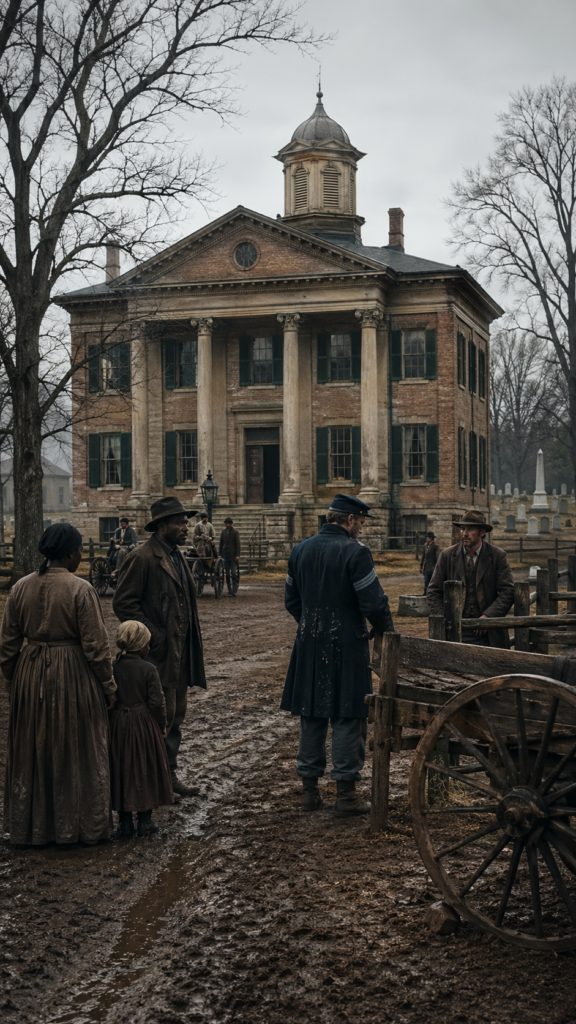
Enduring Divide And Why The War Never Fully Left Missouri
People say the Civil War ended in 1865.
Missouri lived like it ended—and like it didn’t.
Because the war didn’t just damage buildings.
It trained habits.
It trained suspicion.
It trained families to read silence, read rumor, and read which side could punish them.
That training did not disappear when armies marched away.
It carried forward into politics, culture, and community identity.
That is the Enduring Divide.
Not a single argument.
A long pattern.
And Missouri is one of the places where that pattern stayed visible.
Why The Enduring Divide Is Not “Ancient History”
The war in Missouri was never only battlefield-to-battlefield.
It was neighbor-to-neighbor.
County-to-county.
Church-to-church.
Family-to-family.
That kind of conflict does not end cleanly, because it does not have clean borders.
So Missouri’s postwar era did not become a simple rebuilding story.
It became a competing-story era:
- Who was “loyal”?
- Who was “forgiven”?
- Who was “honored”?
- Who was remembered as a citizen—and who was remembered as a problem?
Those questions did not stay in 1865.
They shaped the Enduring Divide that followed.
The Civil War Taught Missouri How To Make Politics Personal
In wartime, power arrives wearing a uniform.
In peacetime, power is supposed to arrive through courts, ballots, and written law.
But Missouri’s war trained people to treat politics like survival.
So after 1865, political fights didn’t feel like policy disputes.
They felt like control disputes.
That is why Missouri’s Enduring Divide shows up in the emotional temperature of arguments:
- fear of losing status
- fear of being punished
- fear of being labeled
- fear that “the wrong people” will define the story
When a state has lived through that kind of pressure, politics rarely feels neutral again.
The Enduring Divide Lives In What Gets Taught And Repeated
The war’s memory did not settle naturally.
It was argued into place.
Through:
- school lessons
- newspaper language
- veteran reunions
- memorial days
- family stories
- local legends
That is how the Enduring Divide becomes durable.
Not because everyone agrees.
Because repetition creates “common sense.”
And once something becomes common sense, it stops sounding like a choice.
It starts sounding like reality.
That’s why memory is never just memory in Missouri.
It becomes identity.
Why Missouri’s Enduring Divide Shows Up In Communities Differently
There is no single Missouri Civil War experience.
Some counties lived under steady Union control.
Some lived under guerrilla pressure.
Some saw conventional battles nearby.
Some saw mostly raids, rumor, and retaliation.
So the Enduring Divide doesn’t look identical from town to town.
One place may remember the war as invasion.
Another may remember it as occupation.
Another may remember it as betrayal by neighbors.
And those differences don’t stay private.
They shape what gets honored publicly.
They shape what gets left unspoken.
They shape who feels like they belong.
What This Means For The Whole Series
Series 5 has been tracking a single truth:
The war ended as an event.
But it continued as a structure.
Reconstruction rebuilt authority, but not trust.
Outlaw legend turned violence into symbol.
Reconciliation turned politics into a struggle over legitimacy.
Monuments turned memory into landscape.
Culture turned memory into habit.
And now we arrive at the result:
The Enduring Divide—the way Missouri carries the Civil War forward through identity, story, and the fight over what the past “means.”
Not because people can’t let go.
But because the war trained systems—social and political—that lasted longer than the shooting.
Thank You For Following Along
If you’ve read through this long series, thank you.
You didn’t just follow battles.
You followed how a war changes a state after the last shot—how it reshapes law, belonging, and memory.
That’s the heart of Missouri’s story: the fighting ended, but the arguments kept moving.
I’m switching to a new article series next, with a fresh focus and a new angle on Missouri history.
If you want to keep walking this road with me, stay close—there’s more to uncover.
Plan Your Next Missouri Civil War Adventure!
Ready to hit the road?
Plan your Missouri Civil War adventure with trusted travel tips, tools, and resources. Visit our Resource Page (Missouri Civil War Resources) to find everything you need for hotels, flights, car rentals, gear, and more.
Check Out These Missouri Civil War (Overview) Articles
Missouri Civil War: Why This Forgotten Story Matters
Civil War In Missouri: 6 Questions You Should Ask
Bleeding Kansas: Missouri’s Volatile Border War (1854–61)
General Lyon Takes Missouri: 1861’s Breaking Point
Guerrilla Warfare in Missouri: Chaos Explodes (1861–65)
The Cloak and Dagger Side of Missouri’s Civil War
Missouri Women at War: Discover The Unsung Heroes
General Order No. 11 – Missouri’s Burnt District
Price’s Raid (1864): Missouri’s Last Daring Gamble
Check Out These In Depth Articles About The Five Phases Of The Civil War In Missouri
Missouri’s Civil War (1854–1900): Explore The Complete Guide
Series 1: The Fires Before The War – Bleeding Kansas (1854 – 1860)
Bleeding Kansas: The Missouri and Kansas Border Ignites
The Kansas-Nebraska Act – Unleashing Pandora’s Box
Border Ruffians & Free-Staters — The Border Turns Hostile
Bleeding Kansas Massacres — Fire and Vengeance on the Border
Missouri State Militias – How They Rose From Border Chaos
Propaganda — How Words Fueled Missouri’s Civil War
Election of 1860 — Missouri at the Breaking Point
Series 2: From Secession to Pea Ridge (1860 – 1862)
Missouri Civil War Ignites – Secession Tears the State Apart
Missouri Civil War Erupts – The Road to War (1860–1861)
Camp Jackson Affair: The Spark That Ignited Missouri
Battle of Boonville – Jefferson City Falls & Missouri Breaks
Missouri Early Battles: The Clash Before Wilson’s Creek
Missouri’s Split Government – A State Torn in Two
Union Control in Missouri – Pea Ridge Seals the State
Series 3: The Guerrilla Years (1862 – 1864)
Missouri’s Guerrilla War – When Order Collapsed
Missouri Guerrilla War – The Brutal Personal Turn
Savage Border War Retaliation – Osceola to Lawrence
Unmasking the Missouri Shadow War – Guerrilla War Evolves
Brutal Order No. 11 – Missouri’s Burnt District
Hidden Underground Networks – Women in Missouri’s War
Centralia Massacre – Missouri’s Darkest Day
Series 4: Price’s Raid & Missouri’s Last Confederate Gamble (1864–1865)
Price’s Raid Begins – Missouri’s Last Confederate Gamble
Price Invades Missouri – The 1864 Raid Begins
Pilot Knob – Battle at Fort Davidson – The Explosive Stand
Price’s Raid Unleashed – Glasgow to Westport
Price’s Retreat – Brutal Run to Newtonia
Missouri Final Days – The War’s Bitter End
Hard-Won Missouri Frontier Peace – The Slow Return
Series 5: Aftermath & Memory (1865 – 1900)
Haunting Missouri War Aftermath – A State in Pieces
Missouri Reconstruction Begins – A Divided State Rebuilds
Jesse James Legacy – How the Outlaw Myth Took Root
Bitter Missouri Reconciliation – How Politics Flipped
Hidden Missouri War Memory – Monuments And Cemeteries
Haunting Folk Memory – How Missouri Remembered the War
Check Out These Books Published By The Sojourner’s Compass
“Missouri in the Crossfire – The Civil War’s Forgotten Frontier” Series
From the streets of St. Louis to the prairies of southwest Missouri, this compelling short-read series uncovers the untold stories of a divided state at war. Each volume explores a new side of Missouri’s Civil War—its campaigns, commanders, civilians, and the conflicts that shaped its destiny.
Written for both history enthusiasts and casual readers, Missouri in the Crossfire brings the human side of the war to life through vivid storytelling, balanced perspectives, and accessible scholarship—all drawn from Missouri’s own battle-scarred ground.
Available on Amazon & Kindle Unlimited
“Battles & Beyond” – Companion Book Series
From river crossings to ridge fights, Missouri’s Civil War story was one of chaos, courage, and contested loyalties. This travel-ready series delivers concise battlefield guides packed with historical context, walking tips, firsthand quotes, and itinerary tie-ins—perfect for travelers, educators, and armchair historians alike.
Led by Jonathon Midgley, author of The Last Hand series, each volume brings forgotten fights into clear focus—making it easy to explore the war’s impact, one battlefield at a time.
Available On Amazon & Kindle Unlimited
Stay Connected
Follow us for travel inspiration, new articles, and short-form video features:
The Sojourner’s Compass TikTok
The Sojourner’s Compass YouTube
The Sojourner’s Compass Facebook
The Sojourner’s Compass Main Website
Leave a Reply