
Series 5: Aftermath & Memory (1865–1900) — Article 1
Missouri Reconstruction begins with torn loyalties, new laws, and hard choices. 1865–1870 shows how peace arrived unevenly—and why.
Table of Contents
Missouri Reconstruction and the Problem of Living Together Again
Missouri Reconstruction did not begin with celebration.
It began with decisions.
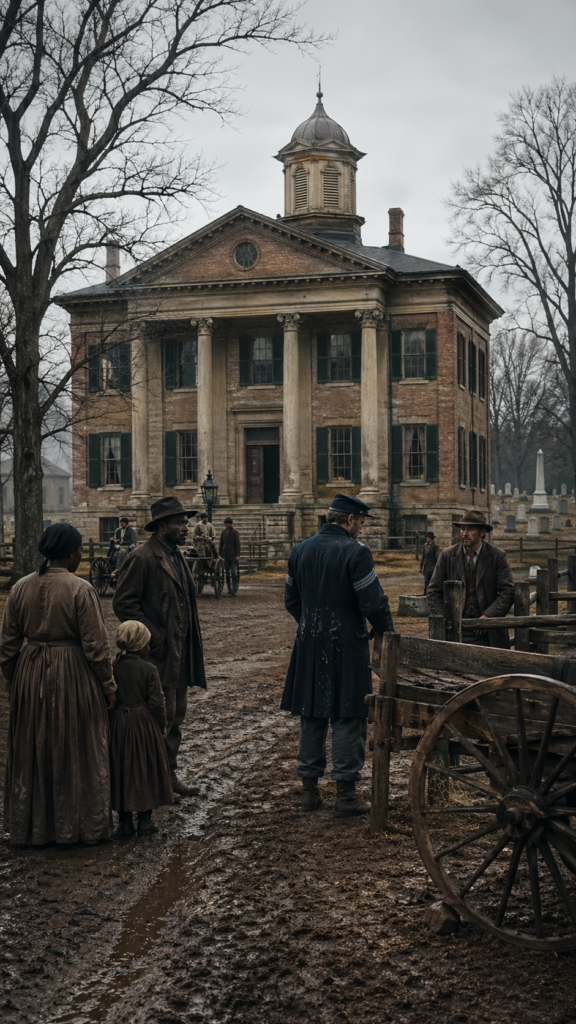
In 1865, the guns were quieter—but the state was not. Missouri Reconstruction opened into a landscape where authority had to be rebuilt, neighbors had to share roads again, and “peace” had to be enforced long before it was trusted.
This is the first stage of Series 5 because it answers a simple question with an uncomfortable truth:
The war could stop, and the conflict could continue—through law, politics, and memory.
Missouri Reconstruction Started With a Vacuum
When the war ended, Missouri Reconstruction ran into a problem that did not exist on paper: who actually had the right to decide what “normal” was now?
During the war, power often arrived wearing a uniform.
After the war, power was supposed to arrive through courts, elections, sheriffs, and written rules.
But Missouri Reconstruction had to work in a state where:
- trust had been trained out of people
- loyalty was still treated like evidence
- violence had been local enough to be personal
- and the “winning side” could look different depending on the county
That is why Missouri Reconstruction feels less like a clean transition and more like a handoff that keeps slipping.
Because the first real battlefield of Missouri Reconstruction wasn’t a ridge line.
It was legitimacy.
Who Counted as Loyal During Missouri Reconstruction
Missouri Reconstruction forced the state to define loyalty in practical terms, not poetic ones.
Not “who said the right words.”
But who could vote.
Who could serve.
Who could hold office.
Who could carry a weapon.
Who could be trusted by law.
And in Missouri Reconstruction, those definitions were not neutral.
They divided households that had already survived the war by refusing to split cleanly.
They divided towns that had learned to keep quiet to stay alive.
They divided families that had lost sons to one side but depended on the other side to keep the county functioning.
Missouri Reconstruction made loyalty something you could lose—sometimes by rumor, sometimes by association, sometimes by old grudges that finally had legal leverage.
That meant “peace” did not arrive as a single moment.
It arrived as pressure.
Missouri Reconstruction and Freedom That Changed Everything
Missouri Reconstruction also unfolded in a society reshaped by emancipation.
Freedom did not simply “add” new citizens to the old order.
It changed the order itself.
Because Missouri Reconstruction had to answer questions the war delayed but could not erase:
- What rights apply now—and who enforces them?
- What happens when an old labor system collapses but old attitudes remain?
- What does protection mean when protection used to depend on who controlled the road?
For newly freed Black Missourians, Missouri Reconstruction meant building life inside an environment that could be legal one day and hostile the next—sometimes in the same town.
For white Missourians, Missouri Reconstruction meant confronting a change they could not vote away forever, even if they could resist it locally.
And that tension fed the central reality of this era:
Missouri Reconstruction wasn’t only rebuilding structures.
It was rebuilding definitions.
Law Became the New Front Line
One of the sharpest shifts in Missouri Reconstruction is that conflict moves indoors.
Into courtrooms.
Into election rules.
Into sheriffs’ offices.
Into paperwork.
That does not make it less intense.
It makes it harder to see—because legal conflict can look calm while it changes people’s lives completely.
In Missouri Reconstruction, “order” becomes something written.
But writing does not automatically produce consent.
So people fight over:
- which laws apply and how strictly
- who gets punished and who gets excused
- what counts as “public safety” versus revenge
- which version of the war becomes the official story
That is why Missouri Reconstruction can feel paradoxical:
The war is “over,” but the stakes remain high.
Because now the weapon is the system.
Why Missouri Reconstruction Felt Unstable in Daily Life
If you lived through guerrilla years, you learned a survival skill Missouri Reconstruction could not erase overnight:
Read the room.
Read the road.
Read the name on the badge.
Read the flags you don’t see.
So even after 1865, daily life in Missouri Reconstruction carried practical questions that sound small until you remember what they meant during the war:
- Is it safe to travel today?
- Who is in town—and why?
- Who is being arrested this week?
- Who is suddenly “welcome” again?
- Who is suddenly “suspect” again?
Missouri Reconstruction required ordinary people to unlearn emergency life.
And unlearning is slow.
Especially when the state itself is still arguing over what peace should look like.
Missouri Reconstruction and the Fight Over Memory Begins Early
This is where Series 5 earns its name.
Because Missouri Reconstruction does not just rebuild roads and courts.
It rebuilds explanations.
People start choosing what the war “meant”:
- Was Missouri a loyal state that suffered invasion and disorder?
- Was Missouri a Southern state held down by force?
- Was Missouri a divided state where survival mattered more than ideology?
- Was Missouri a place where neighbors did what they had to do?
The answers shape politics, monuments, school lessons, and public respectability.
And those choices don’t wait until 1900.
They start immediately—because memory is power.
Missouri Reconstruction is where memory begins to harden into identity.
What This Stage Sets Up for the Rest of Series 5
This article matters because Missouri Reconstruction creates the conditions for everything that comes next:
- veterans trying to fit back into ordinary life
- former fighters becoming public figures—or outlaws
- politics shifting as old coalitions realign
- communities building monuments and arguing over meaning
- families passing down stories that don’t match their neighbors’ stories
In other words: Missouri Reconstruction is not a clean epilogue.
It is the first chapter of what the war became afterward.
And it explains why the Civil War can stop being fought with armies—while still being fought.
Looking Ahead
Next Thursday (May 21, 2026), we move into the next pressure point—when veterans, former guerrillas, and ex-fighters carry the war home with them, and Missouri begins turning battlefield reputations into power, influence, and danger.
New articles every Thursday as we dive deeper into the chaos of Missouri’s Civil War and its lasting divisions.
Plan Your Next Missouri Civil War Adventure!
Ready to hit the road?
Plan your Missouri Civil War adventure with trusted travel tips, tools, and resources. Visit our Resource Page (Missouri Civil War Resources) to find everything you need for hotels, flights, car rentals, gear, and more.
Check Out These Missouri Civil War (Overview) Articles
Missouri Civil War: Why This Forgotten Story Matters
Civil War In Missouri: 6 Questions You Should Ask
Bleeding Kansas: Missouri’s Volatile Border War (1854–61)
General Lyon Takes Missouri: 1861’s Breaking Point
Guerrilla Warfare in Missouri: Chaos Explodes (1861–65)
The Cloak and Dagger Side of Missouri’s Civil War
Missouri Women at War: Discover The Unsung Heroes
General Order No. 11 – Missouri’s Burnt District
Price’s Raid (1864): Missouri’s Last Daring Gamble
Check Out These In Depth Articles About The Five Phases Of The Civil War In Missouri
Missouri’s Civil War (1854–1900): Explore The Complete Guide
Series 1: The Fires Before The War – Bleeding Kansas (1854 – 1860)
Bleeding Kansas: The Missouri and Kansas Border Ignites
The Kansas-Nebraska Act – Unleashing Pandora’s Box
Border Ruffians & Free-Staters — The Border Turns Hostile
Bleeding Kansas Massacres — Fire and Vengeance on the Border
Missouri State Militias – How They Rose From Border Chaos
Propaganda — How Words Fueled Missouri’s Civil War
Election of 1860 — Missouri at the Breaking Point
Series 2: From Secession to Pea Ridge (1860 – 1862)
Missouri Civil War Ignites – Secession Tears the State Apart
Missouri Civil War Erupts – The Road to War (1860–1861)
Camp Jackson Affair: The Spark That Ignited Missouri
Battle of Boonville – Jefferson City Falls & Missouri Breaks
Missouri Early Battles: The Clash Before Wilson’s Creek
Missouri’s Split Government – A State Torn in Two
Union Control in Missouri – Pea Ridge Seals the State
Series 3: The Guerrilla Years (1862 – 1864)
Missouri’s Guerrilla War – When Order Collapsed
Missouri Guerrilla War – The Brutal Personal Turn
Savage Border War Retaliation – Osceola to Lawrence
Unmasking the Missouri Shadow War – Guerrilla War Evolves
Brutal Order No. 11 – Missouri’s Burnt District
Hidden Underground Networks – Women in Missouri’s War
Centralia Massacre – Missouri’s Darkest Day
Series 4: Price’s Raid & Missouri’s Last Confederate Gamble (1864–1865)
Price’s Raid Begins – Missouri’s Last Confederate Gamble
Price Invades Missouri – The 1864 Raid Begins
Pilot Knob – Battle at Fort Davidson – The Explosive Stand
Price’s Raid Unleashed – Glasgow to Westport
Price’s Retreat – Brutal Run to Newtonia
Missouri Final Days – The War’s Bitter End
Hard-Won Missouri Frontier Peace – The Slow Return
Series 5: Aftermath & Memory (1865 – 1900)
Haunting Missouri War Aftermath – A State in Pieces
Check Out These Books Published By The Sojourner’s Compass
“Missouri in the Crossfire – The Civil War’s Forgotten Frontier” Series
From the streets of St. Louis to the prairies of southwest Missouri, this compelling short-read series uncovers the untold stories of a divided state at war. Each volume explores a new side of Missouri’s Civil War—its campaigns, commanders, civilians, and the conflicts that shaped its destiny.
Written for both history enthusiasts and casual readers, Missouri in the Crossfire brings the human side of the war to life through vivid storytelling, balanced perspectives, and accessible scholarship—all drawn from Missouri’s own battle-scarred ground.
Available on Amazon & Kindle Unlimited
“Battles & Beyond” – Companion Book Series
From river crossings to ridge fights, Missouri’s Civil War story was one of chaos, courage, and contested loyalties. This travel-ready series delivers concise battlefield guides packed with historical context, walking tips, firsthand quotes, and itinerary tie-ins—perfect for travelers, educators, and armchair historians alike.
Led by Jonathon Midgley, author of The Last Hand series, each volume brings forgotten fights into clear focus—making it easy to explore the war’s impact, one battlefield at a time.
Available On Amazon & Kindle Unlimited
Stay Connected
Follow us for travel inspiration, new articles, and short-form video features:
The Sojourner’s Compass TikTok
The Sojourner’s Compass YouTube
The Sojourner’s Compass Facebook
The Sojourner’s Compass Main Website
Leave a Reply