
Missouri Civil War Battles — Part 3
Battle of Cole Camp — June 19, 1861: A pre-dawn pro-Southern attack crushed Union Home Guards in Benton County, Missouri.
Table of Contents
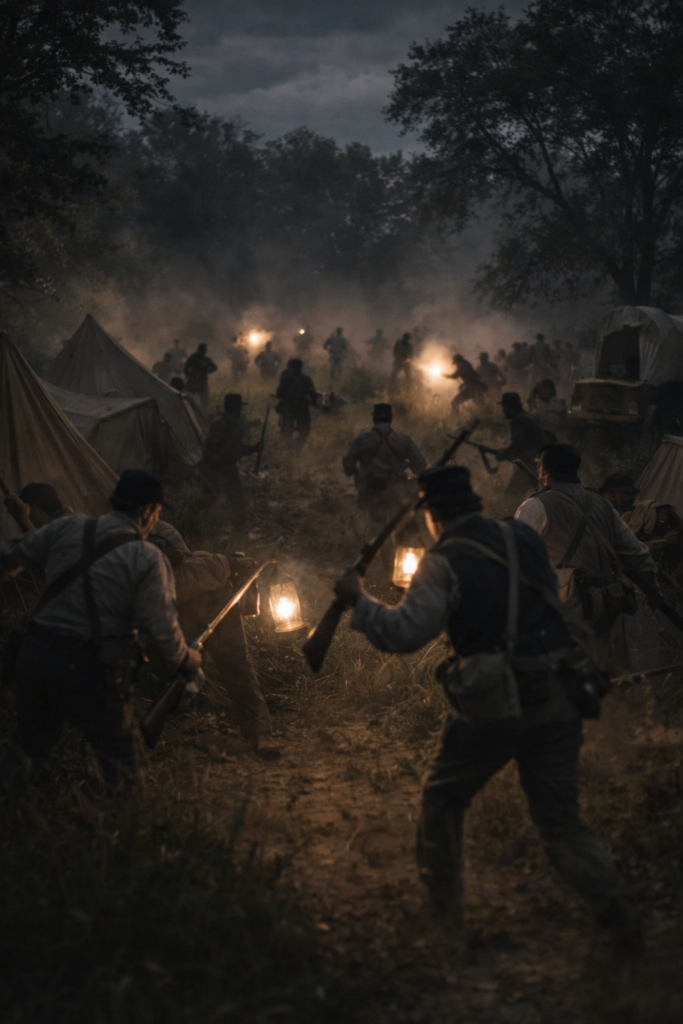
Two days after Boonville, Missouri’s war showed its other face — not a daylight push on a road, but a sudden strike in the dark. Cole Camp (June 19, 1861) was an early warning that this state’s conflict would be as much about surprise, rumor, and neighbor-against-neighbor violence as it was about formal battles.
Battle Snapshot (fast facts)
- Battle: Battle of Cole Camp
- Date: June 19, 1861
- Location: Cole Camp area, central Missouri (Benton County region)
- Type: Battle
- Style of fighting: Unconventional night/pre-dawn surprise attack (surprise assault → close-range chaos → collapse)
Who Was There
- Union / Unionist side:
- Capt. Abel H. W. Cook — commander/organizer of the Benton County Home Guard
- Pro-Southern side:
- Capt. Walter S. O’Kane — commander of the attacking secessionist force from the Warsaw area
- Capt. Thomas W. Murray — associated with the Warsaw “Blues” / supporting pro-Southern force
- Notable units involved:
- Union: Benton County Home Guard, heavily German-American and pro-Union in character
- Pro-Southern: O’Kane’s Battalion / Warsaw-area secessionist militia, mixed mounted and foot elements / Missouri State Guard–aligned force
What Happened (the story)
In June 1861, Missouri didn’t have a clean front line. It had fault lines — political, cultural, and personal — running right through towns and farms. When people picture the Civil War, they often picture big armies. But early Missouri was different: the war arrived before the armies did.
Cole Camp sits in a region where loyalties were sharply divided. That division wasn’t abstract. It shaped who trusted who, who patrolled at night, who slept with a rifle close, and who felt safe enough to believe the worst was still “somewhere else.”
Local Unionist Home Guards formed to protect their communities. These were citizen-soldiers trying to create order in a moment when order was collapsing. They were often short on supplies, short on training, and long on responsibility. They had to guard roads, watch suspicious movement, and prevent their county from being pulled into open rebellion by force.
But the pro-Southern side had its own advantage: initiative and familiarity. They could decide when and where to strike. They could use darkness, confusion, and the psychological shock of a sudden attack to turn a “defensive camp” into a trap.
On the night of June 19, that’s exactly what happened.
A pro-Southern force launched a surprise assault on the Home Guards at or near Cole Camp. This wasn’t a slow build-up with lines forming at dawn. It was an impact — abrupt, close, and disorienting. Night fighting is messy even for trained soldiers. For militia, it can be devastating.
In the dark, it’s hard to tell how many attackers there are. It’s hard to keep a line. It’s hard to relay orders. Fear spreads faster than clarity. A camp that feels “secure” in daylight can become a maze at midnight — shadows, shouts, gun flashes, and people running toward the wrong sound.
The Home Guard force was overwhelmed. Whatever defensive plan existed was swallowed by surprise and confusion. The result was a sharp defeat — the kind that doesn’t just cost men and equipment, but shatters confidence. For the winners, it proved they could strike hard. For Unionists, it proved a terrible truth: being “in control” on paper meant nothing if the other side could hit you when you least expected it.
Cole Camp wasn’t just a battle. It was a message — and Missouri received it loudly.
Who Won + What That Means
- Result: Pro-Southern victory
- Type of victory: Tactical win with deep psychological impact
Tactically, the Home Guards were crushed and scattered. But the bigger effect was psychological and political: it showed that Unionist communities could be attacked suddenly and successfully before larger federal structures could stabilize the region.
That kind of victory feeds recruitment and momentum. It also feeds retaliation. In Missouri, those cycles—raid, reprisal, counter-raid—became a defining pattern.
Why It Matters
Cole Camp matters because it shows, very early, what kind of war Missouri was headed toward:
- Unconventional pressure: ambushes, night attacks, and surprise raids—especially in contested counties.
- Local intelligence as a weapon: people who know the roads, the farms, the crossings, and the rhythms of a town can outmaneuver stronger forces.
- Escalation: defeats like this don’t “end” a problem; they inflame it. Communities arm harder, suspicion deepens, and the line between “soldier” and “neighbor” blurs.
If Boonville is about controlling the river corridor, Cole Camp is about controlling fear. And fear, in a civil war, can move faster than any army.
Next Up In This Timeline
July 5, 1861 — the Battle of Carthage, where the conflict expands into a larger running fight across town and open ground.
When you think of Missouri’s Civil War, what feels more dangerous — a big battlefield… or a sudden midnight attack where you can’t even see who’s coming?
Plan Your Next Missouri Civil War Adventure!
Ready to hit the road?
Plan your Missouri Civil War adventure with trusted travel tips, tools, and resources. Visit our Resource Page (Missouri Civil War Resources) to find everything you need for hotels, flights, car rentals, gear, and more.
Check Out Our Other Missouri Civil War Articles
Missouri Civil War Overview Articles
The Five Phases of Missouri’s Civil War
Missouri Civil War Battles (In Chronological Order)
Camp Jackson Affair — May 10, 1861
Battle of Boonville — June 17, 1861
Check Out These Books Published By The Sojourner’s Compass
“Missouri in the Crossfire – The Civil War’s Forgotten Frontier” Series
From the streets of St. Louis to the prairies of southwest Missouri, this compelling short-read series uncovers the untold stories of a divided state at war. Each volume explores a new side of Missouri’s Civil War—its campaigns, commanders, civilians, and the conflicts that shaped its destiny.
Written for both history enthusiasts and casual readers, Missouri in the Crossfire brings the human side of the war to life through vivid storytelling, balanced perspectives, and accessible scholarship—all drawn from Missouri’s own battle-scarred ground.
Available on Amazon & Kindle Unlimited
“Battles & Beyond” – Companion Book Series
From river crossings to ridge fights, Missouri’s Civil War story was one of chaos, courage, and contested loyalties. This travel-ready series delivers concise battlefield guides packed with historical context, walking tips, firsthand quotes, and itinerary tie-ins—perfect for travelers, educators, and armchair historians alike.
Led by Jonathon Midgley, author of The Last Hand series, each volume brings forgotten fights into clear focus—making it easy to explore the war’s impact, one battlefield at a time.
Available On Amazon & Kindle Unlimited
Stay Connected
Follow us for travel inspiration, new articles, and short-form video features:
The Sojourner’s Compass TikTok
The Sojourner’s Compass YouTube
The Sojourner’s Compass Facebook
The Sojourner’s Compass Main Website
Leave a Reply