
Missouri Civil War Battles — Part 5
Battle of Dug Springs — August 2, 1861: A sharp skirmish near Clever, MO tested Lyon’s army before Wilson’s Creek.
Table of Contents
Eight days before Wilson’s Creek, the war around Springfield got tested — not in a grand set-piece battle, but in a sharp collision on the Old Wire Road. Dug Springs (Aug. 2, 1861) confirmed for Lyon that the southern concentration was real… and the moment Price’s growing force learned the Federals would come out and meet them.
Battle Snapshot (fast facts)
- Battle: Battle of Dug Springs
- Date: August 2, 1861
- Location: Near Clever, Missouri (Christian County), southwest of Springfield
- Type: Battle / Skirmish-scale engagement
- Style of fighting: Meeting engagement / skirmish with cavalry charge and artillery support
Who Was There
- Union commanders (overall context):
- Brig. Gen. Nathaniel Lyon (overall Union commander of the movement from Springfield)
- Union leaders actively engaged on the field:
- Capt. Frederick Steele (infantry advance)
- Capt. David S. Stanley (cavalry)
- Capt. James Totten / Lt. John Lathrop (artillery elements)
- Missouri State Guard / Confederate-aligned commanders:
- Brig. Gen. James S. Rains (Missouri State Guard)
- Capt. Americus V. Reiff (Confederate/Arkansas support element)
- Notable forces involved:
- Union: selected companies of infantry, cavalry, and artillery from Lyon’s force
- Southern side: Missouri State Guard advance elements with Confederate/Arkansas support attached
What Happened (the story)
By late July 1861, Springfield had become a pressure cooker. Lyon was sitting in town with a Union army that was short on supplies and cut off from easy reinforcement. To the southwest, Sterling Price’s Missouri State Guard was coordinating with Confederate forces under Ben McCulloch and Arkansas troops under Nicholas Pearce — a combination that threatened to crush Lyon if it moved as one.
Lyon had a choice: sit tight and wait to be attacked… or move first and learn what was actually coming.
So on August 2, Lyon pushed out from Springfield. The contact at Dug Springs unfolded like a classic meeting engagement: scouts and pickets collide, the sound of shots pulls in heavier elements, and suddenly what looked like “just skirmishers” becomes a serious fight. Union advance companies ran into southern pickets and forward elements near the springs and along the Wire Road.
The southern side had arranged an advanced screen under Brigadier General James S. Rains, and as the Federals pressed forward, the fight thickened. What makes Dug Springs memorable isn’t just that bullets flew — it’s the way the engagement revealed the shape of the coming storm. This wasn’t a handful of scattered Missourians. There were organized troops close enough to respond, reinforce, and try to trap an aggressive advance.
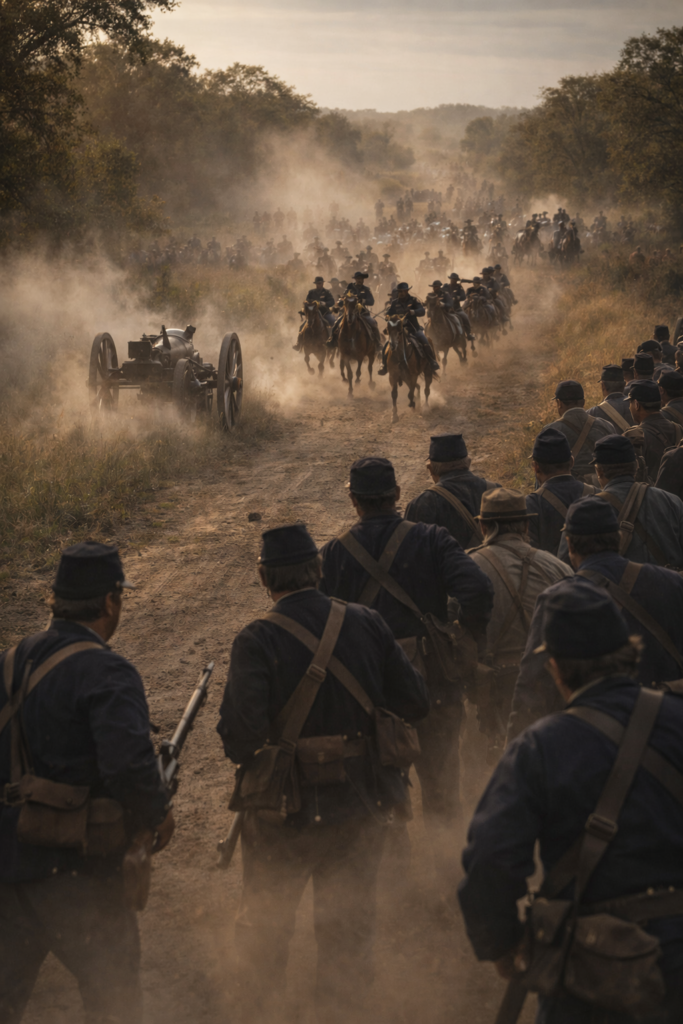
As the battle developed, Union forces found themselves trading fire with a growing enemy presence. Then came one of the most dramatic moments of the day: a Union cavalry charge that hit hard enough to puncture the southern line at a key point. In early-war fighting, a well-timed cavalry strike could do more than cause casualties — it could break momentum, scatter units, and create confusion that spread faster than orders could fix it.
Artillery mattered too. When guns speak in a tight fight like this, the psychological weight can be as important as the physical damage. Fire and smoke on a road, in brushy ground, with men unsure how large the opposing force really is — that’s exactly how a “scare” becomes real. Rains’ men and Reiff’s supporting Arkansas element were forced back, and the Federals held the field.
But Dug Springs wasn’t a clean “win and pursue” kind of day. Lyon had moved out to probe, to hit, and to measure what was in front of him — and what he learned was sobering. The southern concentration wasn’t a rumor. It was building toward something decisive.
Dug Springs ended with Lyon drawing back toward Springfield — not because the fight beat him, but because the larger reality did. He was operating deep, low on supplies, facing a growing enemy coalition. The engagement confirmed what everyone around Springfield was about to learn the hard way:
the campaign was headed toward a major battle.
Who Won + What That Means
- Result: Union victory (field held; southern advance checked)
- Type of victory: Tactical win, strategic warning
On paper, Dug Springs is a Union success — the southern force is driven off, and the Federals prove they can stand and strike. But strategically, the battle functions like a warning light. Lyon learns he’s facing a large, coordinated enemy nearby. The southern side learns the Federals won’t sit passively in Springfield. Both sides come out of Dug Springs more certain that the next clash won’t be small.
Why It Matters
Dug Springs matters because it sits right on the hinge between “early campaign maneuvering” and “major battle.”
- It’s the first serious collision in the Springfield build-up — a real test of nerves and coordination.
- It previews Wilson’s Creek: the same geography, the same road networks, and the same looming question of who controls southwest Missouri.
- And it shows Missouri’s pattern: roads and crossings create battles as much as generals do.
If you’re trying to understand why Wilson’s Creek happened when it did, Dug Springs is one of the clearest answers: it was the moment both sides confirmed the other was close — and willing.
Next Up In This Timeline
August 5, 1861 — the Battle of Athens, a hard defensive fight on Missouri’s northeast border where Union Home Guards hold their ground and repel a secessionist attack.
Have you visited any of the Wilson’s Creek campaign sites — and if you could only pick one stop for a first-timer, which would you choose?
Side note (for visitors — the marker location)
I get asked about this one a lot: the Battle of Dug Springs historical marker is located at the intersection of Old Wire Road and South Walnut Avenue in Clever, Missouri (Christian County), near the ballfields by Clever Elementary/Middle School.
GPS (approx.): 37°07.689′ N, 93°28.556′ W.
Plan Your Next Missouri Civil War Adventure!
Ready to hit the road?
Plan your Missouri Civil War adventure with trusted travel tips, tools, and resources. Visit our Resource Page (Missouri Civil War Resources) to find everything you need for hotels, flights, car rentals, gear, and more.
Check Out Our Other Missouri Civil War Articles
Missouri Civil War Overview Articles
The Five Phases of Missouri’s Civil War
Missouri Civil War Battles (In Chronological Order)
Camp Jackson Affair — May 10, 1861
Battle of Boonville — June 17, 1861
Battle of Cole Camp — June 19, 1861
Battle of Carthage — July 5, 1861
Check Out These Books Published By The Sojourner’s Compass
“Missouri in the Crossfire – The Civil War’s Forgotten Frontier” Series
From the streets of St. Louis to the prairies of southwest Missouri, this compelling short-read series uncovers the untold stories of a divided state at war. Each volume explores a new side of Missouri’s Civil War—its campaigns, commanders, civilians, and the conflicts that shaped its destiny.
Written for both history enthusiasts and casual readers, Missouri in the Crossfire brings the human side of the war to life through vivid storytelling, balanced perspectives, and accessible scholarship—all drawn from Missouri’s own battle-scarred ground.
Available on Amazon & Kindle Unlimited
“Battles & Beyond” – Companion Book Series
From river crossings to ridge fights, Missouri’s Civil War story was one of chaos, courage, and contested loyalties. This travel-ready series delivers concise battlefield guides packed with historical context, walking tips, firsthand quotes, and itinerary tie-ins—perfect for travelers, educators, and armchair historians alike.
Led by Jonathon Midgley, author of The Last Hand series, each volume brings forgotten fights into clear focus—making it easy to explore the war’s impact, one battlefield at a time.
Available On Amazon & Kindle Unlimited
Stay Connected
Follow us for travel inspiration, new articles, and short-form video features:
The Sojourner’s Compass TikTok
The Sojourner’s Compass YouTube
The Sojourner’s Compass Facebook
The Sojourner’s Compass Main Website
Leave a Reply