
Missouri Civil War Battles — Part 6
Battle of Athens — August 5, 1861: David Moore’s Home Guards repelled Martin Green’s pro-Southern force in northeast Missouri.
Table of Contents
Most people think Missouri’s Civil War story starts and ends in the southwest — but Athens proved the border counties were just as combustible. On August 5, 1861, a small town on Missouri’s northeast edge became a defensive battleground where Home Guards held off a secessionist force and showed just how fractured this state really was.
Battle Snapshot (fast facts)
- Battle: Battle of Athens
- Date: August 5, 1861
- Location: Athens, Missouri (Clark County), near the Des Moines River and Iowa border
- Type: Battle
- Style of fighting: Defensive fight (prepared positions, close-range firefights, repulse of attackers)
Who Was There
- Union / Unionist commander:
– Col. David Moore — commander of the 1st Northeast Missouri Home Guard
- Pro-Southern commander:
– Col. Martin E. Green — commander of the Missouri State Guard force attacking Athens
- Notable forces involved:
– Union: 1st Northeast Missouri Home Guard / local Unionist Home Guards defending the town
– Pro-Southern: Missouri State Guard / secessionist militia force, including artillery
What Happened (the story)
By early August 1861, Missouri’s war wasn’t confined to one corner of the state. While Lyon and Price maneuvered near Springfield, the northeast border country was its own world—river towns, tight communities, and loyalties that could change from one farm to the next. That made places like Athens vulnerable. You weren’t just defending a town. You were defending a region’s confidence.
Athens had Unionist defenders—Home Guards—whose job was simple to describe and hard to do: keep the peace in a place where peace was disappearing. They were not a professional army. They were men who knew the roads, the neighbors, and the stakes. They also understood something early-war militia learned fast: if you get caught in the open, you don’t get a second chance.
A pro-secession force moved against Athens to break that Unionist foothold. The attackers expected a quick win—hit hard, scare the defenders off, and take control of the town and its supplies. Instead, they ran into a defense that was ready.
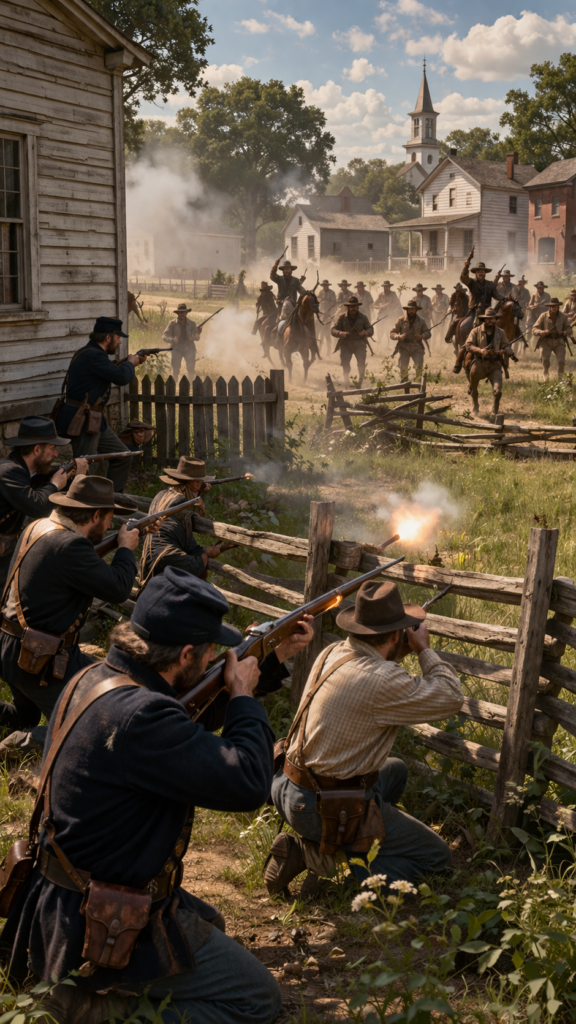
Green’s men also brought artillery, making the attack feel even larger and more dangerous to Moore’s outnumbered defenders. The fighting centered on a classic defensive problem: attackers must cross open space and close distance; defenders must hold steady long enough to make that approach costly. Home Guards used cover—buildings, fences, and anything that turned the town into an obstacle course. In a small-town fight, angles matter. Sight lines matter. A few defenders in the right places can make an attacking force feel surrounded.
The attack came with pressure from multiple directions rather than one neat line. Shots echoed off structures. Smoke hung low. Men fired from windows, corners, and behind fence rails. The defenders’ advantage wasn’t just position—it was purpose. They weren’t trying to “take ground.” They were trying to deny it.
As the attack stalled, the momentum shifted. What begins as an assault can quickly become a withdrawal when attackers realize the defenders aren’t breaking. Athens turned into that kind of fight. The secessionist force was repelled, forced to pull back rather than seize the town.
Athens didn’t make national headlines like Wilson’s Creek. But for the people living along Missouri’s northeast edge, it mattered just as much. It proved that local defense forces could stand, and it proved that Missouri’s war was never going to be neatly boxed into one theater.
Who Won + What That Means
- Result: Union / Unionist Home Guard victory
- Type of victory: Tactical defensive victory with local strategic impact
Athens was a defensive win. The Home Guards held the town and denied the attackers the psychological prize of an easy victory. In a civil war environment, that kind of result matters. It discourages recruitment for the losing side, strengthens Unionist confidence, and shows nearby communities that “holding on” is possible.
Why It Matters
Athens matters because it highlights the part of Missouri’s Civil War that doesn’t fit the big-battle stereotype:
- Border war reality: small towns and counties could become targets based on loyalty and location.
- Local forces: militia and Home Guards often decided outcomes before larger armies could even arrive.
- A divided state: while Springfield and the southwest drew the headlines, the northeast border counties were fighting their own war—fast, personal, and close to home.
Athens also reminds us that control in Missouri wasn’t just about rivers and rail lines. It was about whether communities could defend themselves long enough to stay on the map.
Next Up In This Timeline
August 10, 1861 — the Battle of Wilson’s Creek, the full-scale clash near Springfield where Lyon is killed and the Confederate/Missouri State Guard side wins a tactical victory that shocks the nation.
When you visit Missouri Civil War sites, do you prefer the famous battlefields—or the smaller places like Athens where the war feels closer and more personal?
Plan Your Next Missouri Civil War Adventure!
Ready to hit the road?
Plan your Missouri Civil War adventure with trusted travel tips, tools, and resources. Visit our Resource Page (Missouri Civil War Resources) to find everything you need for hotels, flights, car rentals, gear, and more.
Check Out Our Other Missouri Civil War Articles
Missouri Civil War Overview Articles
The Five Phases of Missouri’s Civil War
Missouri Civil War Battles (In Chronological Order)
Camp Jackson Affair — May 10, 1861
Battle of Boonville — June 17, 1861
Battle of Cole Camp — June 19, 1861
Battle of Carthage — July 5, 1861
Battle of Dug Springs — August 2, 1861
Check Out These Books Published By The Sojourner’s Compass
“Missouri in the Crossfire – The Civil War’s Forgotten Frontier” Series
From the streets of St. Louis to the prairies of southwest Missouri, this compelling short-read series uncovers the untold stories of a divided state at war. Each volume explores a new side of Missouri’s Civil War—its campaigns, commanders, civilians, and the conflicts that shaped its destiny.
Written for both history enthusiasts and casual readers, Missouri in the Crossfire brings the human side of the war to life through vivid storytelling, balanced perspectives, and accessible scholarship—all drawn from Missouri’s own battle-scarred ground.
Available on Amazon & Kindle Unlimited
“Battles & Beyond” – Companion Book Series
From river crossings to ridge fights, Missouri’s Civil War story was one of chaos, courage, and contested loyalties. This travel-ready series delivers concise battlefield guides packed with historical context, walking tips, firsthand quotes, and itinerary tie-ins—perfect for travelers, educators, and armchair historians alike.
Led by Jonathon Midgley, author of The Last Hand series, each volume brings forgotten fights into clear focus—making it easy to explore the war’s impact, one battlefield at a time.
Available On Amazon & Kindle Unlimited
Stay Connected
Follow us for travel inspiration, new articles, and short-form video features:
The Sojourner’s Compass TikTok
The Sojourner’s Compass YouTube
The Sojourner’s Compass Facebook
The Sojourner’s Compass Main Website
Leave a Reply