
Missouri Civil War Battles — Part 8
Battle of Blue Mills Landing — September 17, 1861: Missouri State Guard ambushes Union troops near Liberty, opening the way to reinforce Price at Lexington.
Table of Contents
Blue Mills Landing is the kind of Missouri fight people don’t expect — not a grand battlefield, but a river-bottom trap where the landscape does the killing for you. On September 17, 1861, a small Union force marched out to stop reinforcements…and walked straight into an ambush near Liberty.
Battle Snapshot (fast facts)
- Battle: Blue Mills Landing (often called the Battle of Liberty)
- Date: September 17, 1861
- Location: Near Liberty, Missouri — Missouri River bottomlands near Blue Mills Landing
- Type: Battle/ River Crossing Engagement
- Style of fighting: Ambush in river-bottom terrain (brush, narrow road approach, close-range crossfire)
Who Was There
- Union commander:
- Lt. Col. John Scott (leading a small column toward Liberty)
- Missouri State Guard / pro-Southern commander:
- Brig. Gen. David R. Atchison (Missouri State Guard)
- Colonel Caleb Dorsey (Missouri State Guard)
- Notable forces involved:
- Union: about 600 men—primarily the 3rd Iowa Infantry with Missouri Home Guard, plus one small field piece
- Missouri State Guard: approximately 3,000 Missouri State Guard troops assembled to reinforce Price
What Happened (the story)
After Wilson’s Creek, Sterling Price’s Missouri State Guard gained momentum and moved north and west in ways that made Union commanders nervous. One of the biggest dangers wasn’t just where Price’s main force stood — it was what could happen if fresh recruits and State Guard units from northwestern Missouri slipped across the Missouri River and poured into his army.
That’s where Blue Mills Landing comes in.
North of the river, pro-Southern State Guard forces were gathering. Their goal was straightforward: cross near Blue Mills Landing and march to reinforce Price—who was already tightening the pressure around Lexington. If those men got through, they wouldn’t just add numbers. They’d add confidence and political weight at the exact moment Missouri’s direction still felt undecided.
Union leaders tried to prevent that by moving quickly. Lieutenant Colonel John Scott advanced toward Liberty with a small force—mostly the 3rd Iowa and local Home Guard—pushing through difficult roads and heavy weather. By the time Scott reached Liberty early on the 17th, the situation was already slipping. Southern troops had already crossed the river or were completing the crossing at Blue Mills Landing.
Scott sent scouts ahead toward the river bottoms to find the enemy and confirm what was happening. That decision makes sense on paper. In practice, it was the first step into a nightmare.
The Missouri River bottomland terrain near Blue Mills Landing is not friendly ground for a marching column. It’s low, brushy, and cut by narrow routes where a force can be channeled into a kill zone. Atchison’s men were positioned to use exactly that advantage. Scott’s scouts rode into trouble, and the warning came back fast: the enemy wasn’t just “nearby.” They were set.
Even with the risk, Scott marched toward the landing. He was outnumbered badly, but he also understood what letting those reinforcements cross would mean. The closer his men got to the river bottom road leading to the landing, the more the trap tightened.
Then the ambush snapped shut.
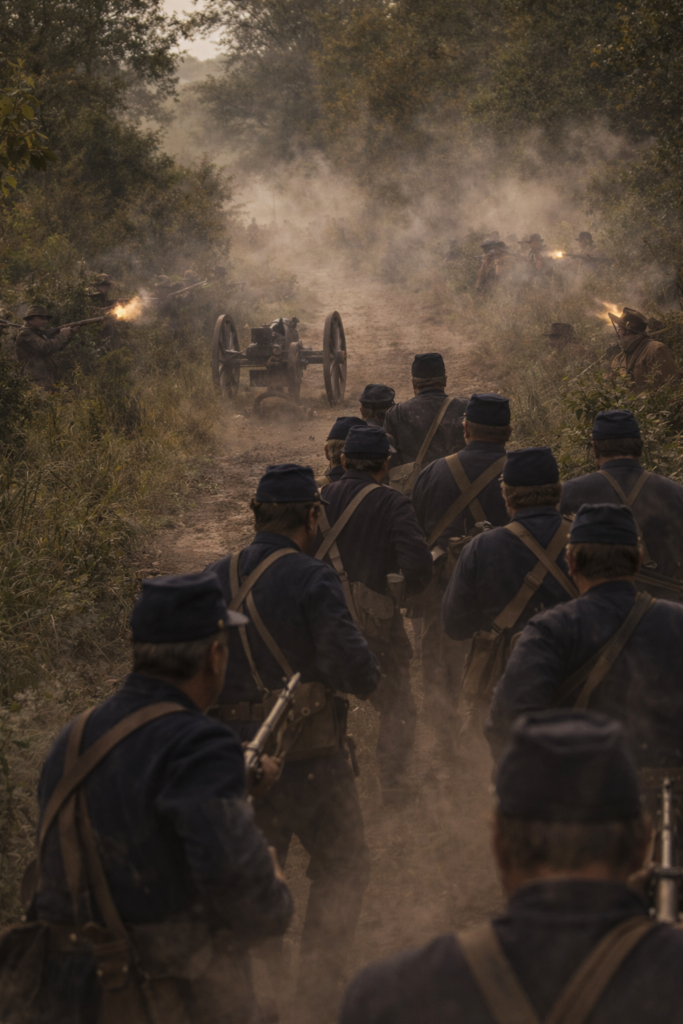
Atchison’s State Guard troops were hidden in brush on both sides of the approach. When Scott’s column entered the danger area, they were hit with fire from multiple directions. In an ambush like that, the first seconds matter most: you can’t see the full line, you can’t easily flank it, and the terrain makes “orderly retreat” harder than anyone wants to admit.
Scott’s men fought. They brought their small gun into action and fired into the brush, trying to break the ambush long enough to withdraw. But the State Guard pressure was too heavy and too well-positioned. The Union gunners were quickly targeted, and Scott faced the decision every commander dreads: keep pushing forward into a widening crossfire… or pull back before the force is destroyed.
He chose to withdraw.
Even that retreat was dangerous. Falling back through river-bottom ground under fire can turn into panic fast. Scott’s men had to haul equipment and wounded, maintain a rear guard, and resist the pull to simply run. They managed to get back toward Liberty—bloodied, shaken, and very aware they’d just survived something that could have become a complete disaster.
The fight itself was short by “big battle” standards—around an hour—but its effect was lasting. Blue Mills Landing wasn’t about holding a ridge. It was about what happens when a smaller force tries to stop a major movement in the wrong terrain at the wrong time.
Who Won + What That Means
- Result: Missouri State Guard victory
- Type of victory: Tactical victory with major strategic consequence
Tactically, Atchison’s force repelled Scott and held the landing approach. Strategically, the outcome mattered even more: the river crossing continued, and the northern Missouri State Guard reinforcements were able to move toward Lexington—exactly what the Union was trying to prevent.
Why It Matters
Blue Mills Landing matters because it’s a perfect Missouri lesson:
- Terrain is a weapon. River bottoms and brush can defeat a force even before numbers do.
- Missouri’s war is about movement. This fight was driven by reinforcements and crossings, not a desire to “take a city.”
- Lexington was the objective. The whole point of this clash was stopping men from joining Price—and Blue Mills Landing shows why Price could press harder at Lexington days later.
If you’ve ever wondered why so many Missouri engagements feel like ambushes, raids, and sudden traps, Blue Mills Landing is a textbook early example.
Next Up In This Timeline
September 13–20, 1861 — the First Battle of Lexington, a siege-like fight remembered for Price’s famous hemp bale assault and a major Confederate/Missouri State Guard victory.
When you visit Civil War sites, do you prefer big battlefields—or “trap terrain” places like Blue Mills Landing where the land itself tells the story?
Plan Your Next Missouri Civil War Adventure!
Ready to hit the road?
Plan your Missouri Civil War adventure with trusted travel tips, tools, and resources. Visit our Resource Page (Missouri Civil War Resources) to find everything you need for hotels, flights, car rentals, gear, and more.
Check Out Our Other Missouri Civil War Articles
Missouri Civil War Overview Articles
The Five Phases of Missouri’s Civil War
Missouri Civil War Battles (In Chronological Order)
Camp Jackson Affair — May 10, 1861
Battle of Boonville — June 17, 1861
Battle of Cole Camp — June 19, 1861
Battle of Carthage — July 5, 1861
Battle of Dug Springs — August 2, 1861
Battle of Athens — August 5, 1861
Battle of Wilson’s Creek (“Oak Hills”) — August 10, 1861
Check Out These Books Published By The Sojourner’s Compass
“Missouri in the Crossfire – The Civil War’s Forgotten Frontier” Series
From the streets of St. Louis to the prairies of southwest Missouri, this compelling short-read series uncovers the untold stories of a divided state at war. Each volume explores a new side of Missouri’s Civil War—its campaigns, commanders, civilians, and the conflicts that shaped its destiny.
Written for both history enthusiasts and casual readers, Missouri in the Crossfire brings the human side of the war to life through vivid storytelling, balanced perspectives, and accessible scholarship—all drawn from Missouri’s own battle-scarred ground.
Available on Amazon & Kindle Unlimited
“Battles & Beyond” – Companion Book Series
From river crossings to ridge fights, Missouri’s Civil War story was one of chaos, courage, and contested loyalties. This travel-ready series delivers concise battlefield guides packed with historical context, walking tips, firsthand quotes, and itinerary tie-ins—perfect for travelers, educators, and armchair historians alike.
Led by Jonathon Midgley, author of The Last Hand series, each volume brings forgotten fights into clear focus—making it easy to explore the war’s impact, one battlefield at a time.
Available On Amazon & Kindle Unlimited
Stay Connected
Follow us for travel inspiration, new articles, and short-form video features:
The Sojourner’s Compass TikTok
The Sojourner’s Compass YouTube
The Sojourner’s Compass Facebook
The Sojourner’s Compass Main Website
Leave a Reply