
Missouri Civil War Battles — Part 7
Battle of Wilson’s Creek — August 10, 1861: A major Confederate and Missouri State Guard victory near Springfield that claimed Gen. Nathaniel Lyon.
Table of Contents
Wilson’s Creek is the moment Missouri’s war stops feeling like scattered clashes and starts feeling like a full-scale collision. On August 10, 1861, just outside Springfield, a brutal pitched battle kills Nathaniel Lyon and proves that control of Missouri would not be decided quickly—or cleanly.
Battle Snapshot (fast facts)
- Battle: Battle of Wilson’s Creek (Battle of Oak Hills)
- Date: August 10, 1861
- Location: Near Springfield, Missouri (southwest Missouri)
- Type: Battle
- Style of fighting: Pitched battle (organized attacks, strong defensive stands, repeated assaults)
Who Was There
- Union commanders:
- Brig. Gen. Nathaniel Lyon
- Col. Franz Sigel
- Confederate / Missouri State Guard commanders:
- Brig. Gen. Ben McCulloch (Confederate)
- Maj. Gen. Sterling Price (Missouri State Guard)
- Brig. Gen. N. Bart Pearce (Arkansas State Troops in the combined force)
- Notable forces involved:
- Union: Lyon’s Army of the West elements (infantry, cavalry detachments, artillery batteries)
- Opposing force: Confederate Army Units, Missouri State Guard, and Arkansas State Troops (operating as a combined army near Springfield)
What Happened (the story)
By early August 1861, Springfield had become a pressure point that couldn’t hold forever. Lyon’s Union force was short on supplies, far from secure lines, and facing a combined Southern army made up of McCulloch’s Confederates, Price’s Missouri State Guard, and Arkansas troops. Lyon understood what that meant: if he waited, he risked being surrounded and destroyed.
So he gambled on what desperate commanders often gamble on—a surprise attack.
Before dawn on August 10, Lyon moved against the enemy camp along Wilson’s Creek. His plan depended on speed, confusion, and dividing the enemy’s attention. Sigel was positioned to strike from another direction, adding pressure and threatening the enemy’s rear. If it worked, it could shatter the camp and change the entire campaign around Springfield.
The morning delivered chaos first—then clarity.
Lyon’s men hit hard in the dark and early light, driving into the southern camp area and forcing the fight up onto higher ground. What followed was not one clean push, but a series of savage exchanges. Lines formed, broke, re-formed, and fought again. Units advanced into smoke, recoiled, and advanced again. In places, the battle became a grinding contest of who could hold a ridge, a slope, a fence line—who could keep their nerve while lead and noise chewed through the air.
The battle’s heart became a fiercely contested high point that soldiers later remembered as “Bloody Hill.” That name tells you everything about the tone of the day. This was close-range, sustained fighting—infantry volleys, artillery blasts, and repeated assaults that turned the landscape into a pressure chamber.
Sigel’s wing initially created real danger for the southern force—enough to inject panic and confusion. But in early-war battles, confusion is a weapon that cuts both ways. Misidentification, shifting uniforms, smoke, and hurried movement could flip an advantage into a collapse. Believing Confederate troops approaching his position were friendly Union reinforcements, Sigel delayed opening fire until it was too late. His position was quickly overwhelmed, removing the second hammer Lyon needed.
Lyon, meanwhile, stayed at the center of the storm. His presence mattered—he was not a commander watching from a safe distance. He was visible, active, and repeatedly in harm’s way. That kind of leadership can hold a line together… and it can also cost you everything.
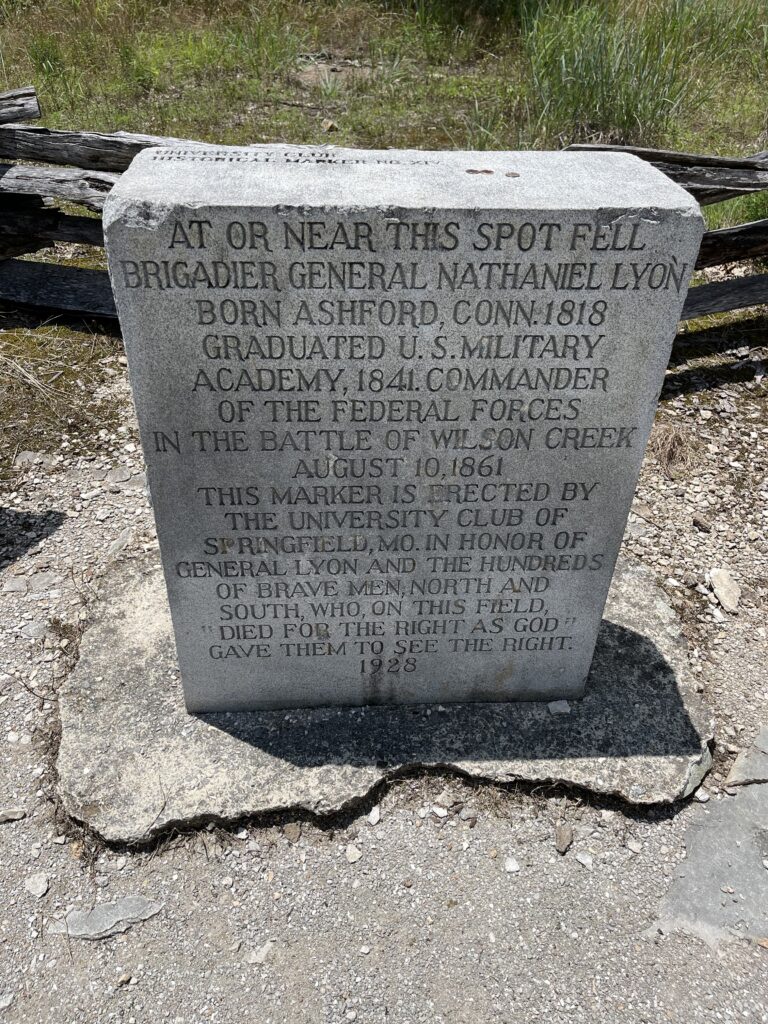
Around mid-morning, Lyon was struck and killed while rallying his men. His death was a shock to the Union force and a rallying point for the opposition. Even so, the Union line did not instantly break. Soldiers kept fighting, kept holding, kept trying to make the gamble work.
But battles aren’t decided only by courage. They’re decided by time, ammunition, organization, and whether your plan survives contact with reality. As the day wore on, the Union force faced the hard math of its situation: isolated, exhausted, and unable to maintain the momentum needed to crack the larger enemy concentration.
By afternoon, the Union force withdrew toward Springfield. Wilson’s Creek ended not as a clean victory parade for the southern side, but as something more complicated—and more Missouri: a tactical win that changed the shape of the campaign without delivering an instant, permanent settlement.
Who Won + What That Means
- Result: Confederate / Missouri State Guard tactical victory
- Type of victory: Tactical win, strategic impact through momentum and morale
The Union withdrew. Lyon was dead. Those two facts alone made Wilson’s Creek a major southern success in the eyes of the nation. It proved that the combined Confederate/State Guard force could stand in a pitched battle and survive—and that Missouri would be contested far beyond courthouse politics and small-town raids.
But it’s important what Wilson’s Creek did not do: it did not magically lock Missouri into Confederate control. Instead, it ensured the war inside the state would deepen and harden. The Union could lose a major battle and still fight for Missouri. That’s exactly what happened.
Why It Matters
Wilson’s Creek matters because it’s one of the earliest major battles west of the Mississippi—and because it defines Missouri’s war in four ways:
- It proved Missouri was a real theater. Not a sideshow, not a footnote—an active front that demanded armies and attention.
- It was one of the first major Civil War battles fought west of the Mississippi River.
- It killed Lyon. Losing a commanding general early changes decisions, confidence, and political pressure overnight.
- It set the tone for instability. Even after a major pitched battle, Missouri did not settle into a clean “front line.” Control would keep shifting, and the state’s internal violence would keep escalating.
If you want to understand why Missouri’s Civil War story feels like constant tension instead of one decisive turning point, Wilson’s Creek is the clearest starting line.
Next Up In This Timeline
September 17, 1861 — Blue Mills Landing, an ambush near Liberty where Federal troops are hit hard in a river-bottom trap.
If you could visit only one Missouri Civil War battlefield once—would you choose Wilson’s Creek for its scale, or a smaller site where the story is more intimate?
Plan Your Next Missouri Civil War Adventure!
Ready to hit the road?
Plan your Missouri Civil War adventure with trusted travel tips, tools, and resources. Visit our Resource Page (Missouri Civil War Resources) to find everything you need for hotels, flights, car rentals, gear, and more.
Check Out Our Other Missouri Civil War Articles
Missouri Civil War Overview Articles
The Five Phases of Missouri’s Civil War
Missouri Civil War Battles (In Chronological Order)
Camp Jackson Affair — May 10, 1861
Battle of Boonville — June 17, 1861
Battle of Cole Camp — June 19, 1861
Battle of Carthage — July 5, 1861
Battle of Dug Springs — August 2, 1861
Battle of Athens — August 5, 1861
Check Out These Books Published By The Sojourner’s Compass
“Missouri in the Crossfire – The Civil War’s Forgotten Frontier” Series
From the streets of St. Louis to the prairies of southwest Missouri, this compelling short-read series uncovers the untold stories of a divided state at war. Each volume explores a new side of Missouri’s Civil War—its campaigns, commanders, civilians, and the conflicts that shaped its destiny.
Written for both history enthusiasts and casual readers, Missouri in the Crossfire brings the human side of the war to life through vivid storytelling, balanced perspectives, and accessible scholarship—all drawn from Missouri’s own battle-scarred ground.
Available on Amazon & Kindle Unlimited
“Battles & Beyond” – Companion Book Series
From river crossings to ridge fights, Missouri’s Civil War story was one of chaos, courage, and contested loyalties. This travel-ready series delivers concise battlefield guides packed with historical context, walking tips, firsthand quotes, and itinerary tie-ins—perfect for travelers, educators, and armchair historians alike.
Led by Jonathon Midgley, author of The Last Hand series, each volume brings forgotten fights into clear focus—making it easy to explore the war’s impact, one battlefield at a time.
Available On Amazon & Kindle Unlimited
Stay Connected
Follow us for travel inspiration, new articles, and short-form video features:
The Sojourner’s Compass TikTok
The Sojourner’s Compass YouTube
The Sojourner’s Compass Facebook
The Sojourner’s Compass Main Website
Leave a Reply