
Missouri Civil War Battles — Part 9
First Battle of Lexington (Battle of the Hemp Bales) — September 13–20, 1861: Sterling Price captured the Union garrison using the famous hemp-bale assault.
Table of Contents
Lexington is one of the most “only in Missouri” battles of the entire war—because the most famous weapon on the field wasn’t a cannon. In mid-September 1861, Sterling Price’s Missouri State Guard took a fortified river town by turning hemp bales into moving cover and squeezing a Union garrison into surrender.
Battle Snapshot (fast facts)
- Battle: First Battle of Lexington (often called the Battle of the Hemp Bales)
- Date: Sept 13–20, 1861
- Location: Lexington, Missouri (Lafayette County), on the Missouri River
- Type: Siege/Battle (siege-like assault culminating in a storming push)
- Style of fighting: Encirclement + pressure + final assault using improvised cover (“hemp-bale” advance)
Who Was There
- Union commander:
- Col. James A. Mulligan (commanding the Union garrison)
- Missouri State Guard / pro-Southern commander:
- Maj. Gen. Sterling Price (Missouri State Guard)
- Brig. Gen. James S. Rains (Missouri State Guard)
- Notable forces involved:
- Union: fortified garrison holding key positions in town, including strong defensive works
- Missouri State Guard: a large State Guard force with mixed infantry and mounted elements, pressing a siege around the town
What Happened (the story)
After Wilson’s Creek, the war in Missouri didn’t slow down—it shifted north and tightened. Sterling Price moved with momentum, and Lexington sat in his path like a door that wouldn’t stay shut. The town mattered for the same reasons so many Missouri places mattered: it sat on the Missouri River corridor, it anchored roads and movement, and it represented control—military control, political control, and psychological control.
The Union garrison under Colonel James Mulligan prepared to hold. In Lexington, defense wasn’t just a posture; it was a system. Strong points, fieldworks, and positions designed to make an attacker pay for every step. Price’s force was still an unevenly equipped citizen army, but it was large, determined, and increasingly confident. Lexington became the kind of problem Missouri specializes in: a fortified place, surrounded by countryside that could feed an attacker, with both sides knowing that the outcome would ripple across the state.
The early phase felt like a siege because it was one. Price’s men pressed in, tightening the ring, probing for weak points, trading fire, and trying to reduce the Union positions through constant pressure. The defenders, for their part, tried to hold their lines, conserve ammunition, and ride out the storm until help could arrive—or until the enemy cracked.
But Lexington didn’t end the way most people imagine sieges ending. The famous moment came when Price’s men found a way to solve the deadliest problem of an assault: crossing open ground under fire.
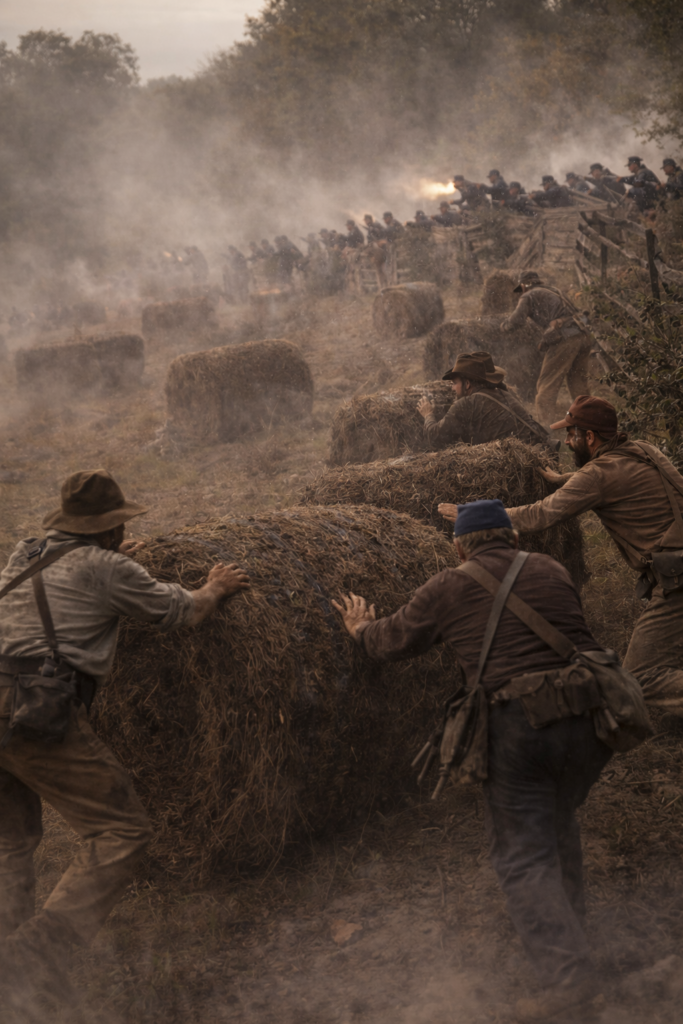
Hemp was everywhere around Lexington—bales from the local hemp industry, heavy and packed tight. Price’s men rolled large hemp bales forward as mobile breastworks. They rolled them forward, pushing them like blunt shields while rifle fire snapped overhead and into the ground around them. The hemp bales were soaked with water to reduce the chance they would catch fire, allowing the attackers to push them steadily toward the Union lines.
That hemp-bale advance didn’t win the battle by itself, but it changed the math. It allowed Price’s men to close distance while reducing exposure. It tightened the noose and forced the defenders to confront a brutal reality: the enemy was coming in behind cover, and the final push was no longer just a threat. With Confederate and State Guard troops now close enough to threaten the inner defenses, Mulligan’s position became increasingly untenable.
As the siege pressure mounted—fire, exhaustion, dwindling supplies, and the hard knowledge that relief wasn’t arriving in time—Mulligan’s garrison reached the limit. Lexington ended in surrender. For Missouri, that wasn’t just a battlefield result. It was a headline. A major Union garrison in a key river town had fallen, and it fell in a way people would talk about for generations.
Who Won + What That Means
- Result: Missouri State Guard victory
- Type of victory: Tactical victory with major strategic and morale impact
Tactically, Price captured Lexington and forced a large surrender—one of the most significant early-war wins for the pro-Southern side in Missouri. Strategically, the victory boosted recruitment, strengthened Price’s reputation, and proved the State Guard could take fortified positions—not just raid and disappear.
At the same time, Lexington also revealed something important about Missouri: even big victories didn’t “settle” the state. They shifted control, sparked retaliation, and raised the stakes. Missouri didn’t stabilize after Lexington—it grew more volatile.
Why It Matters
Lexington matters for several reasons:
- It’s Missouri’s signature early-war siege. If you want to understand how contested the Missouri River corridor was, this is your proof.
- It shows Missouri improvisation. The hemp-bale advance is not a gimmick—it’s a window into how this war adapted to local terrain and local resources.
- It accelerates escalation. Big wins and humiliations in a civil war don’t just change maps—they change emotions. Lexington fed the cycle of revenge, reprisals, and hardening loyalties that would define the border war.
- It also became one of the largest surrenders of Union troops west of the Mississippi during the early months of the war.
If you’ve ever wondered why Missouri’s Civil War feels so personal and unpredictable, Lexington is one of the clearest answers: it’s a formal siege—but it ends in a very Missouri way.
Next Up In This Timeline
Sept 22-23, 1861 — the Sacking of Osceola, a raid that leaves a civilian shockwave when the town is burned.
When you think of Civil War “weapons,” what surprises you more—artillery… or something like hemp bales used as moving cover?
Plan Your Next Missouri Civil War Adventure!
Ready to hit the road?
Plan your Missouri Civil War adventure with trusted travel tips, tools, and resources. Visit our Resource Page (Missouri Civil War Resources) to find everything you need for hotels, flights, car rentals, gear, and more.
Check Out Our Other Missouri Civil War Articles
Missouri Civil War Overview Articles
The Five Phases of Missouri’s Civil War
Missouri Civil War Battles (In Chronological Order)
Camp Jackson Affair — May 10, 1861
Battle of Boonville — June 17, 1861
Battle of Cole Camp — June 19, 1861
Battle of Carthage — July 5, 1861
Battle of Dug Springs — August 2, 1861
Battle of Athens — August 5, 1861
Battle of Wilson’s Creek (“Oak Hills”) — August 10, 1861
Battle of Blue Mills Landing (Liberty) — September 17, 1861
Check Out These Books Published By The Sojourner’s Compass
“Missouri in the Crossfire – The Civil War’s Forgotten Frontier” Series
From the streets of St. Louis to the prairies of southwest Missouri, this compelling short-read series uncovers the untold stories of a divided state at war. Each volume explores a new side of Missouri’s Civil War—its campaigns, commanders, civilians, and the conflicts that shaped its destiny.
Written for both history enthusiasts and casual readers, Missouri in the Crossfire brings the human side of the war to life through vivid storytelling, balanced perspectives, and accessible scholarship—all drawn from Missouri’s own battle-scarred ground.
Available on Amazon & Kindle Unlimited
“Battles & Beyond” – Companion Book Series
From river crossings to ridge fights, Missouri’s Civil War story was one of chaos, courage, and contested loyalties. This travel-ready series delivers concise battlefield guides packed with historical context, walking tips, firsthand quotes, and itinerary tie-ins—perfect for travelers, educators, and armchair historians alike.
Led by Jonathon Midgley, author of The Last Hand series, each volume brings forgotten fights into clear focus—making it easy to explore the war’s impact, one battlefield at a time.
Available On Amazon & Kindle Unlimited
Stay Connected
Follow us for travel inspiration, new articles, and short-form video features:
The Sojourner’s Compass TikTok
The Sojourner’s Compass YouTube
The Sojourner’s Compass Facebook
The Sojourner’s Compass Main Website
Leave a Reply