
Missouri Civil War Battles — Part 12
Battle of Belmont — November 7, 1861: Ulysses S. Grant’s first major Civil War battle tested Union river operations on the Mississippi.
Table of Contents
Belmont is one of those early-war fights that feels like a preview of what the Union would become later—fast movement, river logistics, and a hard lesson learned under fire. On November 7, 1861, Ulysses S. Grant launched an amphibious-style strike on the Mississippi River front, and Missouri sat right on the edge of the action.
Battle Snapshot (fast facts)
- Battle: Battle of Belmont
- Date: November 7, 1861
- Location: Mississippi River front—Belmont, Missouri (opposite Columbus, Kentucky)
- Type: Battle (river expedition)
- Style of fighting: Amphibious landing → assault on a camp position → counterattack → fighting withdrawal to boats
Who Was There
- Union commanders:
- Brig. Gen. Ulysses S. Grant
- Flag Officer Andrew H. Foote (U.S. Navy gunboat support on the river)
- Confederate commanders:
- Maj. Gen. Leonidas Polk (overall commander at Columbus)
- Brig. Gen. Gideon J. Pillow (directed the Confederate counterattack)
- Brig. Gen. Benjamin F. Cheatham (reinforcing Confederate brigade)
- Notable forces involved:
- Union: infantry landed by transport boats with gunboat support
- Confederates: Belmont garrison reinforced by troops ferried across the Mississippi from Columbus, Kentucky
What Happened (the story)
In late 1861, the Mississippi River was becoming a front line. The Union didn’t just want victories on land—it wanted control of the river system that could move armies, supplies, and pressure straight into the heart of the Confederacy. Columbus, Kentucky was one of the key Confederate strongpoints on that river, bristling with guns and meant to block Union movement.
Grant couldn’t take Columbus outright at this stage. But he could do something else: strike at its supporting positions, disrupt the enemy’s confidence, and prove that the Union could move aggressively along the river.
So he went after Belmont, Missouri.
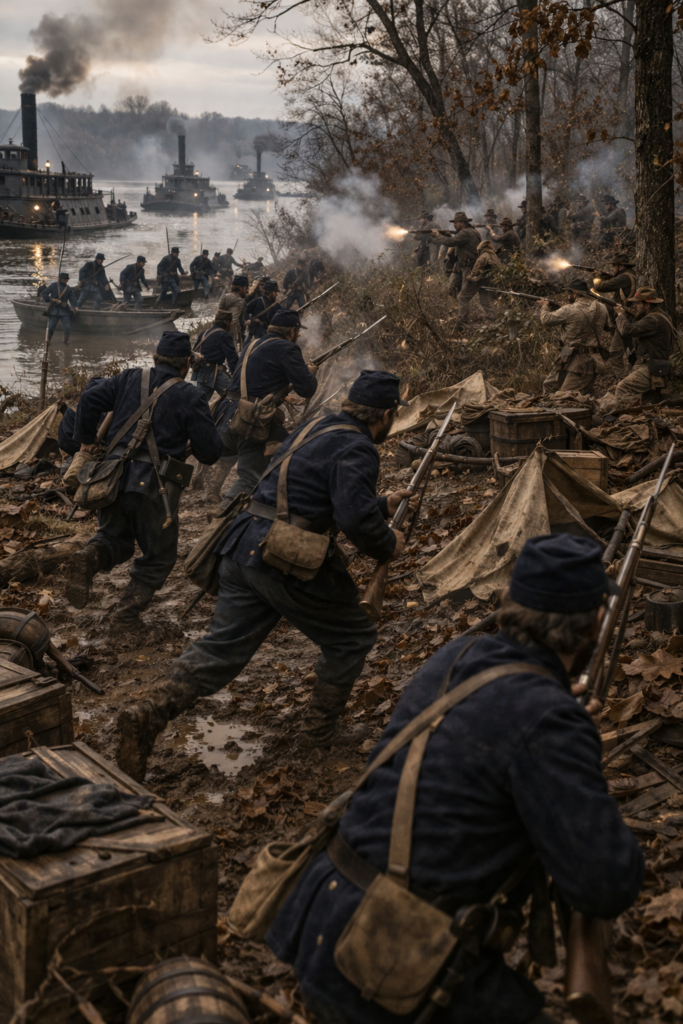
Grant’s force moved by water, landed along the Missouri shore, and pushed inland toward Confederate positions near the river. The attack hit with momentum. Union troops drove into the camp area, forced Confederates back, and for a moment it looked like a clean success—exactly the kind of early win the Union badly needed.
But Belmont was never going to stay simple. The Confederate camp was captured and much of it was destroyed before Grant’s men paused long enough for Confederate reinforcements to arrive.
The Confederate advantage was geography and depth. Columbus was close, heavily fortified, and able to send reinforcements across the river quickly. As Union troops fought in and around the camp, Confederate counterpressure began to build. The fight turned from an assault into a contest of whether the Union could extract itself before being crushed between fresh reinforcements and the river behind it.
And that’s where Belmont becomes a lesson.
A battle near a river sounds like an escape route—until you’re the one trying to get back to the boats under fire. Grant’s troops had to shift from attacking to withdrawing in an organized way, keeping cohesion while the situation tightened. The Confederates pushed hard, trying to turn the withdrawal into a rout and pin the Federals against the riverbank.
Union gunboats and river transport mattered in the end. They provided cover, mobility, and a lifeline that kept the battle from becoming a disaster. Grant managed to pull his force back to the boats and withdraw—bloodied, but intact. Grant himself narrowly avoided capture while directing the final withdrawal to the transports.
Belmont ended without the kind of clean “map-changing” outcome people expect from famous battles. But it did something just as important for an early-war army: it taught Grant and his men what it feels like to fight, win ground, lose momentum, and survive a serious counterattack. It was a test—and the Union passed it without breaking.
Who Won + What That Means
- Result: Confederate tactical victory; Union operational success
- Type of victory: Union tactical success early; Confederate counterattack forces Union withdrawal
Grant accomplished key objectives—he struck hard, disrupted the enemy’s position at Belmont, and proved the Union could operate aggressively on the river front. But he also withdrew under pressure, which allowed Confederates to claim they held the field.
The real meaning is bigger than the scoreboard: Belmont was one of Grant’s first major fights, and it helped shape how he would wage war—move fast, hit hard, and accept that a fight can still be “useful” even if you don’t end the day holding the ground.
Why It Matters
Belmont matters because it ties Missouri directly into the Mississippi River war:
- It shows the river as a battlefield. Boats, landings, and gunboats aren’t background—they’re the strategy.
- It’s an early Grant lesson. The Union is learning how to fight offensively, recover from chaos, and survive counterpunches.
- It signals what’s coming. The Mississippi River campaign won’t stay theoretical—it’s going to grind forward step by step.
- It also marked Grant’s first major Civil War battle, offering an early glimpse of the aggressive leadership style that would later define his campaigns.
Belmont is the kind of battle that foreshadows the Union’s later river successes. Missouri isn’t just a bystander here—it’s part of the river front where the war’s big strategy starts becoming real.
Next Up In This Timeline
December 28, 1861 — Mount Zion Church, a winter fight where Union militia breaks up a guerrilla band in the snow and cold.
When you think of the Civil War, do you picture river-front operations like Belmont—or the local guerrilla fights that kept Missouri unstable for years?
Plan Your Next Missouri Civil War Adventure!
Ready to hit the road?
Plan your Missouri Civil War adventure with trusted travel tips, tools, and resources. Visit our Resource Page (Missouri Civil War Resources) to find everything you need for hotels, flights, car rentals, gear, and more.
Check Out Our Other Missouri Civil War Articles
Missouri Civil War Overview Articles
The Five Phases of Missouri’s Civil War
Missouri Civil War Battles (In Chronological Order)
Camp Jackson Affair — May 10, 1861
Battle of Boonville — June 17, 1861
Battle of Cole Camp — June 19, 1861
Battle of Carthage — July 5, 1861
Battle of Dug Springs — August 2, 1861
Battle of Athens — August 5, 1861
Battle of Wilson’s Creek (“Oak Hills”) — August 10, 1861
Battle of Blue Mills Landing (Liberty) — September 17, 1861
First Battle of Lexington — September 13-20, 1861
Sacking of Osceola — September 22-23, 1861
First Battle of Springfield — October 25, 1861
Check Out These Books Published By The Sojourner’s Compass
“Missouri in the Crossfire – The Civil War’s Forgotten Frontier” Series
From the streets of St. Louis to the prairies of southwest Missouri, this compelling short-read series uncovers the untold stories of a divided state at war. Each volume explores a new side of Missouri’s Civil War—its campaigns, commanders, civilians, and the conflicts that shaped its destiny.
Written for both history enthusiasts and casual readers, Missouri in the Crossfire brings the human side of the war to life through vivid storytelling, balanced perspectives, and accessible scholarship—all drawn from Missouri’s own battle-scarred ground.
Available on Amazon & Kindle Unlimited
“Battles & Beyond” – Companion Book Series
From river crossings to ridge fights, Missouri’s Civil War story was one of chaos, courage, and contested loyalties. This travel-ready series delivers concise battlefield guides packed with historical context, walking tips, firsthand quotes, and itinerary tie-ins—perfect for travelers, educators, and armchair historians alike.
Led by Jonathon Midgley, author of The Last Hand series, each volume brings forgotten fights into clear focus—making it easy to explore the war’s impact, one battlefield at a time.
Available On Amazon & Kindle Unlimited
Stay Connected
Follow us for travel inspiration, new articles, and short-form video features:
The Sojourner’s Compass TikTok
The Sojourner’s Compass YouTube
The Sojourner’s Compass Facebook
The Sojourner’s Compass Main Website
Leave a Reply