
Missouri Civil War Battles — Part 16
Battle of Moore’s Mill — July 28, 1862: Odon Guitar defeated Joseph Porter’s Confederate recruiting force near Auxvasse Creek in Callaway County.
Table of Contents
Moore’s Mill is one of those Missouri fights where the countryside becomes the weapon—tight roads, creek bottoms, and an ambush that turns a routine movement into a crisis. On July 28, 1862, Union cavalry collided with a pro-Confederate force in Callaway County near Auxvasse Creek, and the result helped break a major recruiting push before it could grow into something bigger.
Battle Snapshot (fast facts)
- Battle: Battle of Moore’s Mill
- Date: July 28, 1862
- Location: Callaway County, Missouri — near Auxvasse Creek / Moore’s Mill area
- Type: Battle
- Style of fighting: Cavalry engagement with ambush conditions (tight approach, sudden fire, fast movement, close-range shock)
Who Was There
- Union commander:
- Col. Odon Guitar, 9th Missouri State Militia Cavalry
- Other important Union leaders:
- Lt. Col. William F. Shaffer
- Maj. Henry C. Caldwell, 3rd Iowa Cavalry
- Pro-Confederate commander:
- Col. Joseph C. Porter, Confederate recruiting command
- Notable forces involved:
- Union: Elements of the 9th and 10th Missouri State Militia Cavalry, 3rd Iowa Cavalry, Merrill’s Horse, Rice’s Independent Company Cavalry, and a section of the 3rd Indiana Battery.
- Pro-Confederate: Col. Joseph C. Porter’s recruiting command, consisting largely of mounted northern Missouri recruits and irregular/partisan elements.
What Happened (the story)
By mid-1862, Missouri was deep into the kind of war that didn’t always make national headlines but could decide whether a region stayed stable: recruiting and counter-recruiting. Men weren’t simply joining armies. They were being gathered, organized into new commands, and moved toward larger Confederate forces. If those recruiting efforts had time to mature, they could fuel raids, threaten Union-held territory, and keep entire regions unstable.
That’s why Callaway County mattered.
Near Auxvasse Creek and Moore’s Mill, Col. Joseph C. Porter was gathering a growing pro-Confederate force. Union troops under Col. Odon Guitar moved to intercept him before his command could disperse, grow larger, or move south to join other Confederate forces.
Guitar planned more than a simple frontal attack. He divided his command, sending Lt. Col. William Shaffer with the larger portion on a flanking movement while Guitar advanced with a smaller force and artillery. The idea was to catch Porter between the two Union columns.
But Porter chose to fight.
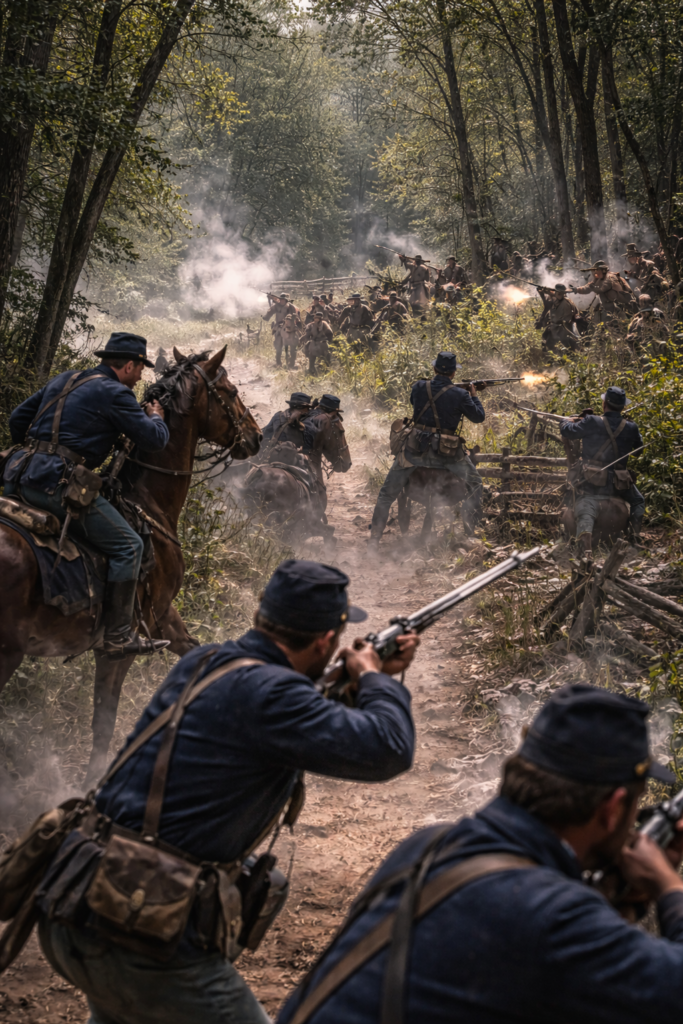
The countryside around Auxvasse Creek offered exactly the kind of ground he needed: timber, creek bottoms, and rolling terrain capable of concealing men until an enemy came dangerously close. Porter positioned his men in the heavy timber and prepared an ambush. A visible trail across an oat field helped draw Guitar’s advance toward the concealed position.
When the Union troops approached, Porter’s dismounted men opened fire at close range.
What had looked like another pursuit suddenly became a hard fight. Guitar deployed his men and artillery, but rough terrain had slowed Shaffer’s flanking column. Instead of immediately trapping Porter between two Union forces, Guitar’s smaller command was forced to absorb the hardest fighting while waiting for help to arrive.
Moore’s Mill became a contest of whether Guitar could hold his position long enough for the rest of his force to reach the battlefield.
For several hours, Porter’s men resisted. But as additional Union troops arrived, the balance began to shift. Federal numbers and firepower increased, and Porter’s position became increasingly difficult to hold. Eventually his line gave way, and his men withdrew northward along Auxvasse Creek.
Guitar held the field.
The victory did not destroy Porter’s command. Porter escaped, and his recruiting campaign in northern Missouri continued. But his immediate attempt to move his growing force south had been checked, denying him the opportunity to link up with larger Confederate forces.
Moore’s Mill was a Union victory, but not the end of the hunt for Joseph Porter. His command would remain active, and within days the fighting would move farther north.
Who Won + What That Means
- Result: Union victory
- Type of victory: Tactical win with recruitment/organization impact
The Union victory did more than win the field. It checked Porter’s attempt to move his growing command across the Missouri River and join larger Confederate forces farther south. But Moore’s Mill did not destroy his command. Porter continued north, gathering recruits before suffering another major defeat at Kirksville on August 6.
Why It Matters
Moore’s Mill matters because it shows how Missouri’s war was fought in the “in-between” spaces:
- Recruiting was strategic. Camps and gatherings were future raids and future campaigns waiting to happen.
- Cavalry and mobility ruled. Whoever could move fastest could hit the other side before it scattered.
- Terrain favored sudden violence. Creek bottoms and timber could turn any movement into an ambush.
It’s also a reminder that Missouri’s conflict wasn’t only about famous battlefields—it was about keeping entire counties from tipping.
Next Up In This Timeline
August 11, 1862 — the First Battle of Independence, where Confederate cavalry and partisans seize the Union garrison in fierce street fighting and build momentum toward Lone Jack.
When you think of Missouri’s Civil War, do you picture open-field battles—or do the cavalry ambush fights like Moore’s Mill feel more “Missouri” to you?
Plan Your Next Missouri Civil War Adventure!
Ready to hit the road?
Plan your Missouri Civil War adventure with trusted travel tips, tools, and resources. Visit our Resource Page (Missouri Civil War Resources) to find everything you need for hotels, flights, car rentals, gear, and more.
Check Out Our Other Missouri Civil War Articles
Missouri Civil War Overview Articles
The Five Phases of Missouri’s Civil War
Missouri Civil War Battles (In Chronological Order)
Camp Jackson Affair — May 10, 1861
Battle of Boonville — June 17, 1861
Battle of Cole Camp — June 19, 1861
Battle of Carthage — July 5, 1861
Battle of Dug Springs — August 2, 1861
Battle of Athens — August 5, 1861
Battle of Wilson’s Creek (“Oak Hills”) — August 10, 1861
Battle of Blue Mills Landing (Liberty) — September 17, 1861
First Battle of Lexington — September 13-20, 1861
Sacking of Osceola — September 22-23, 1861
First Battle of Springfield — October 25, 1861
Battle of Belmont — November 7, 1861
Battle of Mount Zion Church — December 28, 1861
Battle of Roan’s Tan Yard — January 8, 1862
Battle of Pea Ridge — March 7-8, 1862
Check Out These Books Published By The Sojourner’s Compass
“Missouri in the Crossfire – The Civil War’s Forgotten Frontier” Series
From the streets of St. Louis to the prairies of southwest Missouri, this compelling short-read series uncovers the untold stories of a divided state at war. Each volume explores a new side of Missouri’s Civil War—its campaigns, commanders, civilians, and the conflicts that shaped its destiny.
Written for both history enthusiasts and casual readers, Missouri in the Crossfire brings the human side of the war to life through vivid storytelling, balanced perspectives, and accessible scholarship—all drawn from Missouri’s own battle-scarred ground.
Available on Amazon & Kindle Unlimited
“Battles & Beyond” – Companion Book Series
From river crossings to ridge fights, Missouri’s Civil War story was one of chaos, courage, and contested loyalties. This travel-ready series delivers concise battlefield guides packed with historical context, walking tips, firsthand quotes, and itinerary tie-ins—perfect for travelers, educators, and armchair historians alike.
Led by Jonathon Midgley, author of The Last Hand series, each volume brings forgotten fights into clear focus—making it easy to explore the war’s impact, one battlefield at a time.
Available On Amazon & Kindle Unlimited
Stay Connected
Follow us for travel inspiration, new articles, and short-form video features:
The Sojourner’s Compass TikTok
The Sojourner’s Compass YouTube
The Sojourner’s Compass Facebook
The Sojourner’s Compass Main Website
Leave a Reply