
Missouri Civil War Battles — Part 13
Battle of Mount Zion Church — December 28, 1861: Union forces under Benjamin Prentiss scattered a Missouri State Guard recruiting force in Boone County.
Table of Contents
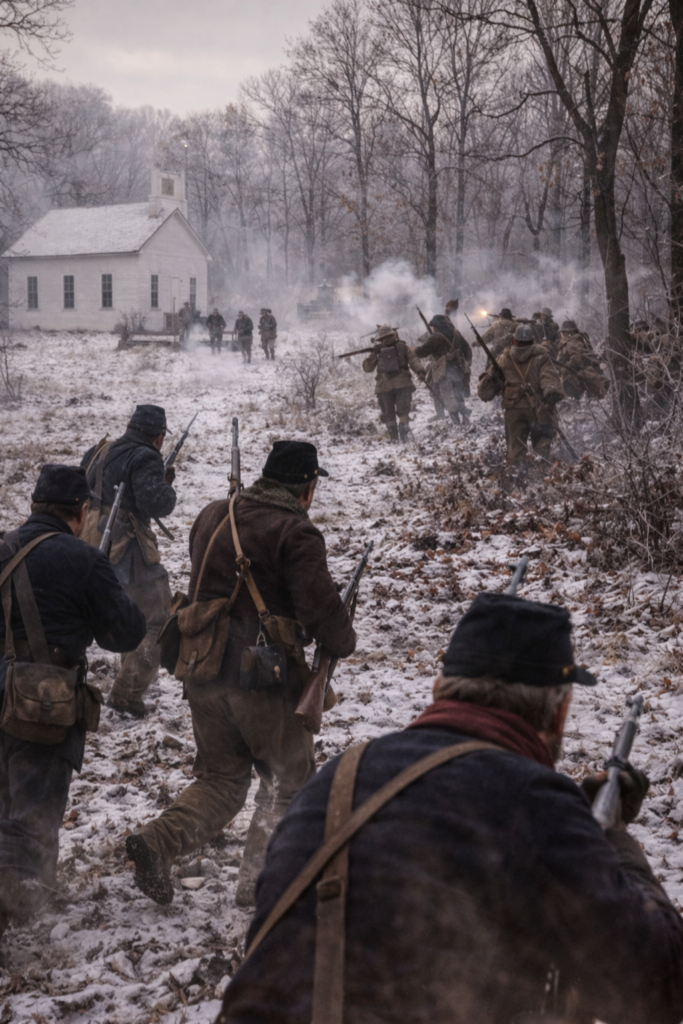
Mount Zion Church is proof that Missouri’s war didn’t “slow down” in winter — it just got sharper. On December 28, 1861, a Union force struck a large body of Missouri State Guard recruits near Hallsville, turning a cold Boone County landscape into a sudden, decisive fight.
Battle Snapshot (fast facts)
- Battle: Battle of Mount Zion Church
- Date: December 28, 1861
- Location: Near Hallsville, Boone County, Missouri
- Type: Battle / Recruitment Action
- Style of fighting: Winter clash with organized formations (mounted movement, infantry volleys, rapid break and retreat)
Who Was There
- Union commanders (United States):
- Brig. Gen. Benjamin M. Prentiss — overall commander
- Col. John Glover — led the 3rd Missouri Cavalry
- Col. John Birge — led Birge’s Western Sharpshooters
- Missouri State Guard commanders (pro-Confederate):
- Col. Caleb W. Dorsey — commanded Missouri State Guard forces (often labeled “rebels” or “secessionists” in period accounts)
- Key units involved:
- Union: 3rd Missouri Cavalry; Birge’s Western Sharpshooters
- Missouri State Guard: approximately 900 Missouri State Guard recruits and partially organized companies
What Happened (the story)
By late 1861, Missouri was fighting two wars at once. One was the headline war—big movements, river fronts, major battles. The other was the war inside the counties: recruiting drives, local control, and armed organizations trying to grow fast enough to matter.
Mount Zion Church belongs to that second war.
In Boone County near Hallsville, Missouri State Guard recruiting had produced a sizeable body of men—hundreds of recruits gathered in one place, forming the kind of concentration the Union could not ignore. Even if recruits weren’t yet hardened soldiers, numbers like that could quickly become a real field force once trained, armed, and attached to larger commands.
Learning of the concentration, Brigadier General Benjamin Prentiss moved quickly to break it up before the recruits could be organized into an effective fighting force. His command included mounted elements and infantry capable of hitting fast and hitting hard. Colonel John Glover’s 3rd Missouri Cavalry provided mobility and striking power, while Colonel John Birge’s Western Sharpshooters offered disciplined infantry firepower—exactly the combination you want when you’re trying to break an organized camp of recruits before it matures into something worse.
On December 28, the Union force struck. Winter conditions shaped everything—bare trees, frozen ground, breath in the air, and limited comfort for men forced to move and fight. But winter also favors decisive action. If one side breaks, there’s nowhere easy to hide.
The Missouri State Guard force resisted, but many of its men were inexperienced and vulnerable to a coordinated Union attack. Once the Union pressure landed—cavalry movement, controlled volleys, and steady push—the State Guard position began to come apart. When cohesion breaks in a large body of recruits, it tends to break quickly: confusion spreads, orders don’t carry, and withdrawal becomes a scramble.
The result was a clear Union success. The recruiting force was shattered, its momentum broken, and Boone County’s immediate threat reduced—at least for a time.
Who Won + What That Means
- Result: Union victory
- Type of victory: Tactical victory with recruitment/organization impact
Mount Zion Church wasn’t about taking a city or holding a river crossing. It was about preventing a force from becoming dangerous. By breaking up a major Missouri State Guard recruiting body, the Union scored a win that mattered beyond the field: it disrupted organization, scattered manpower, and reminded central Missouri that the State Guard could be struck before it grew.
Why It Matters
Mount Zion Church matters because it highlights how Missouri’s war often hinged on recruitment and local concentrations:
- Stopping a recruiting force early could prevent future raids, campaigns, and escalations.
- The victory helped strengthen Union control in central Missouri during the winter of 1861–62.
- Winter didn’t stop movement; it rewarded fast decisions and punished units that broke.
- It shows Missouri as a state where control wasn’t just measured in towns—it was measured in whether armed organizations could form at all.
If you want to understand why Missouri’s Civil War feels like constant pressure in the background, fights like Mount Zion Church are a big reason: they’re about the war’s infrastructure, not just its headlines.
Next Up In This Timeline
January 8, 1862 — Roan’s Tan Yard, another Missouri clash tied to recruiting and armed organization in the countryside.
When you think “Civil War,” do you picture big set-piece battles—or the lesser-known fights like Mount Zion Church that shaped which forces even existed later?
Plan Your Next Missouri Civil War Adventure!
Ready to hit the road?
Plan your Missouri Civil War adventure with trusted travel tips, tools, and resources. Visit our Resource Page (Missouri Civil War Resources) to find everything you need for hotels, flights, car rentals, gear, and more.
Check Out Our Other Missouri Civil War Articles
Missouri Civil War Overview Articles
The Five Phases of Missouri’s Civil War
Missouri Civil War Battles (In Chronological Order)
Camp Jackson Affair — May 10, 1861
Battle of Boonville — June 17, 1861
Battle of Cole Camp — June 19, 1861
Battle of Carthage — July 5, 1861
Battle of Dug Springs — August 2, 1861
Battle of Athens — August 5, 1861
Battle of Wilson’s Creek (“Oak Hills”) — August 10, 1861
Battle of Blue Mills Landing (Liberty) — September 17, 1861
First Battle of Lexington — September 13-20, 1861
Sacking of Osceola — September 22-23, 1861
First Battle of Springfield — October 25, 1861
Battle of Belmont — November 7, 1861
Check Out These Books Published By The Sojourner’s Compass
“Missouri in the Crossfire – The Civil War’s Forgotten Frontier” Series
From the streets of St. Louis to the prairies of southwest Missouri, this compelling short-read series uncovers the untold stories of a divided state at war. Each volume explores a new side of Missouri’s Civil War—its campaigns, commanders, civilians, and the conflicts that shaped its destiny.
Written for both history enthusiasts and casual readers, Missouri in the Crossfire brings the human side of the war to life through vivid storytelling, balanced perspectives, and accessible scholarship—all drawn from Missouri’s own battle-scarred ground.
Available on Amazon & Kindle Unlimited
“Battles & Beyond” – Companion Book Series
From river crossings to ridge fights, Missouri’s Civil War story was one of chaos, courage, and contested loyalties. This travel-ready series delivers concise battlefield guides packed with historical context, walking tips, firsthand quotes, and itinerary tie-ins—perfect for travelers, educators, and armchair historians alike.
Led by Jonathon Midgley, author of The Last Hand series, each volume brings forgotten fights into clear focus—making it easy to explore the war’s impact, one battlefield at a time.
Available On Amazon & Kindle Unlimited
Stay Connected
Follow us for travel inspiration, new articles, and short-form video features:
The Sojourner’s Compass TikTok
The Sojourner’s Compass YouTube
The Sojourner’s Compass Facebook
The Sojourner’s Compass Main Website
Leave a Reply