
Missouri Civil War Battles – Part 17
First Battle of Independence — August 11, 1862: Confederate forces captured the Union garrison after fierce street fighting in Independence, Missouri.
Table of Contents
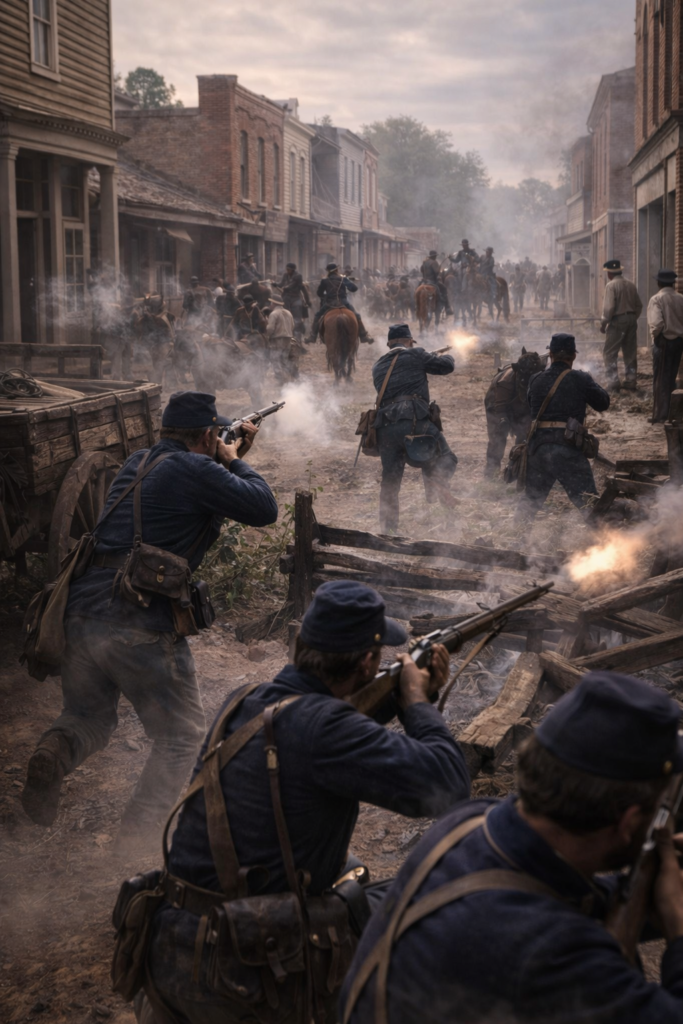
Independence didn’t fall in a sweeping battlefield charge — it fell in street-to-street confusion, where a town became the terrain. On August 11, 1862, Confederate cavalry and partisan forces struck fast, seized the Union post, and proved how quickly Missouri’s war could flip a place from “secure” to “taken.”
Battle Snapshot (fast facts)
- Battle: First Battle of Independence
- Date: August 11, 1862
- Location: Independence, Missouri (Jackson County)
- Type: Battle
- Style of fighting: Urban/street fighting (rapid strike, close-range volleys, buildings and corners as cover)
Who Was There
- Union:
- Lt. Col. James T. Buel — commander of the Independence garrison
- Roughly 300–350 Federal troops
- Confederate / pro-Confederate:
- Col. John T. Hughes — led the attacking force; killed during the battle
- Col. Gideon W. Thompson — assumed command after Hughes was killed
- Col. Upton Hays
- William C. Quantrill — led one attacking column
- George Todd — guerrilla leader involved in the attack
- Notable forces involved:
- Union: garrison infantry and defenders in town positions
- Opposing: mounted cavalry with dismounted fighters pushing into the streets
What Happened (the story)
Before dawn on August 11, the Confederate force moved against Independence in two columns. The attack came quickly. William Quantrill’s men overwhelmed Federal sentries and seized the town square while other Confederate troops pushed toward the scattered Union positions around town.
The Federal garrison was not concentrated in one fortified position. Soldiers occupied a field encampment, the jail, and other locations, while Lt. Col. James T. Buel maintained his headquarters in a two-story bank building. Once the attack began, those separated positions became a serious weakness.
Fighting spread through Independence. Quantrill’s men attacked Buel’s headquarters while other Confederate forces struck Union positions elsewhere in town. At the jail, Federal defenders withdrew toward Kansas City, leaving the building to guerrillas under George Todd.
But the Union defense did not immediately collapse. Buel and the men around his headquarters resisted repeated attacks for several hours. Confederate commanders struggled to dislodge them, and the fighting cost the attackers heavily in leadership. Col. John T. Hughes was killed, leaving Gideon W. Thompson to assume command.
Eventually the Confederates threatened to burn an adjacent building, potentially forcing the Federals from their position. With his command isolated and the situation deteriorating, Buel sought terms. He surrendered his remaining force to Thompson, and approximately 150 Federal soldiers were paroled.
Independence had fallen.
Who Won + What That Means
- Result: Confederate victory
- Type of victory: Tactical victory with short-term recruitment and momentum value
Capturing a town post does more than change a map marker. It boosts recruitment, spreads fear, disrupts Union control, and encourages Confederate recruiting and demonstrates that Union control of the countryside remains vulnerable. Independence helped build exactly that kind of momentum—and it fed the chain of events leading toward Lone Jack days later.
Why It Matters
Independence matters because it shows what Missouri warfare often looked like in practice:
- Towns as battlefields: control isn’t only won in open fields—sometimes it’s won at a courthouse square and a handful of intersections.
- Cavalry pressure: mounted forces could strike where they wanted, then vanish before a larger response arrived.
- Momentum into the next fight: this wasn’t an isolated event—Independence sits on the road to Lone Jack and the running operations that follow.
Next Up In This Timeline
August 8–15, 1862 — the Pursuit of Poindexter/Porter (Compton’s Ferry + Yellow Creek), a series of running actions where Federal pursuit hammers recruiting columns and scatters forces across north/central Missouri. (Compton’s Ferry is commonly tied to Aug. 11, but many accounts treat it as part of the broader Aug. 10–13 running action.)
When you think of Civil War fighting, what surprises you more—urban street battles like Independence, or the running pursuit fights that stretch across multiple days and counties?
Plan Your Next Missouri Civil War Adventure!
Ready to hit the road?
Plan your Missouri Civil War adventure with trusted travel tips, tools, and resources. Visit our Resource Page (Missouri Civil War Resources) to find everything you need for hotels, flights, car rentals, gear, and more.
Check Out Our Other Missouri Civil War Articles
Missouri Civil War Overview Articles
The Five Phases of Missouri’s Civil War
Missouri Civil War Battles (In Chronological Order)
Camp Jackson Affair — May 10, 1861
Battle of Boonville — June 17, 1861
Battle of Cole Camp — June 19, 1861
Battle of Carthage — July 5, 1861
Battle of Dug Springs — August 2, 1861
Battle of Athens — August 5, 1861
Battle of Wilson’s Creek (“Oak Hills”) — August 10, 1861
Battle of Blue Mills Landing (Liberty) — September 17, 1861
First Battle of Lexington — September 13-20, 1861
Sacking of Osceola — September 22-23, 1861
First Battle of Springfield — October 25, 1861
Battle of Belmont — November 7, 1861
Battle of Mount Zion Church — December 28, 1861
Battle of Roan’s Tan Yard — January 8, 1862
Battle of Pea Ridge — March 7-8, 1862
Battle of Moore’s Mill — July 28, 1862
Check Out These Books Published By The Sojourner’s Compass
“Missouri in the Crossfire – The Civil War’s Forgotten Frontier” Series
From the streets of St. Louis to the prairies of southwest Missouri, this compelling short-read series uncovers the untold stories of a divided state at war. Each volume explores a new side of Missouri’s Civil War—its campaigns, commanders, civilians, and the conflicts that shaped its destiny.
Written for both history enthusiasts and casual readers, Missouri in the Crossfire brings the human side of the war to life through vivid storytelling, balanced perspectives, and accessible scholarship—all drawn from Missouri’s own battle-scarred ground.
Available on Amazon & Kindle Unlimited
“Battles & Beyond” – Companion Book Series
From river crossings to ridge fights, Missouri’s Civil War story was one of chaos, courage, and contested loyalties. This travel-ready series delivers concise battlefield guides packed with historical context, walking tips, firsthand quotes, and itinerary tie-ins—perfect for travelers, educators, and armchair historians alike.
Led by Jonathon Midgley, author of The Last Hand series, each volume brings forgotten fights into clear focus—making it easy to explore the war’s impact, one battlefield at a time.
Available On Amazon & Kindle Unlimited
Stay Connected
Follow us for travel inspiration, new articles, and short-form video features:
The Sojourner’s Compass TikTok
The Sojourner’s Compass YouTube
The Sojourner’s Compass Facebook
The Sojourner’s Compass Main Website
Leave a Reply