
Missouri Civil War Battles — Part 14
Battle of Roan’s Tan Yard — Union cavalry smashed John Poindexter’s Missouri State Guard recruiting camp in Randolph County on January 8, 1862.
Table of Contents
Roan’s Tan Yard is the kind of Missouri fight that doesn’t look “big” until you realize what it was really about: stopping a recruiting base before it could become a real army. On January 8, 1862, Union cavalry struck John A. Poindexter’s Missouri State Guard camp and shattered it in a fast, foggy winter attack.
Battle Snapshot (fast facts)
- Battle: Roan’s Tan Yard (also called the Battle of Silver Creek)
- Date: January 8, 1862
- Location: Randolph County, Missouri, along Silver Creek, about 14 miles northwest of Fayette
- Type: Action / camp attack
- Style of fighting: Surprise strike on a camp (rapid mounted pressure, short firefight, rout and capture)
Who Was There
- Union commander:
- Major W. M. G. Torrence (1st Iowa Cavalry)
- Missouri State Guard commander:
- Col. John A. Poindexter (camp and recruiting force)
- Key units involved:
- Union: detachments of the 1st Iowa Cavalry, 1st Missouri Cavalry, 2nd Missouri Cavalry, and 4th Ohio Cavalry, approximately 450 men
- Missouri State Guard: roughly 900–1,000+ men under Col. John A. Poindexter, gathered as part of a recruiting and raiding force (organized as State Guard, not guerrillas)
What Happened (the story)
By early 1862, Missouri’s war wasn’t just about holding towns—it was about preventing the next wave of trouble from forming in the first place. Recruiting camps mattered because they turned scattered sympathy into organized manpower. Once a camp had time to train, arm, and attach to a larger command, it could fuel raids, threaten rail lines, and keep whole regions unstable.
That’s what made Poindexter’s camp at Roan’s Tan Yard important.
For more than a week, Union forces had heard rumors and sightings of a pro-Confederate force operating in the area, but pinning it down was difficult. Winter ground, scattered roads, and local uncertainty made it easy for a camp to stay just out of reach. Then reliable information came in: Poindexter’s Missouri State Guard recruits were concentrated at a base along Silver Creek.
Major Torrence moved quickly. The Union force was built for speed—cavalry detachments gathered from several units—exactly the kind of strike package you use when you want to hit a camp before it can scatter.
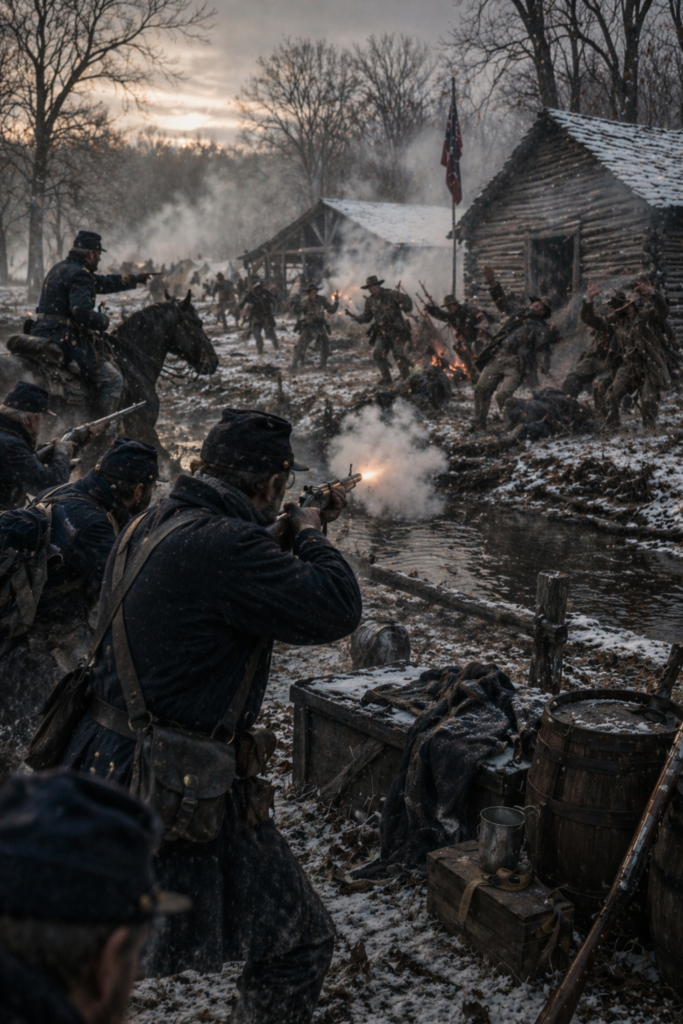
The attack unfolded like a classic camp strike. Union cavalry approached and deployed, using the ground and fog to close distance. The attack unfolded quickly, but Poindexter’s men did not simply scatter at first contact. The camp occupied difficult ground broken by ravines and thick underbrush, while heavy fog limited visibility. Union and State Guard forces exchanged fire before Torrence committed mounted troops against the position. The charge broke the stalemate. Poindexter’s line gave way, and what had been a firefight rapidly became a rout.
Poindexter’s camp was overrun. The Missouri State Guard force broke, and the fight became less about a “battle line” and more about capture, flight, and destruction of a base. Union troops seized horses, weapons, wagons, tents, ammunition, and other supplies. What they could not carry away was largely destroyed, effectively erasing Poindexter’s camp as a functioning recruiting and raiding base.
In Missouri, that kind of result mattered. A defeated camp doesn’t just lose a fight—it loses momentum. It loses confidence. It loses the ability to pull new men into an organized structure.
Roan’s Tan Yard ended as a swift Union victory, and its impact was larger than the smoke on the field: it reduced pro-Confederate activity in the region by hitting the war where it often grew strongest—recruitment and local organization.
Who Won + What That Means
- Result: Union victory
- Type of victory: Tactical win with recruitment/raiding impact
This wasn’t a siege or a headline battle, but it was strategically useful. Union forces disrupted a recruiting base, captured supplies, and forced the Missouri State Guard effort in that area to back off—at least temporarily.
Why It Matters
Roan’s Tan Yard matters because it shows how Missouri’s war worked between the famous engagements:
- Recruiting camps were targets because they created future raids and future campaigns.
- Cavalry mattered in Missouri because speed decided whether a camp lived or died.
- Central Missouri stayed unstable largely because forces like these could form quickly if left alone.
This is the “infrastructure war” of Missouri—quiet until it isn’t, and decisive when it hits.
Next Up In This Timeline
March 7–8, 1862 — the Battle of Pea Ridge in northwest Arkansas, where a major Union victory helps secure Federal control of Missouri and pushes the conventional Confederate threat farther south.
Do you find these “camp strike” actions more interesting than big battles—or do you prefer the major set-piece fights where everything comes to a head?
Plan Your Next Missouri Civil War Adventure!
Ready to hit the road?
Plan your Missouri Civil War adventure with trusted travel tips, tools, and resources. Visit our Resource Page (Missouri Civil War Resources) to find everything you need for hotels, flights, car rentals, gear, and more.
Check Out Our Other Missouri Civil War Articles
Missouri Civil War Overview Articles
The Five Phases of Missouri’s Civil War
Missouri Civil War Battles (In Chronological Order)
Camp Jackson Affair — May 10, 1861
Battle of Boonville — June 17, 1861
Battle of Cole Camp — June 19, 1861
Battle of Carthage — July 5, 1861
Battle of Dug Springs — August 2, 1861
Battle of Athens — August 5, 1861
Battle of Wilson’s Creek (“Oak Hills”) — August 10, 1861
Battle of Blue Mills Landing (Liberty) — September 17, 1861
First Battle of Lexington — September 13-20, 1861
Sacking of Osceola — September 22-23, 1861
First Battle of Springfield — October 25, 1861
Battle of Belmont — November 7, 1861
Battle of Mount Zion Church — December 28, 1861
Check Out These Books Published By The Sojourner’s Compass
“Missouri in the Crossfire – The Civil War’s Forgotten Frontier” Series
From the streets of St. Louis to the prairies of southwest Missouri, this compelling short-read series uncovers the untold stories of a divided state at war. Each volume explores a new side of Missouri’s Civil War—its campaigns, commanders, civilians, and the conflicts that shaped its destiny.
Written for both history enthusiasts and casual readers, Missouri in the Crossfire brings the human side of the war to life through vivid storytelling, balanced perspectives, and accessible scholarship—all drawn from Missouri’s own battle-scarred ground.
Available on Amazon & Kindle Unlimited
“Battles & Beyond” – Companion Book Series
From river crossings to ridge fights, Missouri’s Civil War story was one of chaos, courage, and contested loyalties. This travel-ready series delivers concise battlefield guides packed with historical context, walking tips, firsthand quotes, and itinerary tie-ins—perfect for travelers, educators, and armchair historians alike.
Led by Jonathon Midgley, author of The Last Hand series, each volume brings forgotten fights into clear focus—making it easy to explore the war’s impact, one battlefield at a time.
Available On Amazon & Kindle Unlimited
Stay Connected
Follow us for travel inspiration, new articles, and short-form video features:
The Sojourner’s Compass TikTok
The Sojourner’s Compass YouTube
The Sojourner’s Compass Facebook
The Sojourner’s Compass Main Website
Leave a Reply